



Wing foil is more accessible than you might think. In this complete wing foil tutorial, you'll find everything you need to know to get started: choosing the right equipment (voluminous board, stable foil, wing suited to your size), practicing in the right conditions (side wind, 15-20 knots, sheltered water), and mastering the key stages of takeoff. Plan on a few sessions to feel comfortable on the water — and much less if you're already a gliding sports enthusiast.
What is Wing Foil
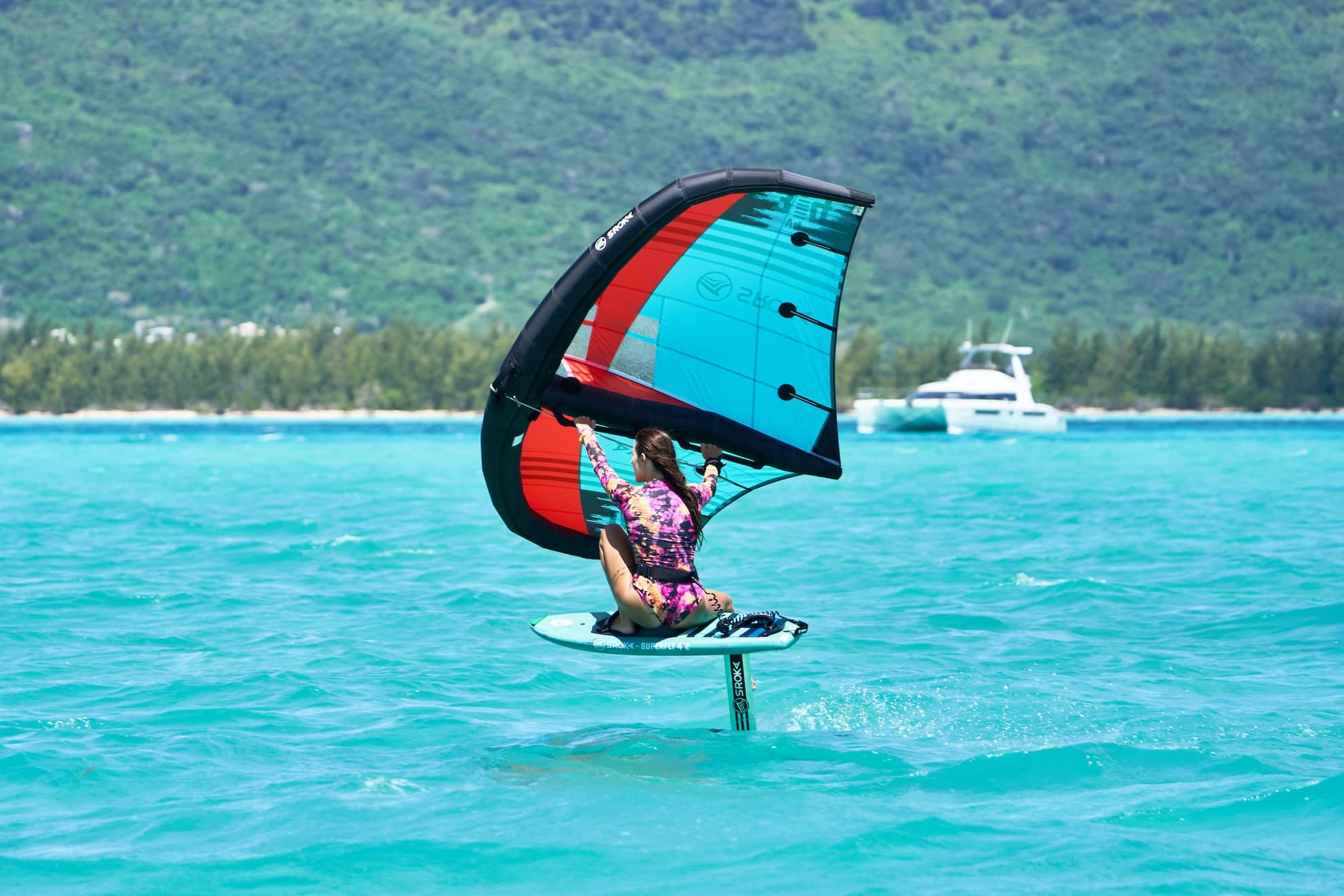
The Wing Foil is the latest addition to water sports. It involves manipulating a wing held in both hands (the "wing") combined with a hydrofoil mounted on a short SUP board. It's a practice halfway between Windfoil, Kitefoil and SUP Foil.
The advantage of wing foil is to move with maximum freedom on any body of water, using the energy of wind and swell. The wing provides maneuverability and facilitates foil takeoff thanks to constant force (the wind). This distinguishes it from downwind SUP foil, which only exploits swell energy. Thanks to the lightness and mobility of the wing, it's possible to alternate between the two approaches during the same session: heading upwind by tacking initially, then heading downwind like in Downwind SUP Foil later for example. It's a very playful discipline that refocuses the practitioner on their sensations, incomparable to others.
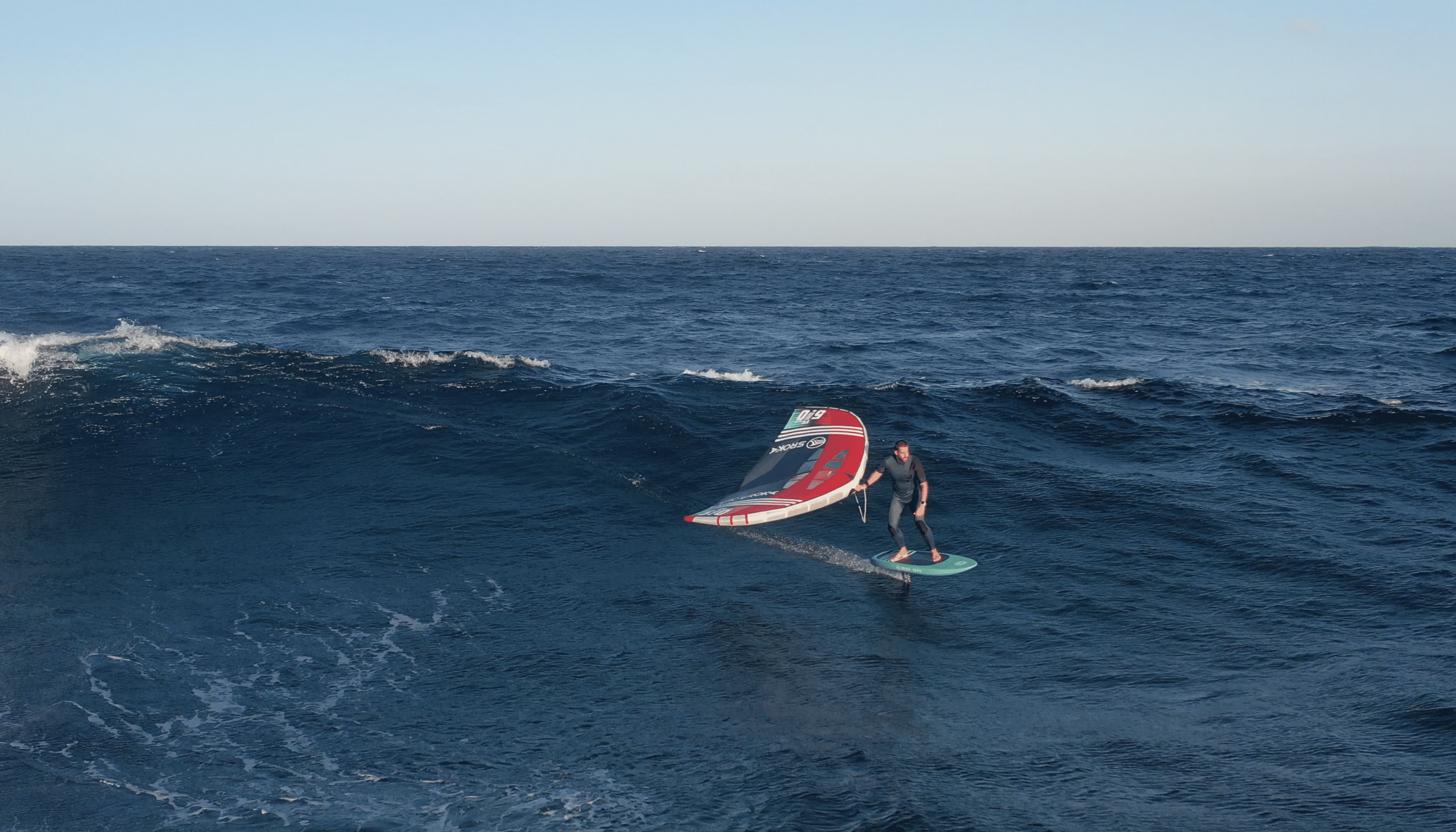
The hydrofoil allows you to take off above the water and surf above the surface. The Wing Foil is practiced on a short but wide and thick (voluminous) stand up paddle board to allow the practitioner to quickly stand up. It can be practiced in any wind direction, but will be more interesting downwind, with a side wind. It's also possible to practice Wing Foil in waves, and use the wing's lift to head back out.
Why take up wingfoil?
Wingfoil is an emerging new discipline that's attracting more and more water sports enthusiasts. Here are some reasons why you should consider taking up wingfoil:
- Immediate sensations: Wingfoil offers exceptional gliding and flying sensations. By flying above the water, you'll experience a feeling of freedom and weightlessness, combined with the fluidity of navigation.
- Accessibility: Wingfoil is easier to learn than other water sports such as Kitesurfing or Windsurf. Thanks to the foil's lift and wing stability, beginners can quickly get their bearings, progress and have fun from the first sessions.
- Great versatility: Wingfoil can be practiced in various wind and water conditions. Whether you're sailing on a lake, at sea or even on wave spots, wingfoil offers incredible versatility to explore new horizons and adapt to the day's water conditions.
- Complete sport: Wingfoil engages your entire body, providing excellent cardiovascular training and strengthening body muscles, particularly the legs, arms and abdominals. It's a complete sport that will keep you fit while having fun on the water.
In short, taking up wingfoil will allow you to discover new sensations, enjoy nature, take on new challenges and experience moments of pure pleasure on the water. Whether you're a beginner or already a water sports enthusiast, wingfoil offers a unique experience worth exploring.
Who can do wing foil?
Wingfoil is accessible to a wide audience, from novices to experienced riders. It's suitable for water sports enthusiasts looking for new sensations. Whether you're a fan of Surf, Kitesurfing or Stand Up Paddle, you can take up wingfoil. However, it's recommended to have some balance control and good physical fitness to fully enjoy this discipline.
How to start Wingfoil?
This wing foil tutorial guides you step by step to get started properly. Here are the essential steps to follow:
- Take lessons or find a mentor: It's recommended to take lessons from a wingfoil school, shop, or find an experienced mentor who can guide you and give you valuable advice. This will allow you to learn the technical basics and acquire good practices from the start.
- Choose the right equipment: To get started, it's essential to choose the right equipment, opt for equipment suited to beginners but that will also allow you to progress. It's also necessary to take your size into account when choosing your equipment. We explain later in this article which wingfoil equipment to choose based on your size, wishes and level.
- Choose a suitable spot: Select a spot with moderate wind conditions and a sufficiently flat and clear body of water. Avoid crowded areas and make sure you have enough space to move around safely.
- Progression by stages: Start by getting used to the board and wing by sailing near the beach. Once comfortable, try to take off in wingfoil using Pumping techniques. Practice regularly to improve your balance, Pumping technique and foil control.
- Stay safe: Wear a flotation vest and use a leash to attach your wing to your wrist. Check weather conditions before heading out for a session and always follow safety rules.
In what conditions to practice Wing Foil?
We recommend starting Wing Foil in moderate wind conditions on a spot sheltered from swell (between 15 and 20 knots established). It's easier to start with a side wind (sideshore) to avoid the risk of being taken offshore without being able to return (onshore wind) or being constantly brought back to shore by the wind (offshore wind).
It's advisable to be careful when choosing your spot to avoid floating seaweed that prevents the hydrofoil from working properly, as well as any other floating objects present. We also recommend spots offering a bay shape. This way, if you drift away, you can always get back to shore and return on foot with your equipment. Finally, it's ideal to start in water depth where you can touch bottom but with enough depth for the hydrofoil not to touch the water bottom. It's then possible for a confirmed practitioner with an average weight of 80 kg to navigate in Wing Foil on a wind range from 8-10 knots to 40 knots.

Prepare your Wing Foil equipment to start Wing properly!
The Wing Foil has different elements, to get you in the water as easily as possible without risking damaging your equipment, we recommend the following method:
- Prepare your Wing Foil board: assemble your hydrofoil and attach it to your board, attach your leash to the board.
- Place it near the water: once the board and foil are assembled, bring them close to where you want to get in the water.
- Get dressed: and prepare yourself as if you were about to get in the water directly.
- Inflate your wing: the wing has a strong wind grip, which is why we recommend only inflating it just before getting in the water. We recommend inflating it away from the wind and if possible attaching it to an object to avoid any risk of it flying away. As soon as the wing is inflated, immediately attach the wing leash to your wrist. Avoid abrasion on sand or asphalt.
- Reach your Wing Foil board: carry the wing by the handle and place the leading edge facing the wind to make it neutral to it and easy to carry. Once you're close to the water with your wing and Wing Foil board, attach your board leash.
- Carry your equipment to the water: since you've placed your Wing Foil board close to the water, you only have a few meters to go while carrying both the board and the wing. Always be careful to carry your board on the windward side and your wing downwind so the wing doesn't catch the wind and get damaged on the foil.
Which foil for a beginner?
For wingfoil beginners, it's essential to choose a foil that offers enough lift and stability to learn and progress quickly. At Sroka Company, we highly recommend our S-Foil 1750 Classic foil for beginners with an average weight of 80 kg. If you weigh more than 90 KG we recommend choosing the front wing at 2000 cm2. Conversely, for weights under 70 Kg, go for a front wing of 1500 cm2. With its large lift surface, a beginner foil allows easy takeoff and optimal flight balance, making it easier to learn your first wingfoil flights. However, don't be fooled by its beginner appearance, as the S-Foil 1750 is also designed to allow you to progress quickly. Its versatility will also allow you to try Dockstart and venture into small waves. By choosing the S-Foil 1750 foil from Sroka, you're opting for ease of learning, stability, progression and a wingfoil learning experience in complete peace of mind.

How to take off in wing foil?
Takeoff is a key step to start in Wingfoil and enjoy it. Taking off in Wing Foil isn't too complicated but does require doing it the right way. Find our tips and illustrated comments below to achieve it from your first session.
Step 1 — Kneeling position
First of all, sit on the board and flip the wing the right way. Sitting astride will give you more stability to handle your wing. To flip it easily, move your hands to the leading edge and grab the wing near one of the ends. At that point, flip the wing to position it the right way. If you're comfortable, you can do this kneeling on the board.

The first step is to kneel on your board while taking the wing (in the right direction) in hand using the handles provided for this purpose. The aim is to position the wing above your head so the ends of the wing don't touch the water. Keep your board perpendicular to the wind. Position your wing well above your head horizontally. When both your hands have grabbed the handles, the goal is to control the wing's power and its reaction to the wind and find a stable position on the board. Once you're stable and controlling the wing well, you can orient it to better catch the wind by pulling more on the back hand to move your Wing Foil board forward. Bruno SROKA's tip "When I pull on my back hand, I gain power, I accelerate, when I release my back hand, the wing catches less wind and I slow down."
Step 2: Acceleration and lifting the front foot
To move to the second step, you need enough speed. To accelerate, pull on your back hand so the wind enters the wing. (Keep your front hand more or less extended). Once you have enough speed to stabilize, you can start getting on the board by starting with your front foot to position yourself in the center of the board (along the longitudinal axis). This allows you to stand up in two stages while maintaining your balance.

Step 3: Foot placement standing
You can then move to the third step: get on the board by placing this time your back foot above the Foil. It's essential to be well balanced on the board. We recommend positioning the back foot above the mast, having good foot placement: the back foot should be centered on the board and ideally located just above the mast. The front foot is shoulder-width apart and is slightly offset (from the longitudinal axis) in front.
Bruno SROKA's tip: "If you have some stability issues, offset the back foot slightly downwind and the front foot upwind from the longitudinal axis. This will allow you to be more stable on the board if the water throws you off balance.
By pressing on your toes, the board will fall off (head toward the wind), if I press on my heels, the board will head upwind."

We recommend initially keeping the wing relatively above your head in a position close to power neutrality to balance on the board then accept lowering your wing more in front of you and put yourself in opposition with the wing. And trim on the back hand to accelerate.

Step 4: The takeoff
The fourth step is takeoff. Like an airplane, you need to generate enough speed to accelerate and thus create lift on your foil to take off. Head slightly downwind and pull (trim) on your back hand to gain more speed. To accelerate harder, you can perform a "Pumping" movement with both hands to gain more power and accelerate more. If you've gained enough speed, the foil will take off almost on its own and smoothly. Help it by pressing lightly on your back foot to lift the board out of the water.
Bruno SROKA's tip: "The key is your speed, if you don't have enough speed then you won't be able to take off. So focus first on keeping the board in the water, and continue to accelerate."
In flight, a feeling of lightness will be your first sensation. Your pressure on the board should be soft and without sudden movement. Transferring weight to the back leg lifts the foil and transferring it back to the front leg lowers the foil. It's important to stay upright and keep your center of gravity above the foil without making sudden movements to avoid falling.
The windsup + Wing pack to get started as a family
To learn to handle a wing with ease, we offer you a SUP adapted for navigation (a fin at the back + a fin in the middle to avoid drifting downwind) and a wing. It's the best way to discover navigation safely, with the whole family.

For surfers:
For practitioners who have more of a Surf and/or Surf foil background than Windsurf or Kitesurf, it can be tricky to navigate using both foot positions (goofy and regular stances). It's possible, as in the photo opposite, to navigate with your back to the sail in one direction and facing the sail in the other. This has the advantage of ensuring good control of the board and foil but has the major disadvantage of making heading upwind much harder (this involves a twist of the body between the axis of the legs and shoulders). We recommend training to change position to be able to head upwind more efficiently and switch back to your most comfortable stance at each turn.
Safety rules
The Wing Foil is a risky gliding sport just like Windsurf, Kitesurf or any other Foil sport. We advise each practitioner to equip themselves with the following items during their session: board leash and wing leash (mandatory), flotation vest / impact vest (mandatory if you exceed the 300m zone), helmet (recommended). It's really not recommended to do a session alone regardless of your level, you must always inform someone of your session and the planned practice times.
We recommend only practicing Wing Foil on spots that have been studied and scouted beforehand. Since marine weather is changeable and random, it's essential to stay close to shore so you can return easily and quickly if the wind shifts, strengthens or drops completely. Be very careful especially of current effects due to tides or swell. Sometimes it's better to skip a session than to have a big problem.
Wing foil, which brand to choose?
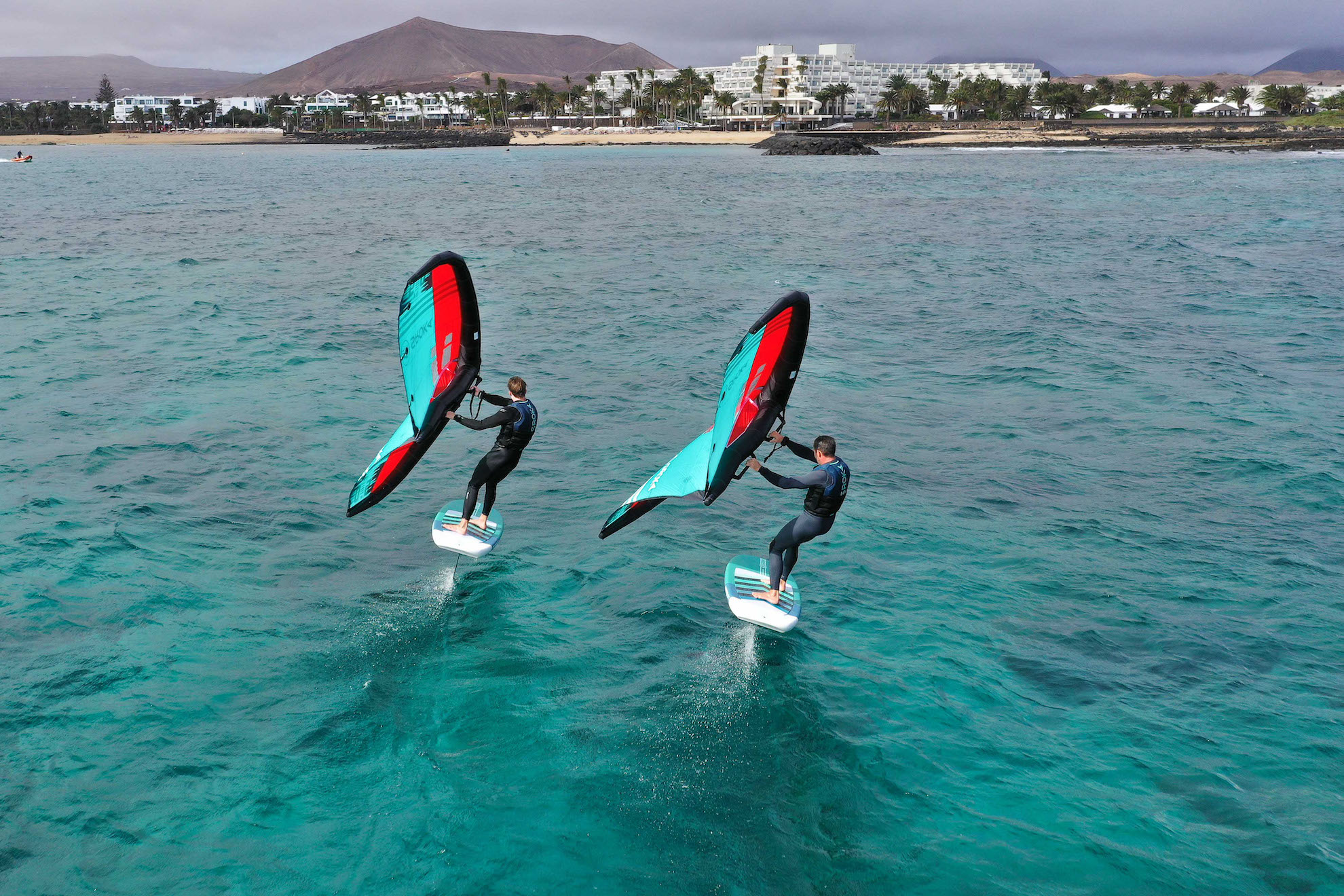
When it comes to choosing a brand for wingfoil, opting for equipment quality is essential. It's important to keep in mind that price doesn't always guarantee quality. At Sroka Company, we emphasize the constant pursuit of the best quality at the best price. Our commitment to quality is reflected in each of our products, with meticulous attention paid to detail, durability and performance.
Choosing quality equipment for wingfoil has many advantages. It guarantees better stability, increased responsiveness, longer lifespan and a more enjoyable gliding experience. Equipment quality also affects the safety and confidence you feel when you're on the water, which is essential to fully enjoy this discipline.
But most importantly, it allows you to progress quickly. Not all equipment is equal unfortunately, and your progression will be greatly determined by your equipment choice. Opting for quality equipment will give you the best learning experience.
When you choose Sroka Company, you can trust in the quality of our equipment and our commitment to offering you the best value for money. Bruno SROKA, three-time world kitesurfing champion, tests all products and is fully involved in product development. We're passionate about wingfoil and want to share that passion with you by offering products that meet your highest expectations.

What equipment to choose to start Wing Foil?
Like any gliding sport, Wing Foil has a technical side that makes equipment choice very important. This technicality is multiplied by the fact that Wing Foil uses both wind energy through the Wing and swell energy through the hydrofoil.
The hydrofoil is made up of a mast, fuselage, front wing and stabilizer. The length of the mast has a real impact on how you navigate: a shorter mast is more reassuring and easy for beginners but a longer mast allows you to gain more height and avoid touching the surface. The most influential parameter of the foil is the front wing: the profile, surface, thickness but also the length and width of the wing have a strong influence on lift and wing behavior (speed, stability and maneuverability).
The Foil board used to practice Wing Foil can vary depending on each person's size and practice level. However, we strongly recommend starting with a stable Wing Foil board (between 105 and 120 L) so you can focus more on wing handling and foil management than on balance when starting out.
The Wing is a wing specially designed for Wing Foil. It can also be used on a SUP board without foil to get started, or with a skateboard type mountain board (moderate wind) or carver (light wind). There are different sizes, constructions and shapes of Wing. The size of a Wing is measured by its area 3m – 4m – 5m – 6m – 7m. A Wing equipped with a boom will be easy to handle but more cumbersome than a wing with handles. Finally, the thickness and shape of the leading edge impact the wing's rigidity, performance and maneuverability. A large leading edge will generate a lot of power but will be slower and heavier.
OUR ADVICE: choosing the Wing is very important since it's the "engine" of your Wing Foil. There are two trends in wing construction: those that are very light but poorly reinforced and therefore not durable over time (wings are very fragile) and those that are slightly heavier with reinforcements but more durable and resistant to impacts. Then: it's more interesting to invest in 2 wing sizes to cover a wider range of use, than in 1 wing and 2 front foil fins.
What wing size for wing foil?
The four front wing sizes of the S-Foil SROKA have been designed to be interchangeable for a plurality of uses allowing you to navigate in Wing Foil and practice other disciplines always according to each practitioner's level and conditions:
- S-Foil XXL 2000: Beginner (90Kg+) in all conditions, intermediate in light wind (12nds and less)
- S-Foil XL 1750: Beginner (70Kg+) in all conditions, intermediate in light wind (12nds and less)
- S-Foil L 1500: Beginner (50Kg+) in all conditions, intermediate in light wind (12nds and less)
What board size for practicing wing foil?
It's important to have a sufficiently stable board according to your size and level to start Wing Foil under the best conditions. Be careful about miniaturization: it's very hard and very frustrating to start with small equipment, even impossible, even with a good level in gliding sports. Board sizes like 5'7 and 6'0 will be ideal for starting, even if a person weighing 50 or 60kg looking for an evolving board can consider a 5'4… but not less.
Our Sky Rider range is available in 7 sizes, 5'4, 5'7, 6'0, and 6'3 Inflatable models also have their advantages (available in 5'3, 6′ and 6'4 for the V2 version and V1 version on sale here, while stocks last) : shock resistant, easy on the knees, stable and easy to transport, while maintaining great gliding sensations thanks to a carbon plate. Find our full article on inflatable boards here.
What speed in wingfoil?
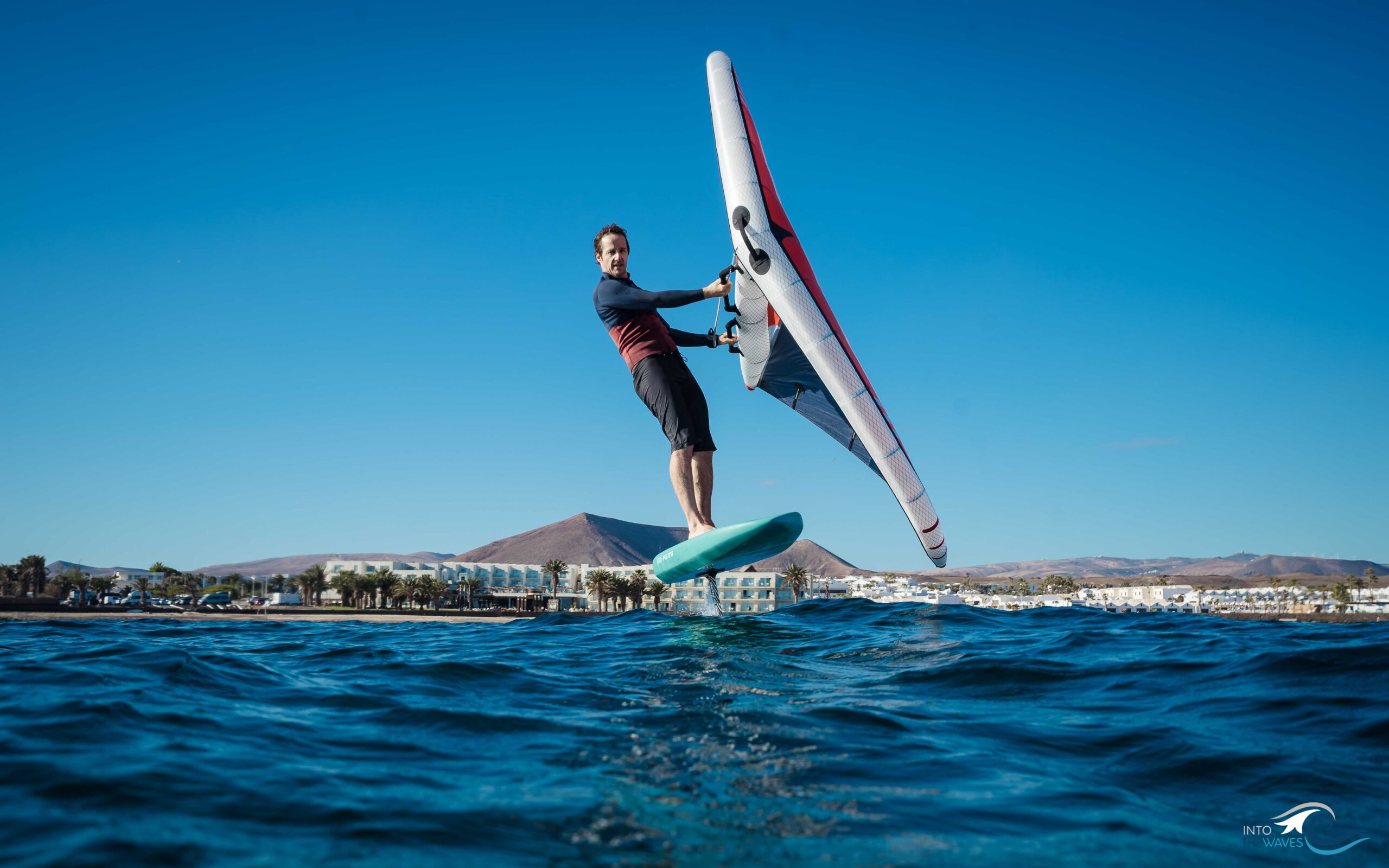
In general, the average navigation speed in wingfoil is around 20 knots. It's a comfortable and pleasant speed to enjoy gliding sensations and freedom on the water. However, with good progression and experience, it's entirely possible to reach higher speeds, around 25 knots or more. This increased speed is generally achieved by the most advanced riders, who perfectly master their technique and fully exploit their equipment's potential. But it's still important to note that it's not speed that determines a rider's level, as it depends on several variables such as weather conditions, the type of body of water and equipment
Kitesurf or wing foil?
The choice between Kitesurf and wingfoil depends on personal preferences and the desire to experience intense occasional sensations or more regular and versatile practice.
|
Criteria |
Wing foil |
Kitesurf |
| Equipment setup | Quick (5-10 min) | Longer (lines, bar) |
| Space needed | Reduced | Important (wing deployment) |
| Practicable conditions | Wide (8 to 40 knots) | More demanding |
| Main sensation | Flying above water | Gliding + powerful jumps |
| Learning curve | Accessible | More technical |
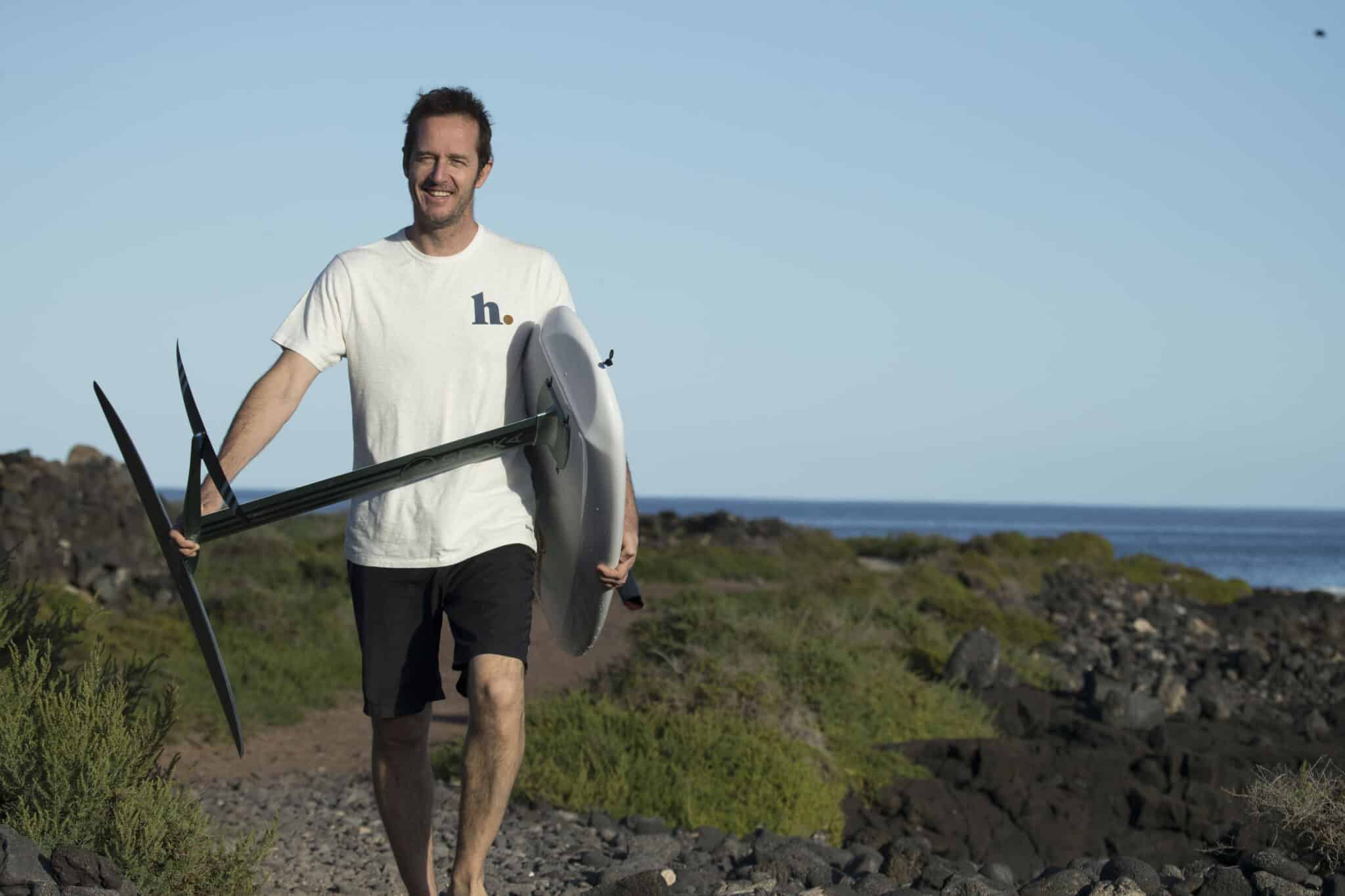
Bruno Sroka's opinion on wing foil
The Wing Foil is a Freeride sport where you maximize pleasure by minimizing equipment. Easy to prepare, it's pure pleasure. We're not looking for speed or jump height, but the sensation of gliding on water and wind swell, alone or with friends without hassle. It's a 100% fun sport that's made for those who want to smile constantly on the water.
Bruno SROKA's advice:
- Start on flat water, sheltered from swell, and never with onshore wind
- Don't overestimate yourself. If conditions aren't right for starting, don't go.
- Buy equipment suited to your level, size and practice location
- Pay attention to other practitioners. Over time, you'll head more and more upwind and downwind, with the wing sometimes you have a loss of visibility so check well downwind that there's no one when you start surfing waves
- Start with a large front fin. It's more stable, a bit slower and allows you to fly in lighter wind conditions quickly and without getting hurt.
- Choose your equipment correctly. It's better to invest in a 4m wing and a foil with two front fin choices to optimize the wind range and make good savings
Need help, don't hesitate to contact us at 02 98 32 53 69 or at contact@srokacompany.com
