


How to choose the right paddle for paddleboarding!
The paddle is an essential element for paddleboarding. The paddle can be compared to a car's engine. Therefore, choosing the right paddle for paddleboarding is crucial to match your needs. Your choice will determine your paddling comfort, your power to generate speed, and your efficiency to reduce fatigue over time.
What type of paddle?
-
1. Fixed, adjustable, or detachable paddle.
- Fixed paddleboard paddle: this is a paddle whose length cannot be adjusted. It is lighter, stiffer, and more performing than an adjustable paddle, but it must be cut to the correct size for you. Indeed, it is suitable for experienced paddlers who paddle regularly and have a defined paddling style.
- Adjustable paddleboard paddle: this is a paddle whose length can be adjusted thanks to a clip or screw system. It is heavier, less rigid, and less performing than a fixed paddle, but it offers more versatility and comfort. It is suitable for beginner or intermediate paddlers who paddle occasionally or in varied conditions.
- Detachable paddleboard paddle: this is a paddle that separates into two or three parts to facilitate transport and storage. It can be fixed or adjustable. It is more practical than a single-piece paddle, but it presents more risks of breakage or play at the joints.
What material to use?
-
2. An aluminum, fiberglass, or carbon shaft? What is your choice?
- Aluminum: it is a strong, resistant, and economical material, often used for the shaft or blade. It offers good stability in the water, but it is also heavy and cold. It is suitable for beginners or occasional paddlers looking for an inexpensive and durable paddleboard paddle.
- Fiberglass: it is a light, rigid, and resistant material, often used for the shaft or blade. It offers good performance and good power transfer; it is also more expensive and more fragile than other materials. It is suitable for intermediate or experienced paddlers looking for a quality paddleboard paddle.
- Carbon: it is a very light, very rigid, and very performing material, often used for the shaft or blade. It offers excellent responsiveness and excellent comfort, but it is also very expensive and sensitive to shocks. It is suitable for experienced or expert paddlers looking for a high-end paddleboard paddle.
3. What size blade?
- The blade plays an important role in the performance of a paddleboard paddle. It comes in different shapes and sizes. As a general rule, the wider the blade, the more water it propels. The power of the movement allows you to paddle less often. A narrower blade requires less force to paddle. As paddle strokes are less effective, more movements are needed to advance at the same speed as with a wider blade. So if you are looking for comfort, prefer a larger blade. If you are looking for performance, reduce the size of your paddle's blade.

What type of blade?
As with the paddle shaft, there are different types of blades.
Mainly there are plastic blades: it is a light, flexible, and inexpensive but very solid material. It offers good maneuverability, but it is also less rigid and less performing than other materials. It is suitable for beginners or occasional paddlers looking for an easy-to-use and very solid paddleboard paddle.
Then there are composite blades, generally fiberglass or carbon, which provide rigidity, efficiency, and performance. However, they are more expensive and more fragile to impacts. So, for a family with children, we advise against this option.
-The blade plays an important role in the performance of a paddleboard paddle. It comes in different shapes and sizes. As a general rule, the wider the blade, the more water it propels. The power of the movement allows you to paddle less often. A narrower blade requires less force to paddle. As paddle strokes are less effective, more movements are needed to advance at the same speed as with a wider blade.
In conclusion, a wide blade is suitable for strong riders, capable of powerful paddle strokes without getting tired too quickly. A narrower blade is generally intended for women and children with less arm strength.
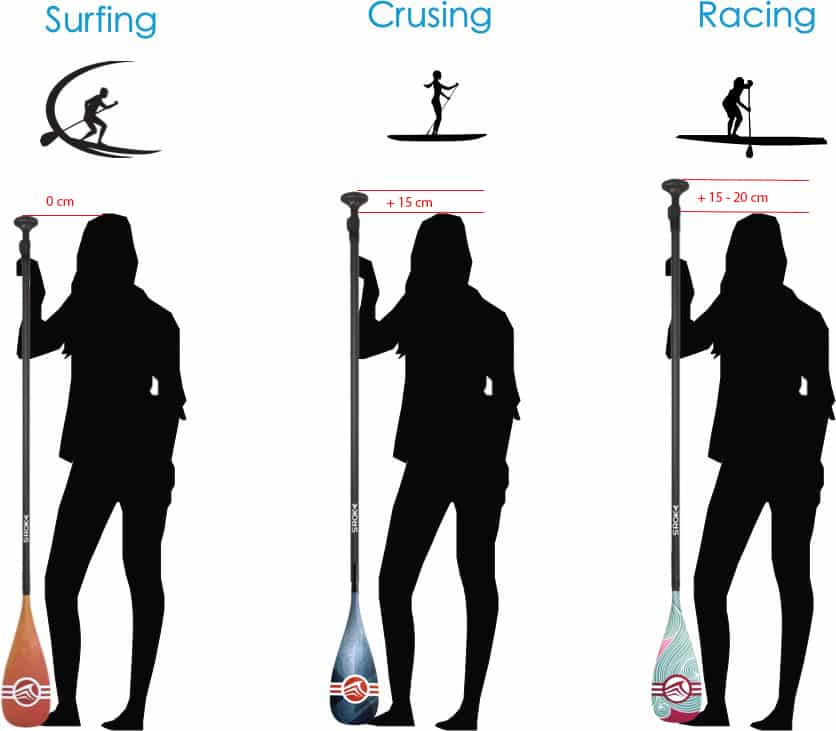
What should be the length of a paddleboard paddle?
The length of a paddleboard paddle depends on several factors: the rider's height, the thickness of the paddleboard, its width, and also the activity practiced with the paddleboard.
As a general rule, you should add 10 to 20 cm to your height to find the length of your paddle. But this is by no means an absolute rule, because not all paddle activities require the same paddle length. For paddle surfing, the paddle should be a little shorter to avoid hindering your movements. Do you enjoy long hikes on your Stand Up Paddle? In this case, don't skimp on the paddle's length. Here are some guidelines to help you choose your paddleboard paddle.
- For paddle surfing or short-distance rides, choose a paddle 8 cm taller than your height.
- Are you looking for a versatile paddle for medium-distance SUP hikes? Opt for a paddle 20 cm taller than your height.
- Long-distance paddle hikes are more effective with a paddle 25 cm taller than your height.
In conclusion
To choose the right paddle for paddleboarding, you need to consider your skill level, physical dimensions, frequency of practice, and paddling style.
- If you are looking for performance, we recommend the 60% carbon paddle which will provide rigidity and performance.
- If you are looking for a family-friendly option with an attractive price, we recommend the paddle with an aluminum shaft and a plastic blade.
- If you are looking for a mix of performance and durability: a carbon shaft with a plastic blade. The 50% carbon paddle with a carbon-look plastic blade is for you.
- If you are looking for a paddle for your child so they can join you, take the kids paddle.
If we compare a paddleboard to a car, the board corresponds to the car's body, and your car's engine to the paddle. Therefore, choosing the right paddle will allow you to optimize your paddleboard's performance and your paddling efficiency. A good paddle can last a lifetime. A board will change depending on your technical evolution.