


Once familiar with the sensations of flying in Wing Foil, some riders want to exploit the full potential of this sport. To satisfy your desires for freeride navigation and trick execution, we create high-performance and maneuverable wing foil products and packages. We pay attention to them being scalable, to support you in your beginnings, and to fulfill your desires for freeride and performance. Sharing our passion for foiling goes far beyond product creation; we make sure to give you the best advice to have a blast on the water. Do you want to move up to the next level and land your first jumps? Here are all our recommendations on "How to jump well in Wing Foil," to push the limits of this sport.
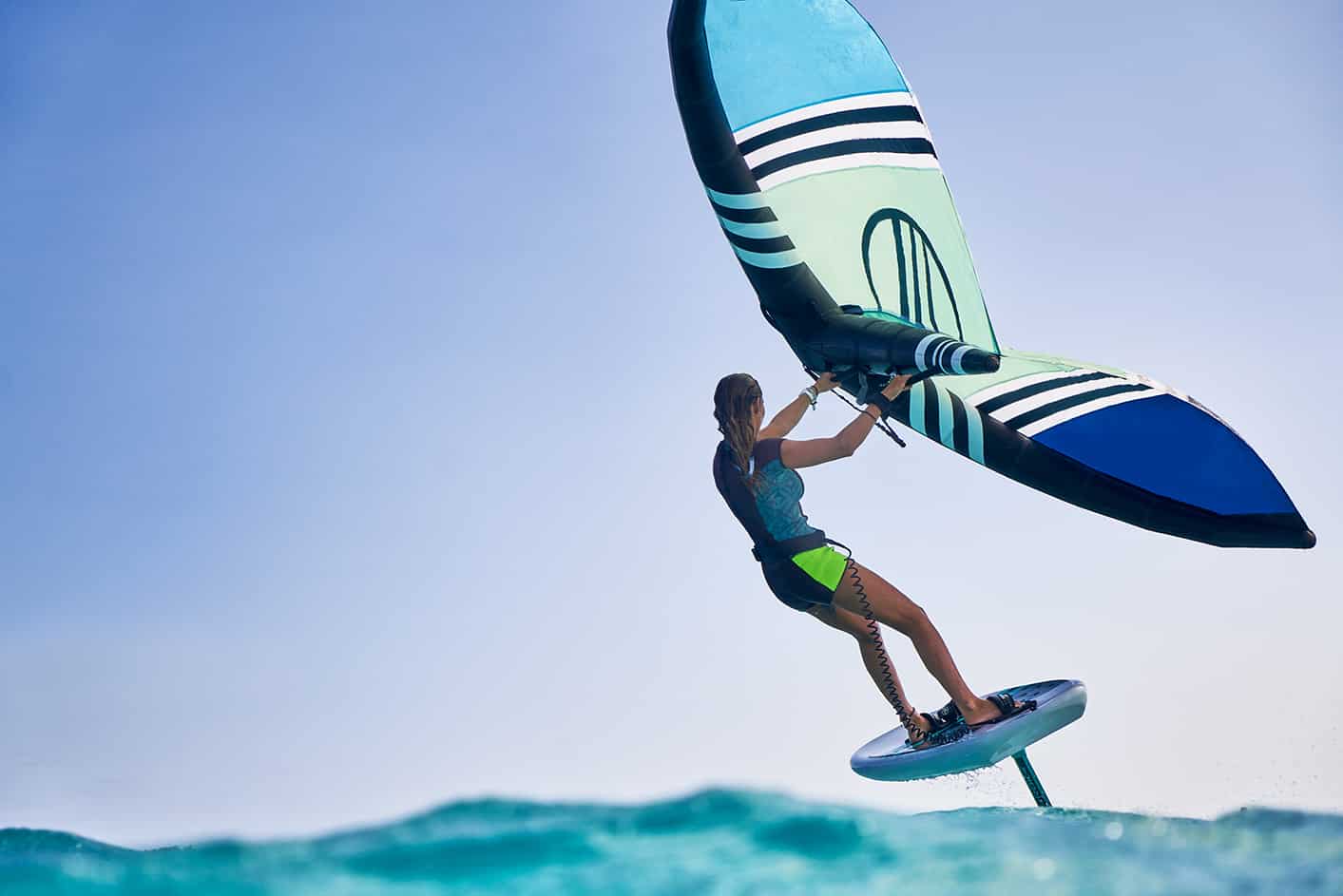
7 tips for jumping well in Wing Foil (Level 1)
THE SPOT AND CONDITIONS
Unlike some foil disciplines, jumping in WingFoiling doesn't necessarily require powerful waves. It is entirely possible to start on flat water during a first attempt. However, it is ideal to start during a session with plenty of wind (at least 20 knots), with enough chop and/or swell to help you with the jump's impulse. Also, consider a spot with enough depth. Indeed, you could damage your foil upon landing or in case of a fall.
THE EQUIPMENT
When you start jumping in WingFoil, prioritize safety above all else and equip yourself with protection, a helmet, and an impact vest with specific wingfoil accessories.
For jumping, a slightly smaller board will be ideal due to its increased responsiveness and small footprint. These boards are generally equipped with foot-strap inserts, which are very useful for jumping. Straps will provide stability in flight, control, and prevent you from losing the board in the air. A board that is too large will not be suitable for jumping. We advise you to have a board that is equal to or less than 5'5 (depending on body size).
For more information on the use of straps or strapless in Wing Foil, we invite you to read this dedicated article. Finally, to get maximum speed and an optimal jump, we recommend a fast foil and a relatively small front wing (less than 1500 cm2).
Find our SROKA quiver for jumping in Wing Foil at the end of the article
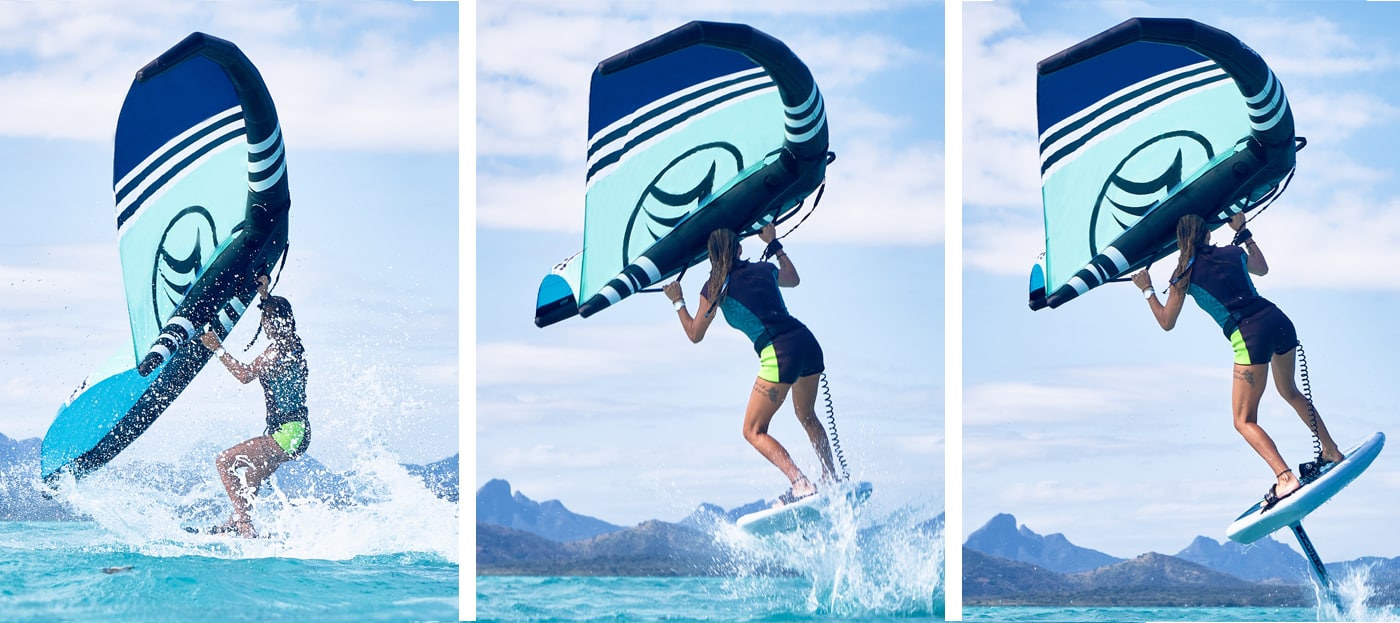
PREPARATION
Well-balanced on your board, crosswind, gain maximum speed by loading with your wing and foil (i.e., by edging as much as possible on your board by pressing on your heels and pulling on your toes). Take maximum power with your wing to accelerate. To do this, position the wing as vertical as possible in front of you to catch maximum wind. Position yourself on your preferred side to start jumping.
THE IMPULSE
Spot a section (a chop or a small wave) in front of you.
As you approach the top of your wave, flex your legs more and more (three to four meters before) to prepare for the impulse and store maximum power (continue to edge, pressing hard on your heels). Your gaze should be directed towards the impact zone (the jump's trigger zone). As you get closer to the top of the wave, move slightly upwind while continuing to gain maximum power.
Flex your legs, crouch down, and, just before impact (takeoff), add pressure to your front leg to push the foil down and then up. This will generate additional lift at the moment of takeoff (you should feel the board nose-diving just before impact). Make sure the front of the board doesn't touch the water, as this could slow you down and unbalance you. This step is very important to maximize the power transmitted to the foil at impact and thus increase your chances of getting as high as possible.
TAKE OFF
At this moment, move slightly towards the wind axis (luff) and continue to gain maximum speed. At the moment of take-off, put your weight on your back leg to lift the foil. Extend your legs by pushing on them to jump as high as possible. You are now jumping. You can now position the wing above your head by bending your arms (umbrella position).

THE FLIGHT
Upon takeoff, hold your wing above you like a parachute. Orient it to glide as much as possible. Pay attention to your position: do not lean back or forward and stay as grouped as possible to better control your flight and descent. In case of complete loss of control, do not hesitate to detach from the board to avoid injury.
THE DESCENT AND LANDING
This is the second part of the jump. Stay grouped while keeping the nose of the board pointed towards the sky, to land on the back of the board. Keep your wing in an umbrella position until landing. Extend your legs slightly before touching the water to cushion the landing in the water and then flex them again to cushion when the foil hits the water. If your landing is successful, the foil will immediately take flight again once the board is out of the water.
For a soft landing, never fall flat with your full weight. This could cause you to fall, injure yourself, and break your board. Therefore, never land flat; prioritize landing on the back of the board.
Learning to jump requires time and repetition. So don't hesitate to practice.
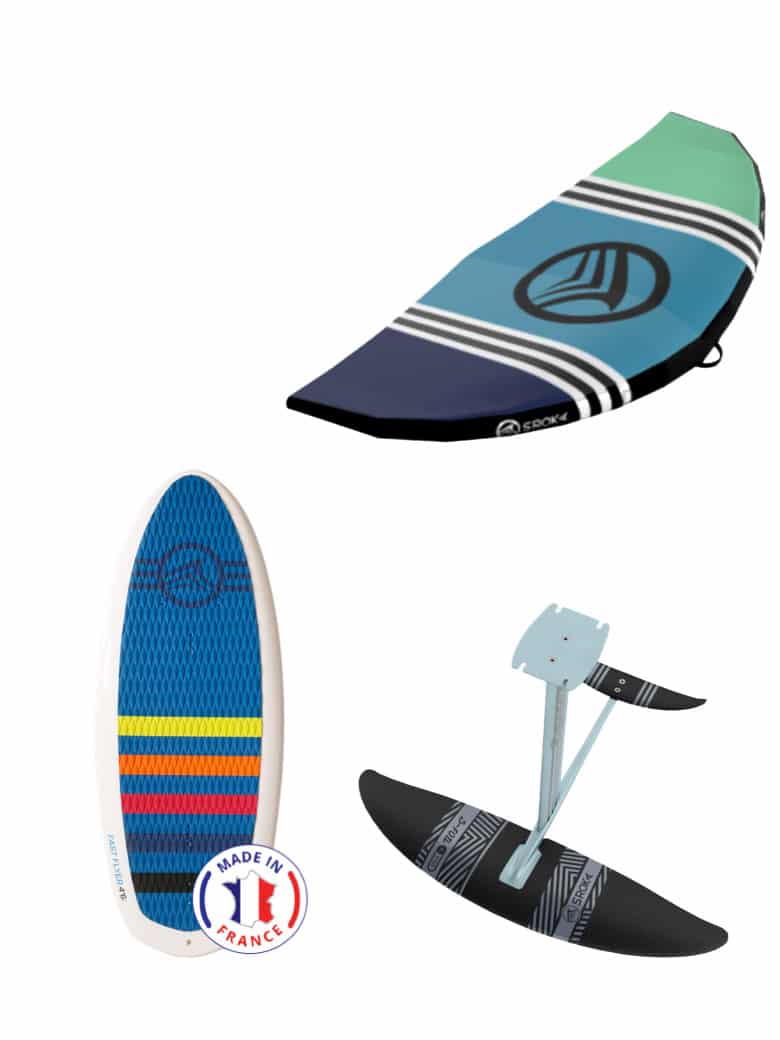
Choose SROKA for Wing Foil jumping
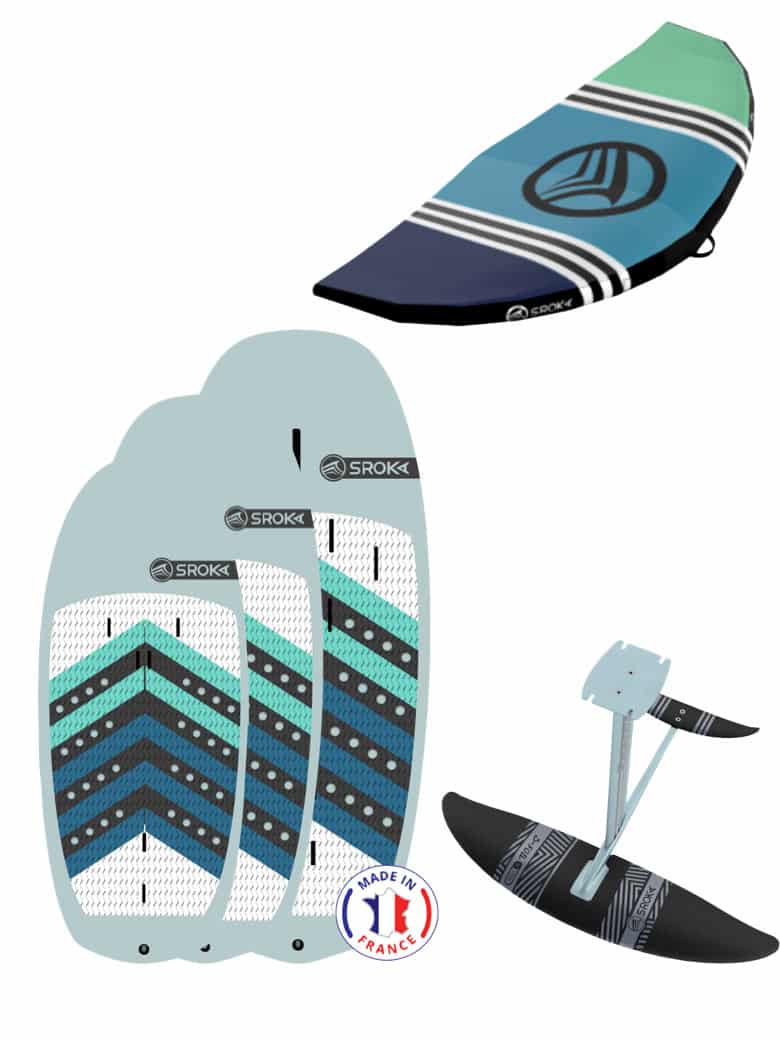
To progress in Wing Foil jumping, equipment choice is crucial. The Rigid Wing Foil Pack Sky Rider + Classic S-Foil + Wing V4 is particularly suited for this practice: the reactive and compact Sky Rider board offers the necessary maneuverability to generate good impulse, while the Classic S-Foil will provide the essential speed and lift for controlled jumps. The powerful and maneuverable Wing V4 completes this pack for high-performance freeride practice.
In summary:
- If you are a beginner, don't forget to equip yourself with protections
- Choose a spot with chop
- Start on your preferred stance and gain speed by loading your wing and foil
- Spot a section to lean on, flex your legs to push down the foil
- Extend your legs to create impulse, while sheeting in the wing with arms extended above your head as much as possible
- Stay well above the board during the flight and descent
- Absorb the impact by extending your legs, pushing the front wing down first
- Keep the wing sheeted in above your head throughout the landing
Advanced tips/pro tips:
- Look at the intended landing zone
- Take your time and progress gradually