



All our tips for starting surf foil dockstarting
"It's not for us old folks, it's for young people with energy and a sense of balance" — You can hear this type of argument on the beaches. It's totally false. This ultimate guide to starting surf foil dockstarting is for all practitioners, regardless of age or skill level. We will give you all the steps, tips for easy learning, and information to choose the right equipment to progress or perform, covering different techniques.
Starting dockstarting requires a lot of repetition to overcome the initial difficulties. But you will find it an excellent training method when there is no wind for wing foiling.
What is dockstarting?
Are you familiar with dockstarting? It's that thing where you fall off the pontoon on your foil, pretending to be an athlete, and try to stay airborne by wriggling like worms. It's fun, eco-friendly, and good for losing weight. No need for wind, waves, or wings to foil. Just good beginner equipment, a light board, and a spot with a pontoon and sufficiently deep water. Dockstarting, it's a struggle at first, but you can learn it. And it's great for progressing in pumping foil and preparing for surf foil. It's a very good way to let off steam in a short time. Muscle strengthening guaranteed!
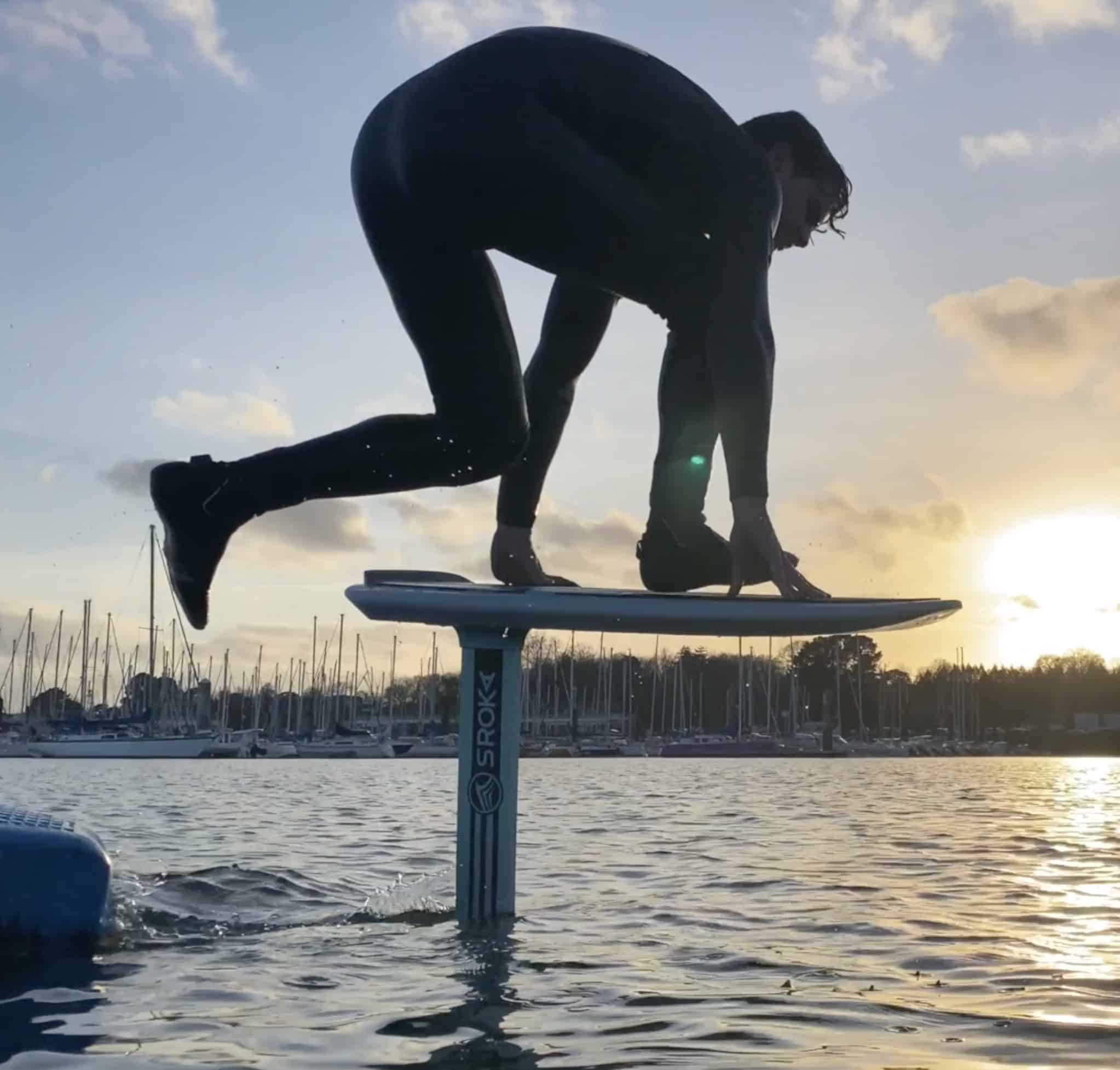
How to start foil dockstarting: the steps to succeed
1 – Choose a suitable pontoon or dock
The first tip for successful dockstarting is to choose the right spot. To practice foil dockstarting, it is essential to find a wide and stable pontoon that allows you to run with the board in your hands. Avoid narrow or unstable docks or pontoons that could throw you off balance when picking up speed.
Preferably choose a floating pontoon, where your front wing can pass underneath the dock without hindering you while running. A pontoon between 30 and 60 cm high relative to the water surface is perfect. You will need to adapt the mast height to the pontoon height: a high pontoon requires a longer mast, a low pontoon allows for a shorter mast. Also, remember to check the depth: sufficiently deep water is essential to avoid contact with the bottom, especially during the first sessions where control of flight height is still approximate.

2 – Generate speed by running
To successfully dockstart on a foil, you need to generate speed by running on the pontoon or dock with the board in your hands (hold the board by the rails) and position the foil slightly under the water. Try to run as fast as possible while maintaining your balance. Generally, the smaller your foil, the more speed you will need to pick up. Some large foils like our 2000 HA require almost no speed to start, our riders can even start from a standstill. So adapt your travel speed to the power and surface of your front wing.
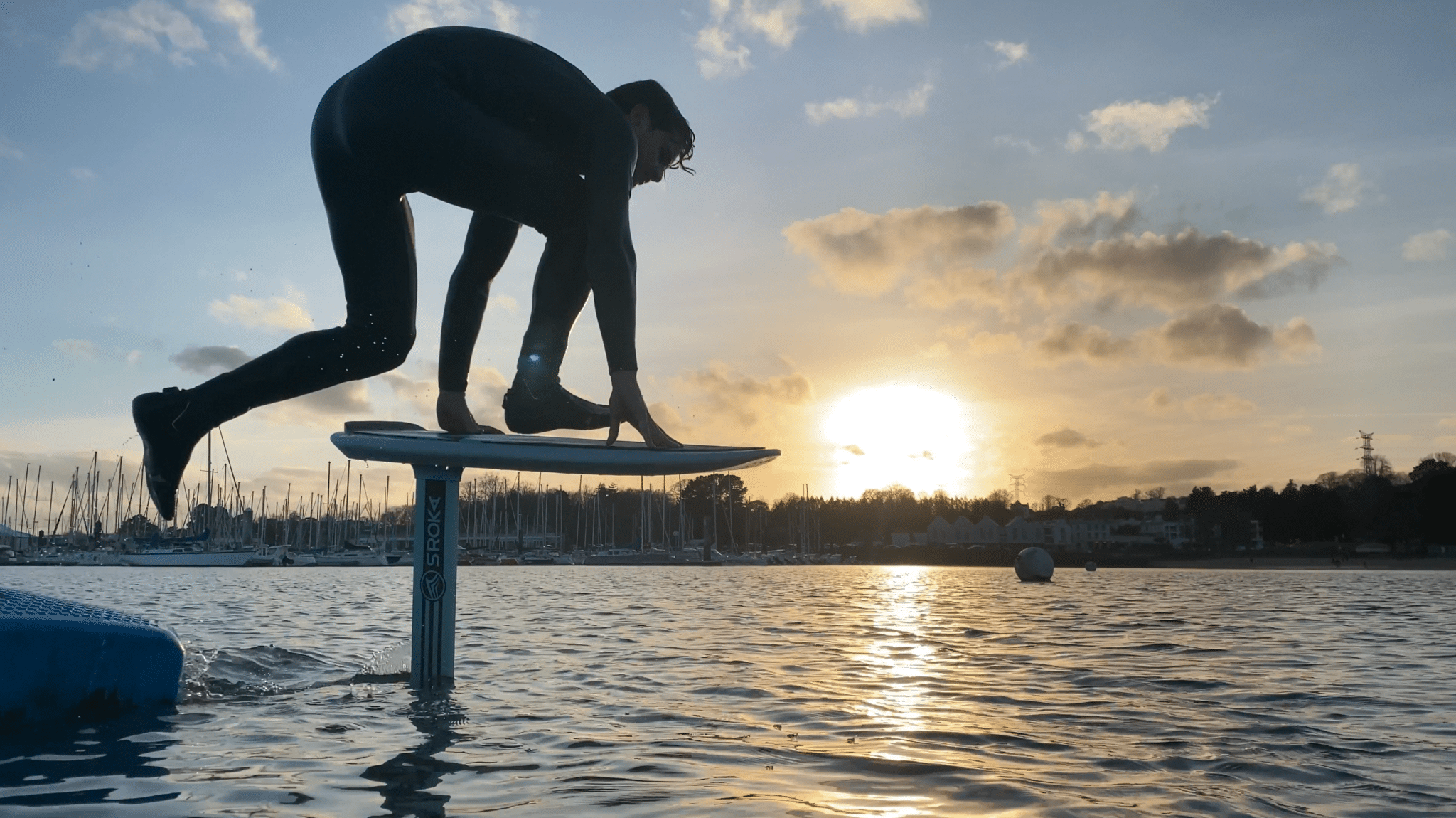
3 – Jump onto the board and maintain balance
Once you've generated enough speed by running, it's time to jump onto the board. To do this, release the front rail of the board to place your front hand on the board's surface, and jump onto it, landing with your feet well-positioned. You can use the position of your hands to help position your feet as close as possible to the ideal position.
Foot placement is very important, as incorrect placement is difficult to correct. It's up to you to define your optimal position. Generally, on a small board, the back foot is directly over the mast and the front foot is just behind the front hand, which is positioned on the deck.
Bruno SROKA's advice: Keep your gaze fixed forward and try to be as stable and "straight" as possible during landing. "Straight" means your center of gravity should be above the board. If you are too far forward, backward, left, or right, you start with an imbalance that will be difficult to correct.
4 – Stay airborne: master foil pumping
Once you are well-positioned on the board, it's time to start pumping and gliding for as long as possible. To do this, continue to generate speed with pumping and oscillate your foil downwards, then lighten your pressure so that the foil rises again. Ideally, it's not just the legs that work; you need to transmit energy to the foil by using your entire body weight through imbalance.
Keep your gaze fixed forward and try to keep your center of gravity above the board while airborne.
Flying as high as possible will reduce foil drag and thus allow you to fly longer with minimal effort.
Arm movement during pumping: initially, you can use your arms to lighten yourself, which also helps to set a pumping frequency and rhythm. As you improve, the use of arms becomes less necessary.
By following these steps and practicing regularly, you should be able to master the dockstart foil technique and take off quickly and easily from any pontoon or dock.
Your first dockstart session: what to expect?
The first dockstart session is both a frustrating and motivating experience. Here's what you need to know before you start:
- Expect to fall often. Repetition and practice are key. Each attempt teaches you something.
- Start with a large foil. A front wing with a lot of surface area forgives starting errors.
- Set micro-goals. In the first few sessions, the goal is simply to stand on the board after the jump, before even thinking about flying.
- Plan 30 to 60 minutes of training — dockstarting is physically intense. Muscle strengthening guaranteed, especially for the legs, back, and abs.
- Film yourself. Reviewing your technique is one of the most effective ways to identify your mistakes and progress in dockstarting.
Common mistakes and tips to avoid bad starts
Here are the main mistakes to avoid, and the little extras to remember:
-
Prioritize a rigid foil that allows you to automatically transmit your pressure to the foil. You will gain efficiency.
-
Fall and contact with the bottom: choose a spot with sufficiently deep water. Check that there are no buoys or chains under the pontoon to avoid damaging the foil.
-
Incorrect foot positioning: poor placement upon landing is very difficult to correct in flight. Practice this movement on dry land on the pontoon before starting.
-
Too much or not enough running speed: always adapt your speed to the surface of your front wing. A large HA foil requires less momentum than a compact mid-aspect foil.
-
Avoid hitting your board continuously on the pontoon to preserve your equipment for as long as possible.
- When you fall, try to hold onto your board to prevent it from hitting a boat if you are in a harbor.
What equipment to choose for dockstarting?
So you still want to try dockstarting? First, you need to choose good gear, otherwise you'll struggle. The most important thing is the foil, because that's what will make you fly or make you dive.
Choosing the foil
There are different types of foils depending on their aspect ratio, which is the relationship between the length and width of the wing. The higher the aspect ratio, the longer the wing with fewer chords. The lower the aspect ratio, the more chord the wing has and the less span it has.
Low/mid aspect foils
Medium aspect ratio foils (mid aspect) are the easiest for beginners. They are simpler to manage and take off with in dockstarting. A medium aspect ratio foil is one with less span and more chord. With this type of foil, you can easily correct your initial mistakes thanks to their maneuverability, which allows you to easily get them back on the desired axis, and they have excellent low-speed power. However, they glide for less time than high aspect foils (of roughly equal size) and will therefore require a higher pumping frequency.
Our best mid aspect wings dedicated to pumping are the classic range wings, especially the 1750 and 2000.
If you choose a foil that is too small or too technical, you will likely fail. So you have to accept taking an easy foil that will glide a little less but will allow you as a beginner to pump for a few seconds to tens of seconds.
High aspect foils
High aspect ratio foils are the most efficient because they offer better glide and glide much longer and more easily with less effort. They are made for those who want to cover long distances by pumping. However, they are more technical to master at the start and to relaunch after a turn, due to their large wingspan.
Our best HA wings dedicated to pumping are the Lift 1350 and 2000.
The 1350 will be perfectly suited for lighter riders (under 70 kg) or advanced riders who want to go faster.
The 2000 will be suitable for riders over 70 kg or anyone who wants to glide for a long time with less effort.
A wing with a large wingspan will give you much more glide but will turn slower. So if you are looking for record times or distances, we advise you to use this type of front wing with a high aspect ratio.
Choosing the mast height
The mast in the water generates drag. So if you have a long mast and want to stay very low on the water, you will have a lot of drag. To be efficient in pumping, you need to fly high on the water to have less mast surface in the water and thus less water drag. Therefore, a mast between 70 and 80 cm seems perfectly suitable. The higher you are on the water, the less deep the foil is, and thus the less drag there will be around the mast. This mast height is also determined by the height of the pontoon. If the pontoon is high, then the mast height will need to be increased. If the pontoon is low on the water or if you want to do a beach start, then a 70 cm mast will be recommended.
Choosing the fuselage length
Pumping involves oscillating your foil up/down.
The length of the fuselage will influence the pumping frequency and consequently the ease of oscillating the foil along the longitudinal axis. The further the stabilizer is from the front wing (long fuselage), the more it will stabilize the foil along the longitudinal axis and thus slow down oscillation (oscillation will be more difficult). However, for beginners, there will be more time to improve pumping efficiency.
We have created a special pumping fuselage where the mast is set back by 3 cm compared to other SROKA fuselages. This allows for better weight distribution on the back and front leg, thus optimizing flight time.
A shorter fuselage will facilitate oscillations but will be less stable yet more playful.
So, depending on your level, you can make your foil easier or more playful for pumping.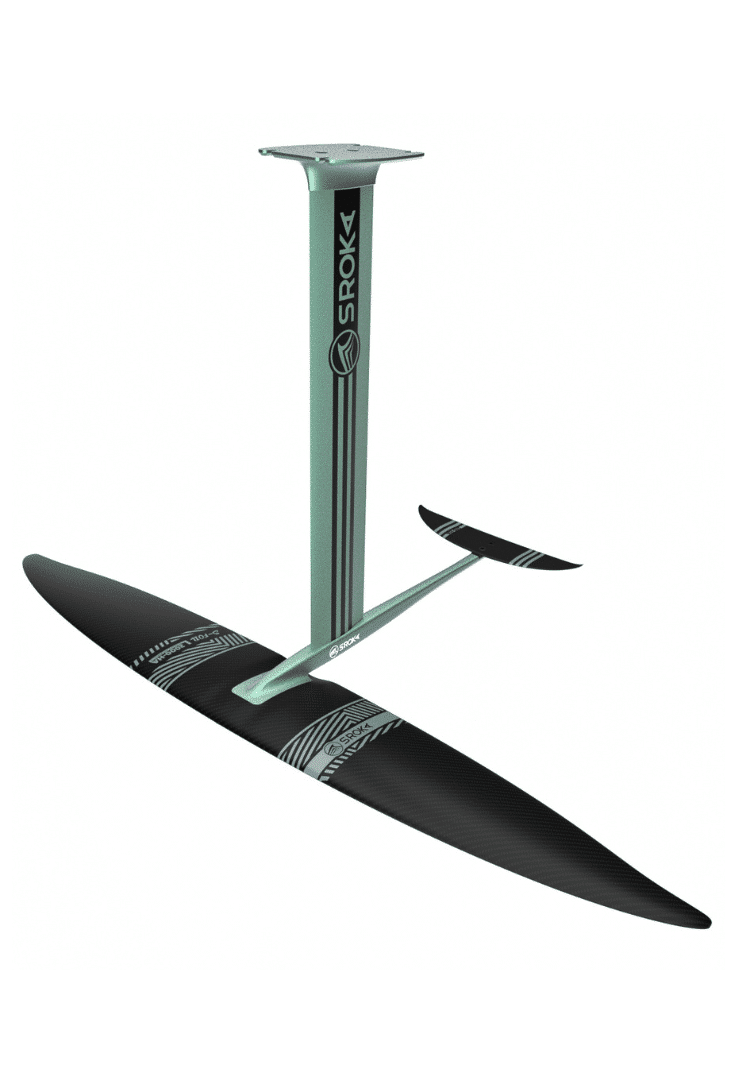
The stabilizer
By definition, the stabilizer is there to stabilize and provide a little lift to the foil.
A large stabilizer will make pumping easier at the start, by slightly slowing down the foil and giving more support on the foil. But it will block the foil's oscillation a bit more and slow down your foil more.
A smaller stabilizer will increase the foil's glide and stabilize the foil less. Consequently, it will make the foil easier to oscillate. It will require more finesse in the inputs and will therefore be more technical (recommended for good riders).
We have developed a 290 cm HA stabilizer with high elongation. It allows you to fly for a long time with less effort. However, it will slow down the foil.
The goal of pumping is to fly as long as possible and/or cover the greatest distance. Therefore, speed requires a lot of speed and will not allow you to fly very long. With the aim of starting pumping or flying for a very long time, we advise you to choose a larger stabilizer (the 290 HA).
Choosing the board
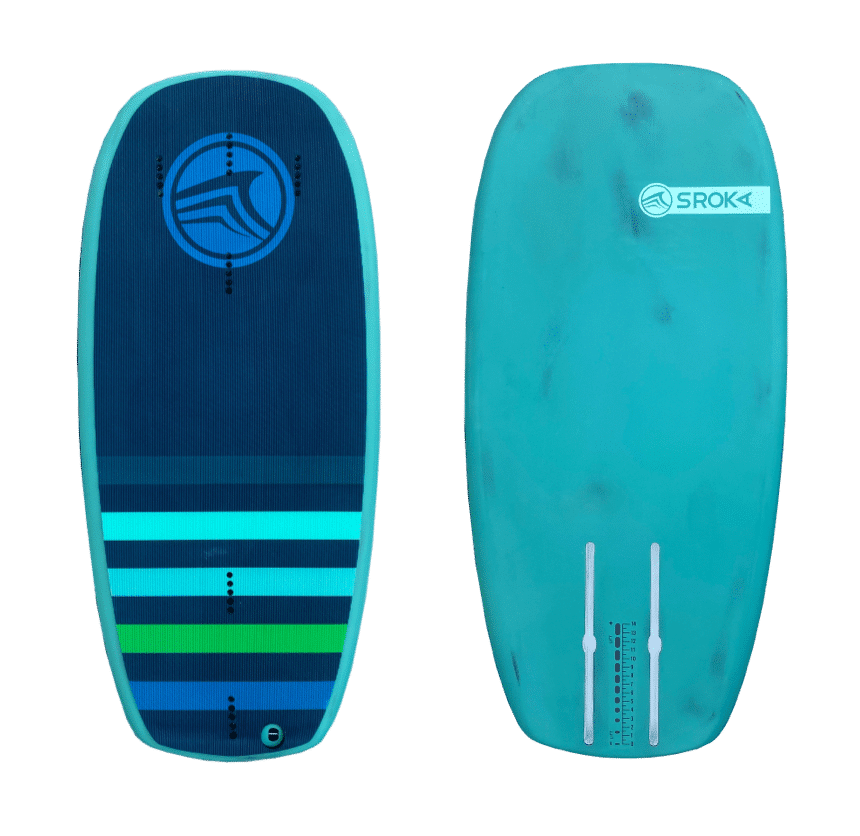
For pumping, choose a board that is light, compact, strong, and stiff. Stiffness is key to transferring energy to the foil. Otherwise, you'll be pumping in vain (the board will deform and tire you out for nothing). A compact board under 4'0 is more suitable for efficient pumping.
What board volume for dockstarting?
A low volume is recommended. You can use your surf foil board, but volume is not necessary. The less volume, the easier it will be to pump. A volume around 14-17 L is a good alternative.
What board length for dockstarting?
A board that is too large will be a disadvantage compared to a board that is too small. For dock starting, you don't need a long board. If you go for the 4'0 Pocket (125 cm) or the Mini Pocket 3'3 (97 cm), you will have the two most interesting options. Beginners will opt for the slightly larger board. It will provide more ease and space to position yourself. The Mini Pocket will be more for demanding riders who want a more compact and lighter board.
What is the best spot to start dockstarting?
The pontoon, the best option for beginners.
Dock starting is a sport that can be practiced almost anywhere. No need for special conditions. All you need is a place to start and your equipment.
A pontoon is ideally the best place to start dock starting. It is stable, easy to find, and allows you to easily get back on the pontoon after each attempt. Ideally, you need to find a pontoon with a bit of length that will allow you to gain speed. Pay attention to obstacles in the water: ropes, buoys, or others. If you use a wing with a large wingspan, this can be a disadvantage and cause a fall.
To find the perfect pontoon near you, use Google Earth or Google Maps; this will help you find the best option.
The ladder planted in the sand, or starting from the beach for experienced practitioners.
If you don't have a pontoon near you, you can create your own "pontoon" using a folding ladder placed in the water. This opens up endless possibilities, but you'll need to perfect your technique to get started with minimum momentum.
So, practice on the pontoon to reduce your running distance to be able to start without momentum.
The second option is to start from the beach, which is called a beach start. If you choose this option, go for a mast around 70 cm and ideally a beach that quickly drops into depth. This will prevent your foil from constantly hitting the sand.
Starting with dockstarting is not the easiest. If you practice wingfoiling, we advise you to get used to pumping by holding the wing by the front handle (in freefly mode) and trying to pump as much as possible to stay in the air. You can do the same in wakefoiling by gaining speed behind the boat and then letting go of the tow rope. Surf foiling is also a good method but requires mastering the take-off, which is not an easy task for a beginner.
Pumping is a very good alternative when there isn't enough wind at our spots.

What are the benefits of dockstarting?
Dockstarting and pumping aren't just for fun, they're also good for you. Here's why:
- Good pumping technique will allow you to take off earlier in wingfoiling. You can also avoid some falls when you go through a lull, by pumping until you find wind again.
- It's useful for connecting waves in surf foiling or for flying in freefly in wing foiling.
- It strengthens cardiovascular health and leg, back, and abdominal muscles. You will use your leg muscles to propel the foil, your back muscles to maintain posture, and your abdominal muscles to stabilize your torso. It also works your cardio because you have to exert constant effort to move forward.
- It's a perfect solution for training when there's no wind at our spots. Very fun once you get past the initial stages. You can easily create a friendly competition among friends.
- The main advantage is the little equipment needed. All you need is a foil and a board.


