


Prerequisites and equipment:
Before any attempt to take off, make sure you have enough depth underwater to avoid damaging the foil. Equip yourself with a wingfoil board adapted to your weight, a wing adapted to your size, and a stable foil to start with. For a weight of 80 kg, we recommend a 1750 cm² foil and a 5 m wing. Don't forget your leashes for the board and the wing so you don't lose your equipment.
The ideal conditions for progressing in wing foil are: a side wind between 15 and 20 knots, calm seas, and enough space to return to the beach in case you don't drift downwind. Beginners drift a lot at first.
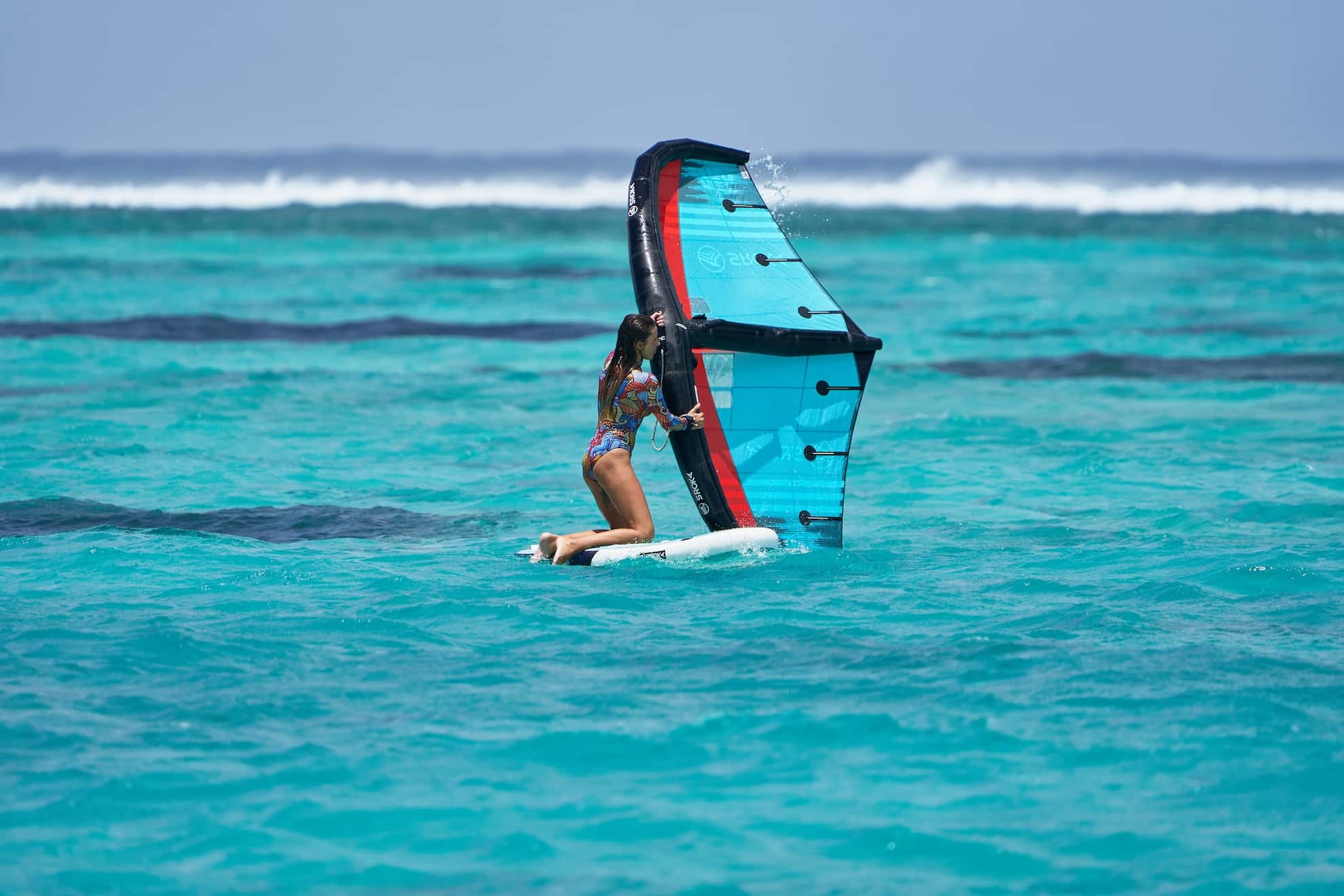
1. Mount and sit on the board or immediately get on your knees.
Before you can kneel, sit astride the board. This will allow you to be very stable and take the time to observe the water, your trajectory, and check for any obstacles in front of you.
When you are in this position, take the opportunity to turn your wing the right way up so that you can retrieve it more easily. To do this, grab one end and pivot your wing in the water. To prevent the wing from turning over again, we advise you to hold the wing by the leash, but as close as possible to the wing. This will prevent it from turning over again.
Variant
If you are very stable, go directly to the kneeling position, turn your wing the right way up.
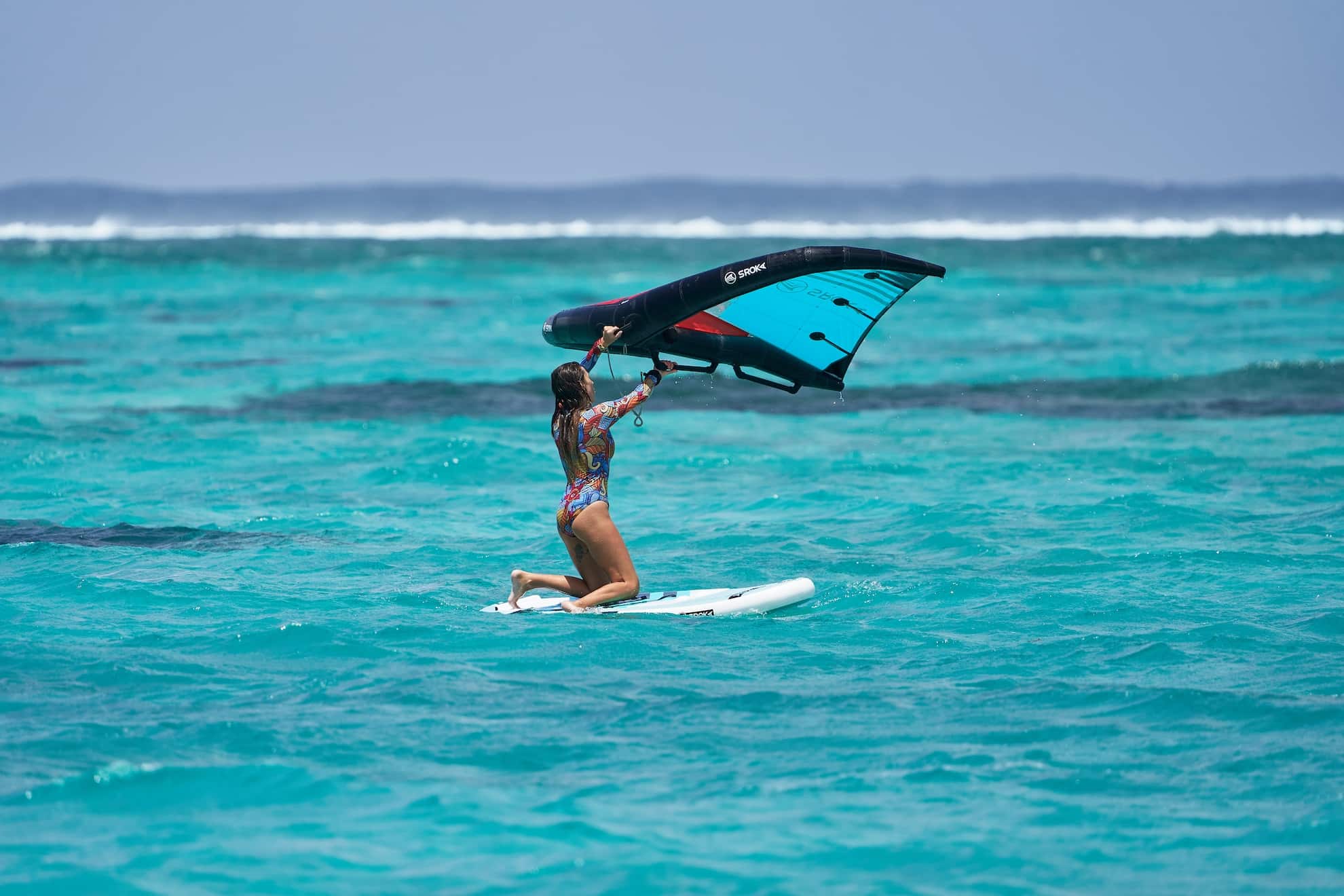
2. Go from sitting to kneeling on the board
Place both hands on the rail to the right and left of the board, then lean on your hands to get on your knees. If you have stability problems, you can lean on the leading edge of your wing with one of your hands to stabilize yourself on the water.
In this position, bring the wing above your head without either end touching the water. Orient your wing so that it catches the wind by pulling on the back hand, which will allow the wing to inflate. Find a stable and balanced position on the board, then let yourself glide on the water.
If you want to slow down, keep the wing almost neutral (stretch your back hand) to prevent it from inflating further (flag position).
Variations:
Some prefer to get on the board not in line with the board, but perpendicularly. This technique can help you in some cases, but it can be problematic on very small boards in the future. We therefore do not recommend it.

3. Stand up:
It is easier to be moving on the board to get on it than to be still. Indeed, the movement of the board optimizes the lift of the float.
Here are the steps to stand up on a wing foil:
Kneeling position :
-
- Kneel on the board, positioning your front foot in the longitudinal axis of the board.
- Push on this foot to stand up.
- Then, position your back foot centered above the mast of the foil.
- Remember this: your center of gravity (between your legs) must be above the front wing for balance in flight.

Foot spacing :
-
- Feet should be spread at the same distance as your two shoulders.
Tip: if your front foot is slightly offset towards the windward rail, your back foot should be proportionally offset to the other side to keep your center of gravity above the longitudinal axis of the board.

4. Gain speed to take off.
As a beginner, you will take off like an Airbus A380. It is therefore essential to gain horizontal speed, as this speed will allow you to generate lift on your front wing and thus take off.
Here are the steps to follow:
-
Find the right spot for you :
- Look for a suitable place to progress.
-
Gain speed :
- Sheet in your back hand while remaining as upright as possible on the board.
- Make sure the mast and your body remain in the same axis to facilitate lateral stability.
-
Take-off :
- When sufficient speed is reached, press lightly on your back leg to lift the board out of the water and start flying.
-
Stop :
- If you need to stop, release your back hand and press a little more on your front hand to bring the board back down to the water.
In summary
From a sitting position, I get on my knees while holding my wing by the leash, near the leading edge. Then, position your wing above your head and sheet in with your back hand, being careful that the ends of the wing do not touch the water. Place your front foot on the board, then push with your leg to place your second foot above the mast. Gain speed and take off.
To stop, release your back hand, reduce your height and place the board in the water. Be careful of the bottom so as not to touch it with your foil.
If you still have questions on this subject, or for any other request, do not hesitate to contact us!