


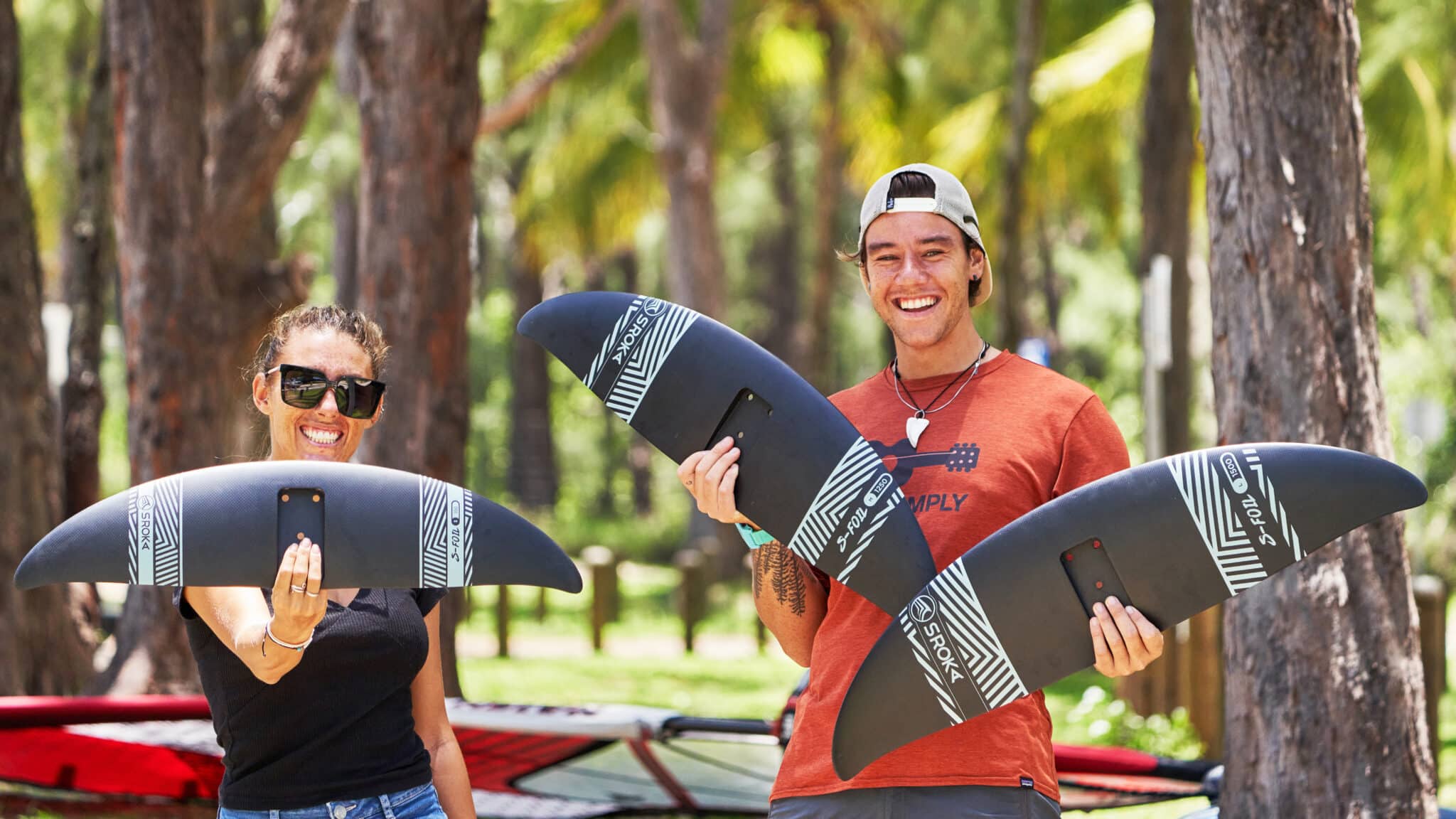
Foiling has revolutionized board sports. It allows you to glide over swells, move from one wave to another, partially or totally out of the water. It is accessible for all body types, all levels, all conditions... Whether with a wing, kite, surf, SUP board... Here are all the criteria to take into account to decide between a Low Aspect or High Aspect wing.
Understanding how a foil works
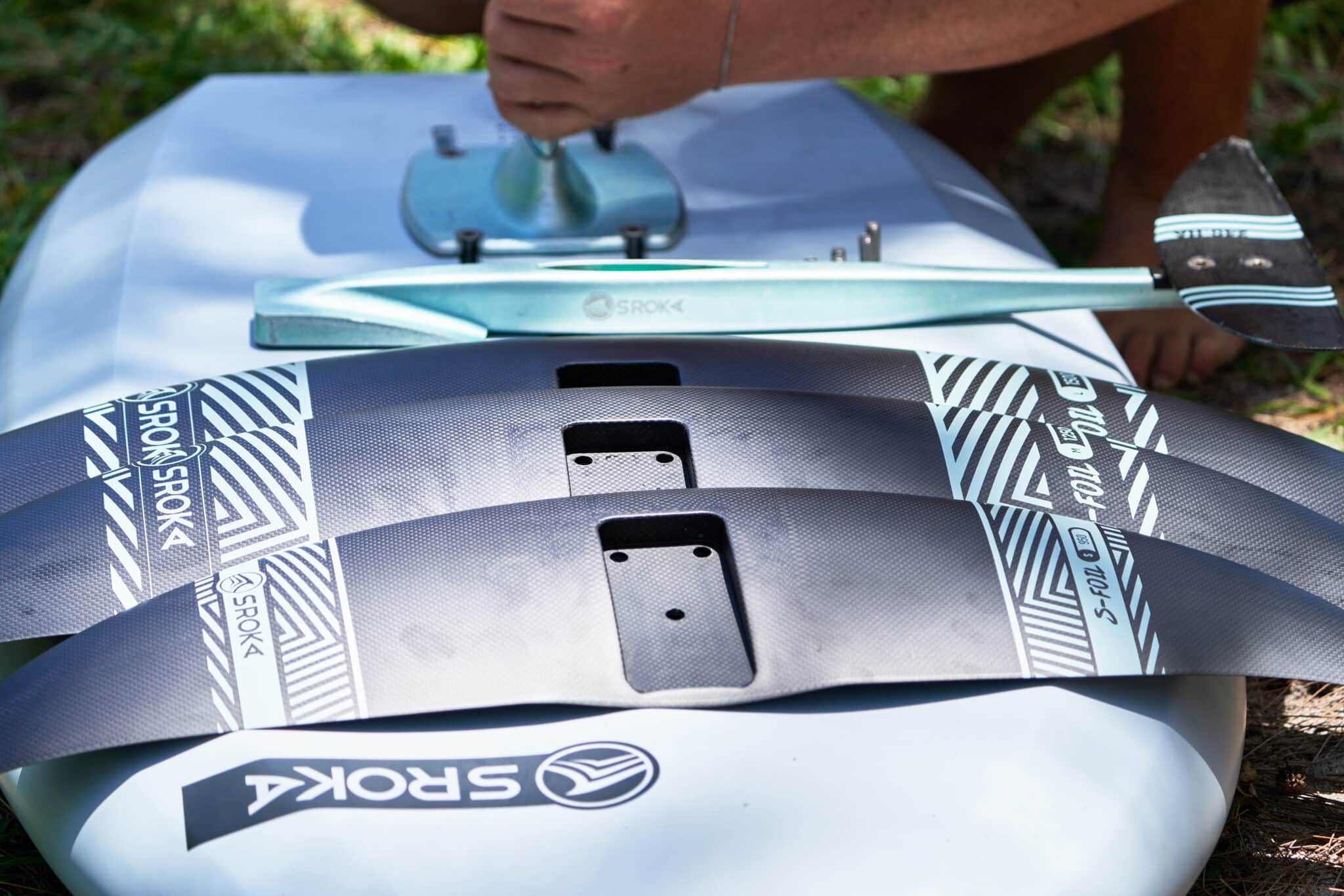
A foil works like an underwater airplane by generating a hydrodynamic lift force thanks to the speed it acquires. Composed of a mast, a fuselage, a front and rear wing (the stabilizer), the foil allows the rider to glide on the water. The wings are arranged parallel to the board, and can be controlled simply by foot pressure. The front wing has a curved shape on the upper part, and flatter on the lower part, which creates lift. The width of the wing, measured from the center of the leading edge to the center of the trailing edge, is called the "chord". While the length of the wing, measured from one end to the other, is called the "span", it's the same principle as in aeronautics.
What is the aspect ratio of a foil?
Before choosing between a high aspect ratio foil or a low aspect ratio foil, it is important to understand what aspect ratio is. The aspect ratio of a foil is a mathematical ratio that describes the shape of the wing. It is the ratio between the span of the wing (the distance between the two ends) and its chord (the distance between the leading edge and the trailing edge).
The higher the aspect ratio, the larger the wing's span is compared to its chord. This means the wing is longer and narrower. Conversely, a low aspect ratio indicates a shorter and wider wing.
There are 3 categories of aspect ratio for a foil:
- Low Aspect Ratio: These foils have a lot of chord and very little span. They are good foils for beginners but they quickly saturate in speed because of their large chord.
- Medium Aspect Ratio: This is a compromise between a high aspect ratio foil and a low aspect ratio foil. They correspond to our range of classic foils. These foils are accessible for beginners while maintaining a very good margin for progression.
- High Aspect Ratio: These high aspect foils have very little chord and a large span.
How to calculate the aspect ratio of a front wing?
There are two calculations to determine the aspect ratio of a foil's front wing:
- The most precise formula for calculating aspect ratio: wing span squared divided by the wing's lifting surface area. This formula takes into account variations in chord along the entire wing shape and allows for a precise calculation of the aspect ratio. However, this formula can be more complex to use as it requires knowing the wing's lifting surface area, which can be more difficult to measure.
- The simplest formula for calculating aspect ratio: wing span divided by wing chord. This formula is practical if you don't know the wing's lifting surface area. However, it does not account for chord variations and therefore only provides an approximation of the aspect ratio.
Choosing between a high aspect foil or a low aspect foil
Here are some key points to consider when choosing between a low aspect ratio foil and a high aspect ratio foil:
Speed
The speed of a foil is proportional to its drag. It is common to think that a high aspect ratio front wing is faster than a medium aspect ratio wing, but this is not entirely true. In fact, drag is generated by various elements such as the overall surface area, twist, and speed squared.
In summary:
- Drag is maximized by: speed, aspect ratio, thickness, and front wing chord.
- The more twist there is, the more stable the front wing is, but this reduces speed.
- The profile of the front wing also plays an important role: for example, if the maximum thickness (maître beau) is very advanced on the front wing, the foil will start earlier but will lose speed.
As you can see, the speed of a wing is not solely dependent on its aspect ratio; many other factors must be considered. We can still say that, as a general rule, with equal parameters (if only the aspect ratio is varied), a wing with a high aspect ratio will be slower than a wing with a Medium Aspect ratio.
Maneuverability
A low aspect ratio foil will be more maneuverable, which is ideal if you want to make sharp turns while maintaining great ease of control. The chord provides stability in the longitudinal axis. The aspect ratio limits maneuverability. Indeed, the higher the aspect ratio of a wing, the less maneuverable it will be.
Weight
The weight of the wing doesn't influence the overall performance of the foil, but we can still give you some pointers to help you see things more clearly.
Firstly, the weight of the wing is determined by the amount of material put into it. If the wing is foam-filled, its weight will be lower.
However, a high aspect ratio wing does not necessarily have significant thickness. Therefore, it will more likely be made of carbon (depending on the thickness), making it slightly heavier than a foam wing. Low aspect, thin wings, on the other hand, require a lot of rigidity and will therefore be heavier because they are constructed from 100% carbon. Conversely, a wing with a moderate but thick aspect ratio will be foam-filled. However, since the wing is larger, it will be just as heavy.
Skill level
Low aspect ratio foils are more suitable for beginner foilers because they offer better stability. However, they do not offer much room for progression. This is why, at Sroka, we have decided to design foils with a moderate aspect ratio (medium aspect ratio) that offer ease of learning, tolerance, but also excellent glide so that your foil can evolve with you.
Practice conditions
The choice of wing depends on what you want to do. For gliding on swells, a high aspect wing will be more efficient. Indeed, in most cases, foils with a higher aspect ratio generate more glide (fineness of flight) and allow you to fly longer without having to use the wing. However, with equal surface area, profile, and thickness, they will not go faster than a medium aspect.
If you are looking for control and maneuverability at high speed, a wing with a moderate aspect ratio will be more interesting. This is the case if you want to get into freestyle, for example.
At Sroka, our philosophy is to create products that perfectly meet your needs, while remaining versatile, rather than forcing you to adapt to the equipment. We are always open to comments and feedback on the Sroka sessions Facebook group, because it is above all for you and to share our passion that we design these foils.
If you still have questions about this, or for any other request, do not hesitate to contact us!