


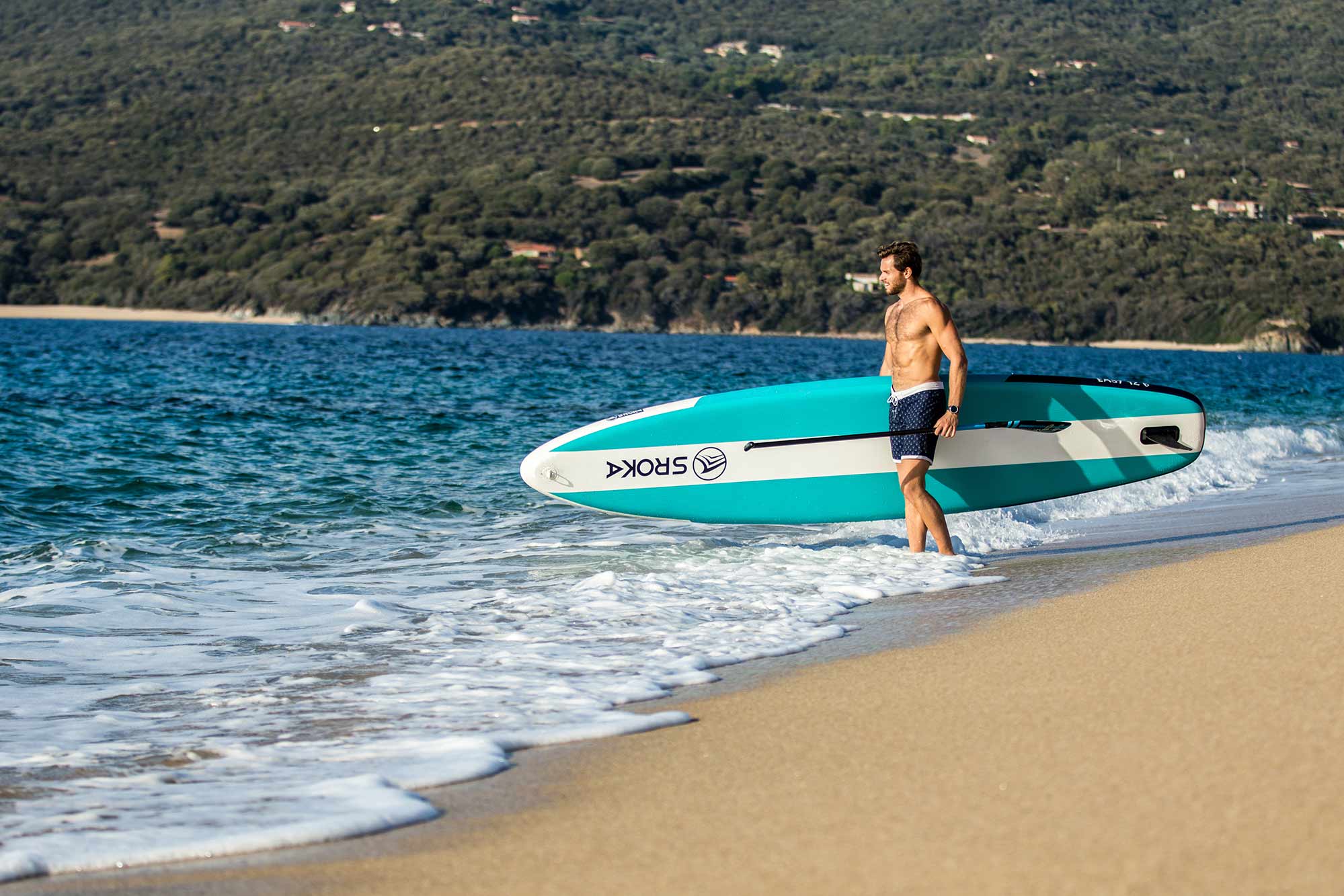
Whether it's for a first purchase, a gift, or simply a desire for change, it can sometimes be difficult to choose your stand up paddleboard. The offers are numerous and so are their characteristics.
You are probably wondering what would be the best choice between an inflatable paddleboard and a rigid paddleboard and what their differences really are. Both have their advantages and disadvantages; here is a comparison to help you choose your SROKA stand up paddleboard.

Transport
The first point of comparison, and not the least, is transport. There's no doubt about it, transporting an inflatable SUP is much more practical. This is, of course, due to the fact that it can be deflated and thus folded. This way, once stored in its carrying bag, it's super easy to take it to your favorite spots.
Let's consider public transport. It's much easier to use with your paddleboard in a backpack than with your board under your arm.

Robustness
Rigid SUPs seem more solid at first glance due to their material. This is not the case; from a solidity perspective, inflatable paddleboards win hands down. Inflatable SUPs are not afraid of impacts, unlike rigid SUPs. So don't panic if it gets hit by a paddle or scrapes a rock.
This solidity is explained by the construction of the SUPs: the materials used, the construction technique, the labor (handmade or not, time spent on design,...).
At Sroka, we build all our paddleboards with high-quality PVC and glue. These are the same materials used for professional rigid-hull inflatable boats. To guarantee additional durability for our paddleboards, we use fusion technology for the deck and hull. Finally, our paddleboards have 3 to 4 layers of PVC on the rails (depending on the model) to further reinforce the paddleboard. This ensures our SUPs are incredibly robust!

Performance
To begin with, generally, rigid paddleboards are a bit more stable, at the same size, than inflatable paddleboards. Moreover, rigid SUPs will also perform better in waves. This is due to their carefully designed shape which gives them more grip. Indeed, on a rigid paddleboard, the rail can be worked (the edges of the board), which is not possible on an inflatable paddleboard.
As for glide, it is slightly better on rigid paddleboards. However, with a well-constructed inflatable board, you can almost match the glide of a rigid board. Let's say that the inflatable paddleboard offers very high performance in 80% of intended uses. However, if you want to pursue paddleboarding at a high level, a rigid SUP is recommended.

Usage
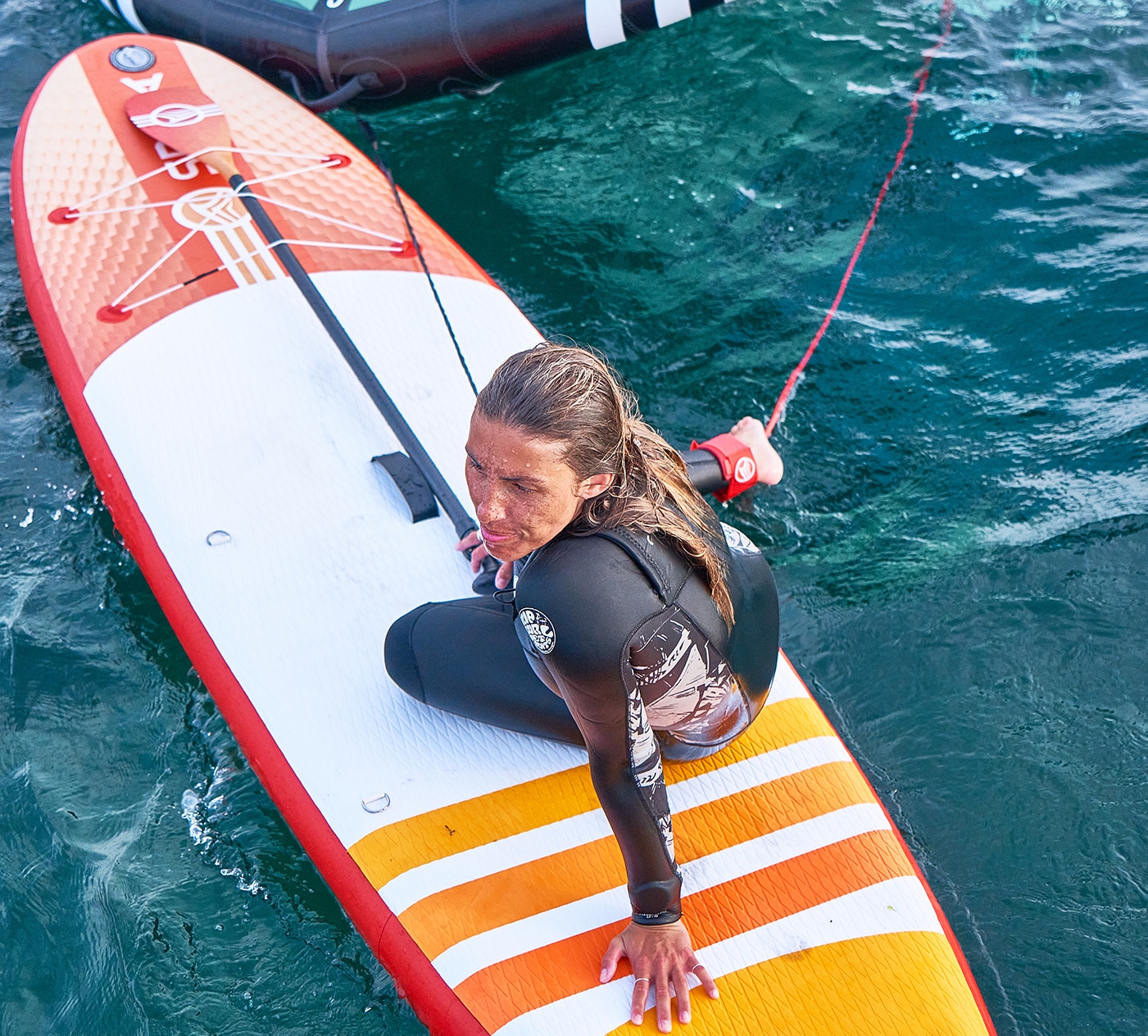
Inflatable paddleboards have the advantage of being easy and practical to use. These are paddleboards that can be perfectly suited for family use. Indeed, they can be used by all family members. One of the big advantages of inflatable paddleboards is their use by children. They can get on them without problems, with little risk of getting hurt in case of a fall, unlike a rigid paddleboard. There's also no need to worry about children damaging the inflatable paddleboard thanks to its robustness. Moreover, during a family outing, the car is often well-filled, so an inflatable paddleboard will be much easier to fit among your belongings.

Storage
As for storage, it obviously depends on the space you have available. It's clear that with a large garage or shed, you'll find a place for your rigid paddleboard. Nevertheless, from a practical point of view, the inflatable SUP remains much easier to store. Indeed, since it stores in a backpack, it doesn't take up much space. For those who don't want to bother deflating their paddleboard after every session, it's possible to store it inflated.
Price
Generally, an inflatable stand-up paddleboard will be less expensive than a rigid SUP.
Let's take the case of a high-end paddleboard: for a rigid paddleboard, you can expect to pay around €2,000, while a high-end inflatable paddleboard costs between €600 and €999. This is the case for Alpha paddleboards, high-end SUPs that offer exceptional glide performance.
In Summary
The differences between an inflatable paddleboard and a rigid paddleboard are numerous. However, we can conclude that 80% of the time an inflatable paddleboard is the most recommended option. Indeed, it is clear that it is the best option if you want an all-purpose SUP (leisure, touring, beach afternoons, yoga...). A good quality inflatable paddleboard will undoubtedly offer very good performance and excellent durability, while remaining at an accessible price. Not to mention transport and storage which are ultra practical and easy.
However, if the goal is to compete or achieve high performance in waves, a high-end rigid SUP will be preferred.
If you still have questions on this topic, or for any other request, do not hesitate to contact us!