



Flying with your Wing Foil equipment requires a bit of organization, but it's possible! In this article, you'll find all the precautions to take for a worry-free trip. If you plan to fly with your inflatable SUP, Kite, or Surfboard, these tips will also be very helpful!
1 – Choose the right airline to transport your wing foil by plane
To transport your wing foil by plane, you must first choose your airline carefully. Indeed, baggage policies vary greatly among airlines. In some cases, the price of baggage can be up to three times more expensive than the ticket price. The cost of excess baggage is therefore the first element to consider when booking. Sometimes, it is better to change airlines, even if it means paying a bit more for the ticket, but with lower baggage surcharges. We also advise you to inquire about the authorized baggage dimensions. Weight is not the only factor taken into account. Don't forget to pay close attention to restrictions regarding baggage length and width.
2 – Properly pack your wingfoil equipment
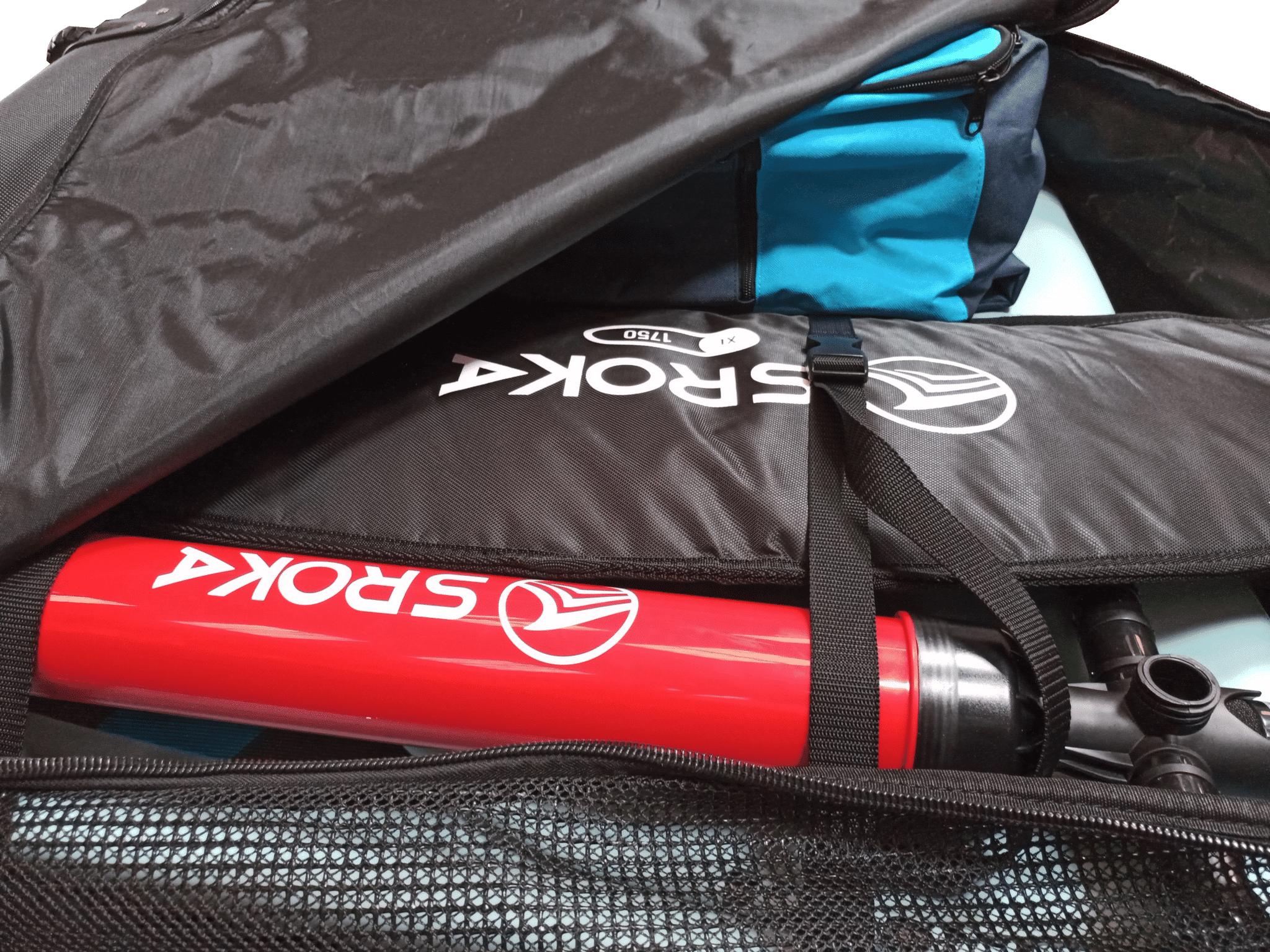
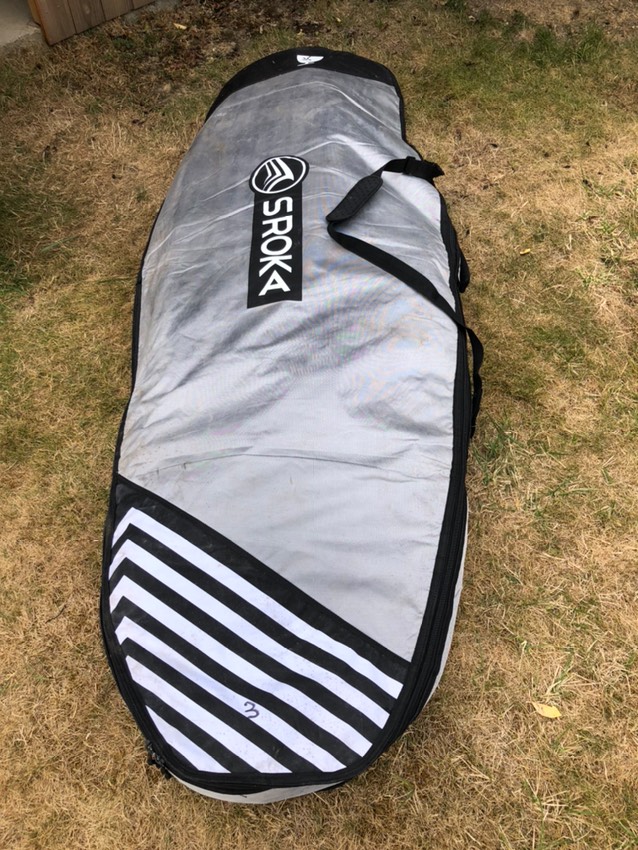
Before flying, you need to plan how to protect your wing foil set. Choose a board bag that is large and strong enough to accommodate the equipment. For your foil, disassemble it and store it in its protective and transport bag. You can then slip it into your board's large bag.
Don't hesitate to take one size up to fit your foil and wing inside.
Then, you need to properly pad the wingfoil board to prevent it from being damaged during the flight, especially if you are transporting a rigid board. We advise you to wrap the deck, edges, and rails of your foil board with protective foam. It is also important to brace everything to prevent the different elements from moving too much. Finally, distribute the weight as evenly as possible to avoid putting too much strain on one part of your bag and thus damaging the seams there.
Sroka transport bags are perfectly designed to protect your foil and board and facilitate transport.
3 – Flying with your Wing Foil: choose inflatable
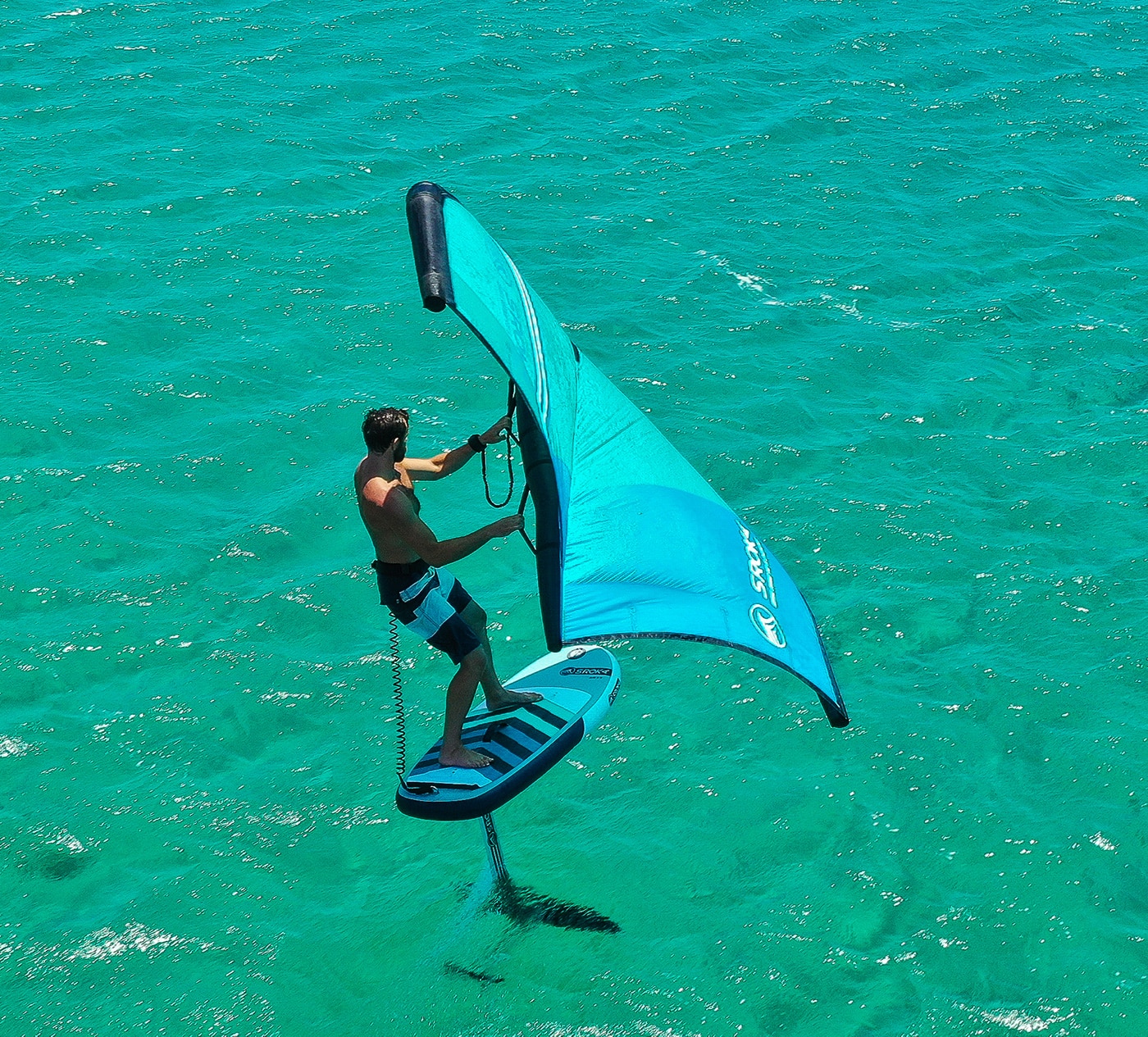
For air travel, the inflatable wing foil board is the perfect solution. Unbreakable, foldable, and compact for transport, the inflatable board offers only advantages.
Indeed, with inflatable, transport and storage problems are over! The board fits in a backpack.
At Sroka, we build all our inflatable boards with high-quality PVC, identical to that used for professional semi-rigid boats. This ensures unbeatable durability.
The rigidity of our inflatable wingfoil boards will also surprise you! Contrary to popular belief, well-constructed inflatable foil boards are extremely rigid. For example, on our Sroka V1 and V2 inflatable wing boards, we chose to integrate a carbon plate on the hull to achieve unparalleled rigidity and maximum performance.
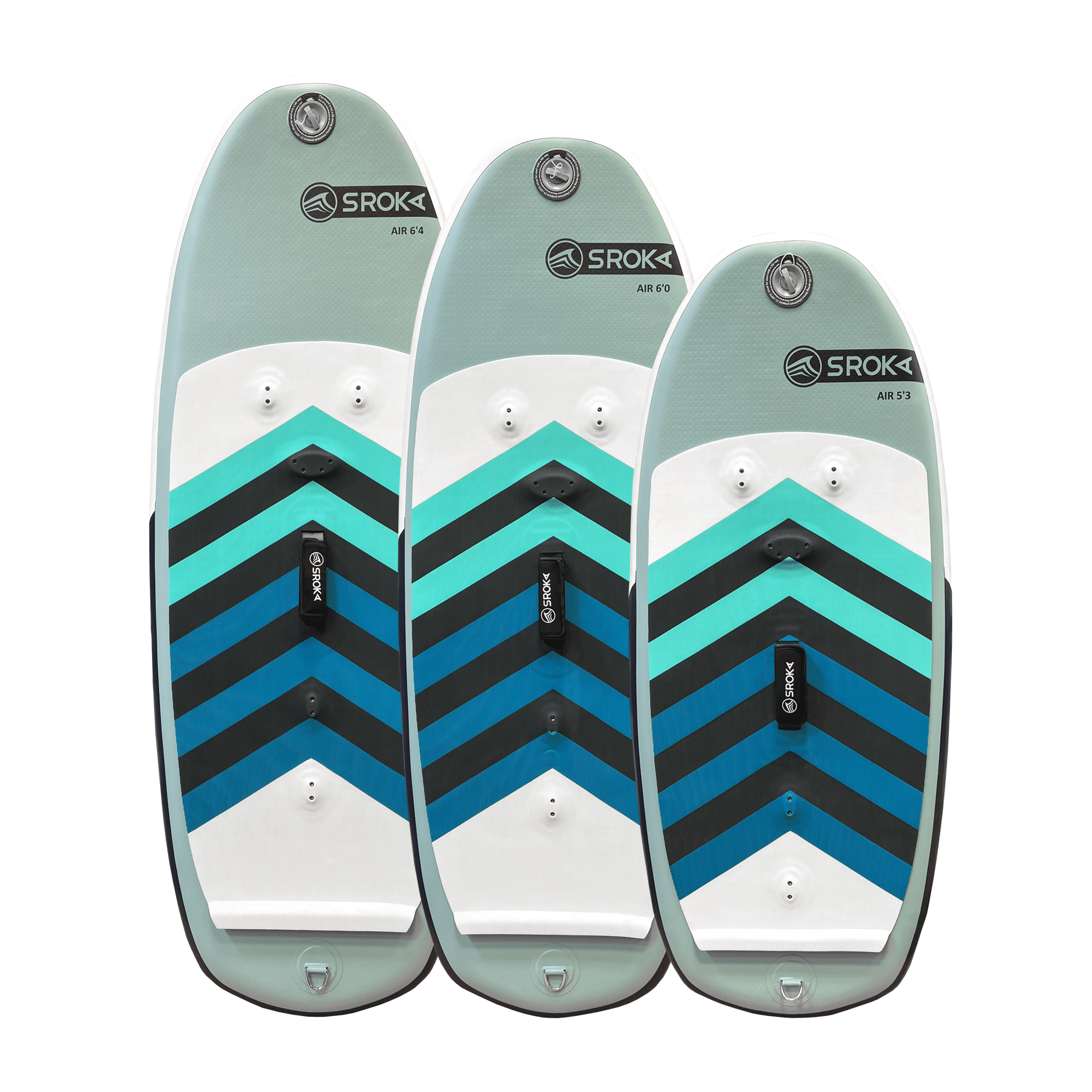
The choice of inflatable therefore seems obvious if you want to be able to take your wingfoil equipment everywhere with you. Its high shock resistance and ease of use and transport make it an essential ally. It is also very good equipment for anyone who wants to start wingfoiling simply.
Inflatable wing foil board V2: the ultimate travel board
The Sroka inflatable V2 offers superb performance and incredibly precise handling thanks to the carbon plate and foot strap inserts. The feeling on the water is closer than ever to a rigid board. It also allows for super pleasant recovery during touch-downs thanks to its rocker and immediate takeoff.
Built with reinforced PVC used on semi-rigid boats, it offers unmatched resistance and rigidity.
4 – Watch out for oversized baggage
Airlines generally set a maximum weight of 23kg for checked baggage (with some airlines allowing up to 32kg). In addition to this maximum weight, there are dimensions not to be exceeded. Beyond this weight and these dimensions, your luggage will not be accepted. It is therefore important to carefully check the dimensions and weight of your luggage, otherwise you may not be able to take it with you.
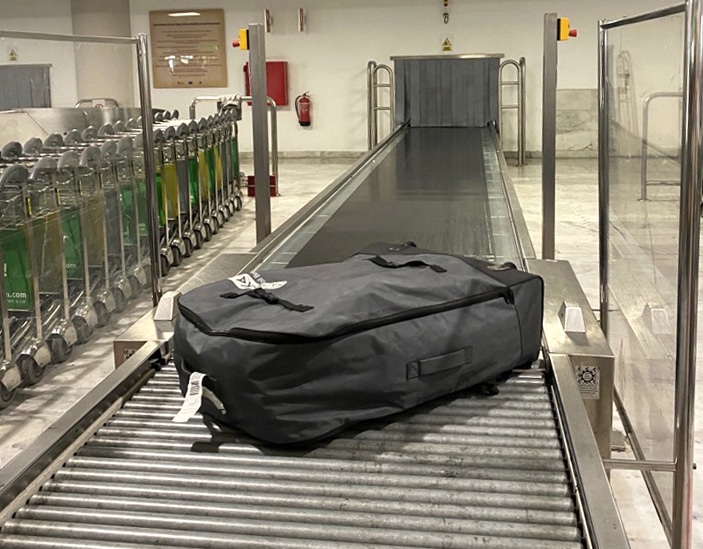
Only take the strict essentials if you don't want to pay too much. To do this, check the weather conditions before you leave and try to find information from local clubs. In any case, you will have to check in your oversized baggage at the counter. Most of the time, oversized baggage will need to be dropped off on a special conveyor belt. Try to locate this belt in advance to save time.
Upon landing, your baggage will also arrive on a different belt.
5 – Anticipate
We advise you to purchase your baggage in advance. It costs less than buying it at the airport during check-in. Normally, it is recommended to arrive early for your flight. This is even more important when you want to fly with your wing foil. Plan, if possible, at least 2 hours in advance. This will give you more time to manage your equipment at the airport. Airports are even more crowded during the summer, and traveling with your wingfoil can quickly become complicated. To make it through the airport easily, give yourself a good lead time before your flight.
PS: Remember your straps if you want to attach your wingfoil equipment to the roof of a car upon arrival.

6 – What to do if your wingfoil equipment is damaged?
To avoid any unpleasant surprises, it is advisable to check that nothing has been damaged directly upon exiting the plane. If an item of your wing foil equipment is damaged during your flight, make a claim immediately at the airline counter. Subsequently, you will be compensated in exchange for purchase and repair invoices, if you can provide them. It is advisable to do it on the spot right away. In general, the claim deadline is set at 7 days, but remember to check this deadline with your airline. After this period, you will no longer be able to prove that the damage was caused as a result of your flight. You may therefore have to bear the necessary repairs yourself.
If you still have questions on this subject, or for any other request, do not hesitate to contact us!