


Looking for thrills on the water, confrontation, and competition? Paddle racing is the discipline for you! Discover this demanding and exciting watersport, and learn more about techniques, equipment, and competitions.

What is paddle racing?
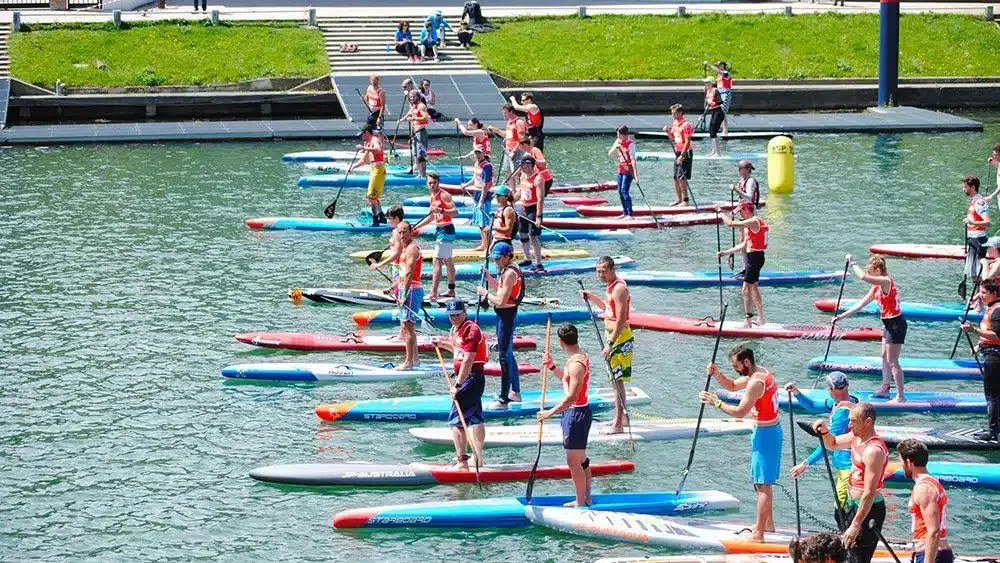
Paddle racing, or SUP racing (Stand Up Paddle Race), is a water race where participants, standing on a board, propel themselves with a paddle. The goal is to cross the finish line first. The start can be from the water or from land (this is called a beach race).
This discipline stands out from traditional SUP by its competitive nature and its emphasis on speed and endurance. Races take place over different distances and in various bodies of water, such as the sea, lakes, or rivers. The courses vary from short sprints to long races requiring endurance.
This booming sport attracts practitioners of all levels, from beginners to professional athletes. It combines watersports, physical challenge, and contact with nature. Whether you are looking for competition, pushing your limits, or simply enjoyment, paddle racing might be for you.
What are the types of paddle racing competitions?
Paddle racing offers a variety of competitions suited to all levels and styles. Here’s an overview of the main categories you might find:
- Long-distance races: if you enjoy endurance challenges, long-distance races (marathons) are for you. They can cover several kilometers, sometimes up to 20 km or more, depending on the competition. Here, strategy, managing physical effort, and resistance to fatigue are paramount. It’s a real test of mental and physical strength.
- Technical races: these competitions feature shorter but more technical courses, with tight turns, obstacles to overcome, or frequent changes of direction. They require great agility and technical mastery of the board.
- Sprints: these races are short and intense, perfect for thrill-seekers. They often take place over distances of 200 to 500 meters.
- Downwind: downwind races utilize tailwinds and waves for spectacular races. Participants literally surf on the waves, using the wind as an ally to gain speed. These competitions are often organized over long distances for maximum thrills.
- Relays: relays add a team dimension to paddle racing. In teams, each member must complete a part of the course before passing the baton to their teammate. These competitions are often very lively and strengthen team spirit.
The different types of race paddles
For paddle racing, choosing the right equipment is essential. It can determine a victory or a defeat, or make a session enjoyable or grueling. So, which paddle should you choose? What criteria should you base your decision on? We’ll detail the different types of race paddles.

Hardboards vs. Inflatables: Which choice for competitors?
Competitors looking for responsiveness often opt for a hardboard paddle. Made from composite materials like carbon, these boards offer smoother glide and better rigidity, resulting in optimal performance on the water.
Inflatable paddles, on the other hand, are valued for their practicality. Easy to transport and store, they are ideal for those who travel or lack storage space. Although slightly less performant in terms of speed, recent technologies have considerably improved their rigidity and durability, making them increasingly competitive.
Board shapes: narrow and long boards vs. wider boards
Narrow and long paddle boards are designed for adrenaline. Their narrow width reduces water resistance, allowing for faster glide. However, they require good balance and some experience to master.
Conversely, wider boards offer better stability, which can be an advantage on rough waters or for beginners in competition. While slightly slower, they allow for a calmer and more assured ride, especially on technical courses.
How to choose a SUP Race board?
When choosing your paddle race board, consider your goals, your skill level, and the race conditions. A well-suited board will allow you to paddle with confidence and maximize your performance on the water. Here are the criteria for making your choice.
Criteria based on skill level and type of race
Your skill level and the type of race you are participating in will influence the choice of board type. For beginners, a slightly shorter and wider, more stable board seems to be the ideal model for gaining confidence and balance, like a 12’6″ x 28″ wide. Advanced competitors, on the other hand, can opt for narrower and longer boards like a 14-foot board with a 27″ width.
The type of race is also important: short sprints require light and reactive boards, while long-distance races demand models that offer good glide and lasting comfort.
Board size and volume
The size and volume of the board determine its stability and glide capacity. A longer board (14’) is generally faster and offers better glide, ideal for long-distance races. The volume must match your weight and build to ensure good glide and control: a board that is too voluminous will be difficult to handle, and a board that is too small may not offer enough stability.

Choosing the tail and nose
A square and wide tail offers better stability and facilitates sharp turns, an advantage for technical courses, particularly useful in races with many turns or on choppy waters. In contrast, a narrow tail reduces drag and is faster, but requires much more balance.
Paddle race techniques
Mastering paddle race techniques is essential for improving your performance and maximizing your efficiency on the water. Discover some tips to perfect your style.
Position on the board
Your position on the board will influence your glide. Place your feet equidistant on either side of the central handle to maintain optimal stability. Your weight should be centered, neither too far forward nor too far back, to avoid slowing down the board. Maintain a relaxed posture, with a straight back and relaxed shoulders, to avoid unnecessary tension. To check proper positioning and its influence on your performance, use a GPS watch and compare your performance with different positions on the board. This will help you find the right placement depending on the conditions you will be navigating. Positioning may differ depending on the body of water.
Paddle grip
Properly holding your paddle is fundamental for efficiency. Hold the T-handle with your top hand, while the other hand grips the shaft. The arm holding the top of the shaft should be extended. You will push with this top arm. The hand holding the shaft in the middle will pull the shaft backward. It is your body that should move forward, not the paddle that should move. This technique will allow you to gain efficiency.
Different arm movements
There are several arm movements in paddle racing, each adapted to different situations. The forward stroke is the most commonly used to move forward. For turns, the reverse stroke, where you paddle backward, helps to pivot the board quickly. The "staggered stroke" is an advanced technique that allows you to maintain high speed while making subtle directional adjustments.
Breathing
Controlled breathing is essential to maintain your rhythm and avoid exhaustion. Inhale deeply and exhale through your mouth in sync with your paddle strokes. This helps stabilize your heart rate and provide enough oxygen to your muscles. By mastering your breathing, you can extend your endurance and stay focused, even during the most intense races. Paddle racing is a cardio sport like running or cycling. Therefore, good oxygenation is fundamental.
Our tips for a successful SUP Race
To excel in SUP Race, it's not enough to have the right board and the right technique. Comprehensive preparation, from physical condition to nutrition, is largely sufficient.
Physical and mental preparation
Good physical condition is the foundation for success in SUP Race. Incorporate specific training sessions, such as strength training for the arms, legs, and core, as well as cardio exercises to improve your endurance. Don’t forget the importance of recovery: rest and stretching are essential to prevent injuries.
Mental preparation is just as important. Visualize the race, imagine your movements and strategies, and prepare to stay focused, even when faced with unexpected events. Meditation or breathing exercises can also help you stay calm and manage stress.
Gliding and paddling techniques
Practice regularly to perfect your paddle strokes, improve your balance, and optimize your glide. Vary your exercises: work on sprints for power, long distances for endurance, and turns for maneuverability.
On the water, adopt an efficient posture and maintain a consistent rhythm. Learn to read water conditions to adjust your technique and take advantage of currents or waves.
Nutrition and hydration before and during the race
Your diet before the race should be balanced and rich in carbohydrates to provide you with the necessary energy. Avoid meals that are too heavy or difficult to digest. During the race, proper hydration is essential, especially if you are paddling in the sun. Bring a "camel bag" or an isotonic drink to compensate for the loss of fluids and minerals.
For longer races, plan easy-to-consume energy snacks, such as bars or gels, to maintain your energy levels.
Sroka’s range of race paddles: innovation and performance
At Sroka, innovation and performance are at the heart of our race paddles. Whether you are a competitor or an adventure enthusiast, our models offer you glide and durability.
The high-end Alpha Fusion Inflatable Paddle embodies adventure. This inflatable paddle will allow you to explore new horizons. Fusion technology, with thermal welding and three layers of PVC on the rails, makes it lightweight, rigid, and very resistant. Made with the most advanced dropstitch and professional PVC, it guarantees a smooth glide and total freedom on the water.
Ready to take on new challenges? Discover our complete range of race paddles, designed to push your limits on the water.
If you still have questions on this topic, or for any other request, do not hesitate to contact us!