


How is a carbon foil made?
Building a carbon foil is no small feat. There are different ways and techniques to manufacture a carbon foil. However, building a carbon foil requires technical expertise and know-how. In this article, we detail the different steps to explain how a foil is made.
It's important to differentiate between the construction of the mast and fuselage assembly, and the wings, which are technically simpler to produce. An excellent carbon foil is determined by its stiffness, glide, and therefore, the quality of the profiles used, the thickness (chord and general thickness), and the quality of the materials used.
From the outside, it is very difficult to compare a high-performance (stiff) mast with a flexible mast. One mast looks like another. However, the performance on the water can be totally different. Some carbon masts are less stiff than some aluminum masts. Yet everyone thinks that a carbon mast performs better.
Let's delve into the details of carbon foil manufacturing to better understand and choose your carbon foil.
What are the different steps to manufacture a carbon foil?
Design
The design of carbon foils is a crucial step in the manufacturing process of a carbon foil.
- To work efficiently, the foil project manager provides the most precise specifications possible and defines the specific characteristics they are looking for to create this carbon foil.
- Then engineers use advanced 3D software to precisely design the foils. This software determines the precise characteristics of each profile and allows for choosing the best profile in accordance with the specifications.
- Finally, in a third step, they model the different parts of the foil: the wings, the fuselage, the mast, and the plate, and above all, optimize their shape and interlocking by refining certain parts or thickening certain potentially fragile areas.
Thanks to these simulation tools, engineers simulate the behavior of the foil in different conditions and observe the potential drag of each part of the foil, determining the potential speed of each winglet or stabilizer.
This step is fundamental for saving time during subsequent prototyping. It allows for making informed decisions during the foil design to achieve the best possible performance.
The characteristics of a carbon mast for speed versus jumping are not the same. The stress constraints are different. Therefore, the mast shapes are adjusted according to the needs.
Generally, if glide is desired, the drag of the mast, fuselage, and wings is reduced. To reduce drag, the thickness and chord of the mast are decreased, and the thickness of the fuselage is refined while being as stiff as possible. The complexity of a good carbon foil lies between excellent fineness and maximum stiffness.
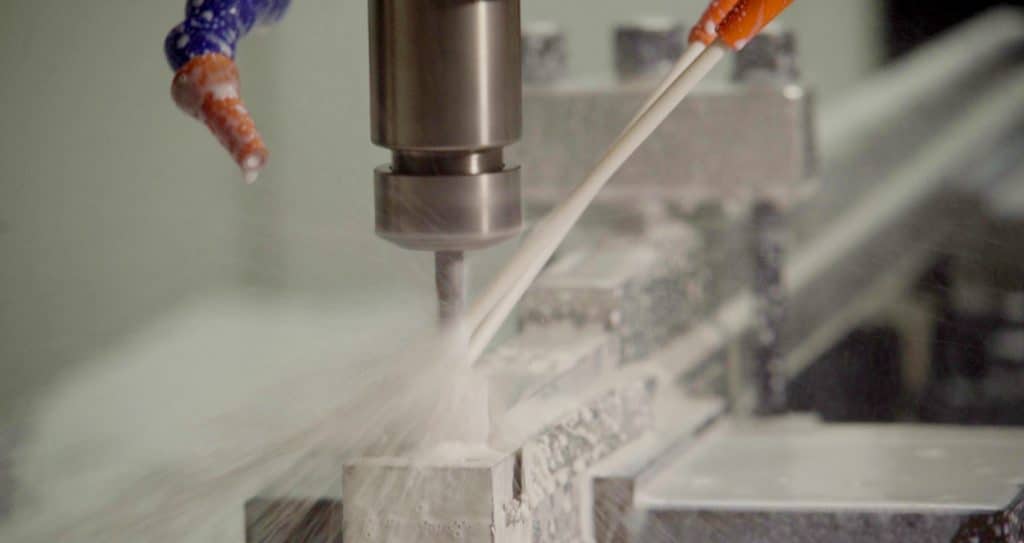
Prototyping / Mold Machining
Once the engineer and project manager have found a compromise on the general shape and performance of the foil, the design phase begins with the production of a prototype.
This step involves machining the mold for the different parts of the foil. If the design is well executed, the prototype is merely a confirmation phase. Otherwise, the 3D modeling must be redone.
Machining is performed with high precision using a CNC, a machine that cuts aluminum or steel (molds can also be made from wood or "lab" in some cases for rapid propagation).
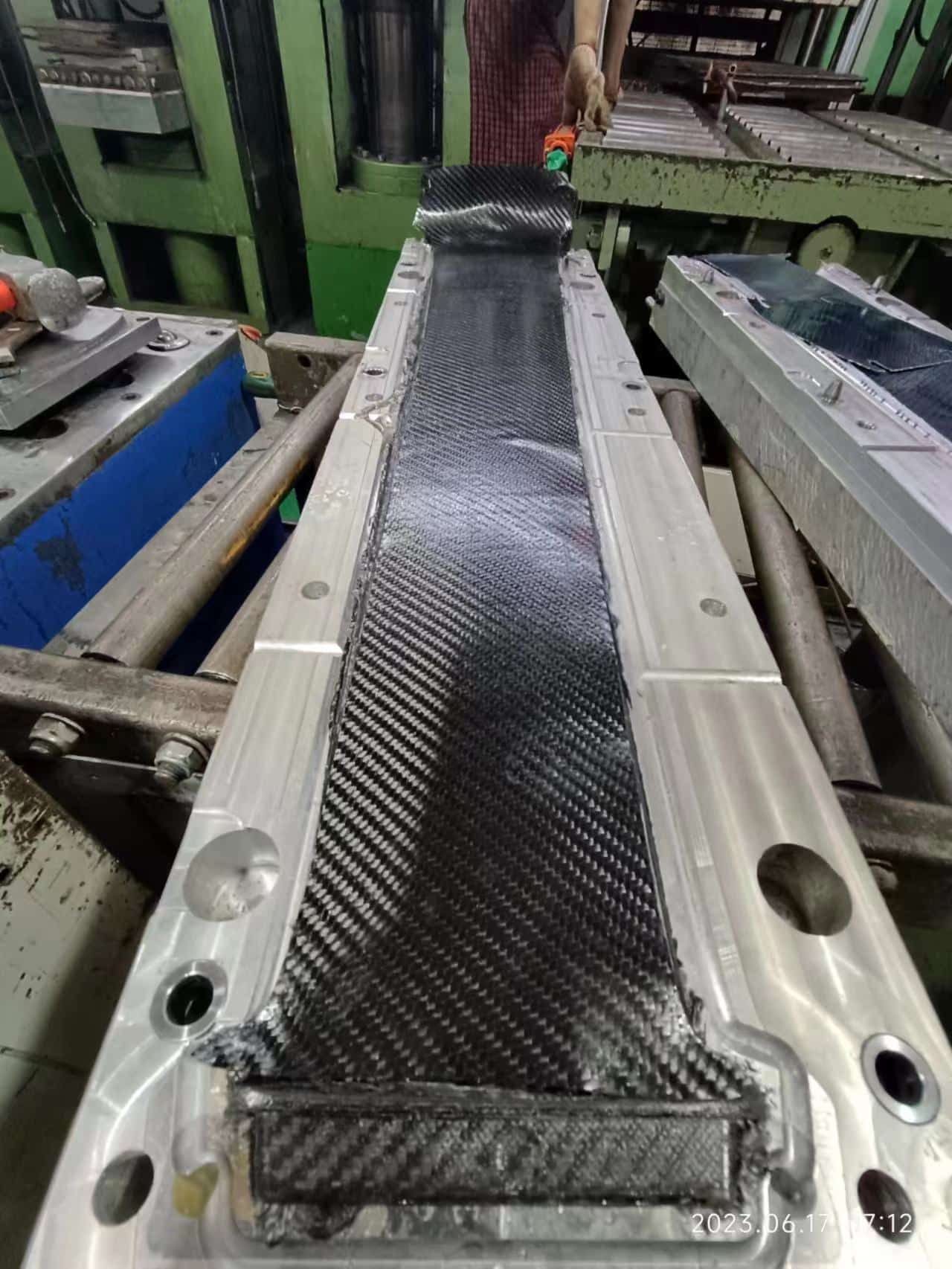
Positioning of carbon fabrics in the mold.
Once the mold is finished and polished, another machine laser-cuts the carbon fabric. Increasingly, prepreg carbon (pre-impregnated during manufacturing) is used. This method offers several advantages: it allows for the ideal amount of resin on the carbon, prevents personnel from working with toxic resin, and provides significant time savings and precision.
After this step, the fabric pieces are placed in the molds, orienting them in specific ways to achieve more strength in certain areas or more stiffness in others. Once the mold is closed, it is heated and compressed with a hydraulic press.
The carbon fabric pieces are oriented in the molds in specific ways to achieve more strength in one area or more stiffness in another. The angle of positioning of the carbon fabrics, the quantity, or the thickness influence the mechanical resistance of the part. This is one of the key steps in manufacturing a carbon foil. If the factory does not possess or has little of these fundamental techniques, then the part will never have the desired characteristics.

Curing
Once the mold is closed, it is heated and compressed with a hydraulic press (several tons). Sometimes, for certain parts, an autoclave is used, which further increases the pressure on the entire part. However, this requires a lot of labor, time, and infrastructure. Increasingly, large presses are used to apply several tons to all the different parts of the molds.

Finishing
Once cured, excess material is removed. Each piece is sanded by hand or with a robot to obtain a smooth surface.
Finally, holes are drilled for inserts or screws. A varnish is applied. The piece is then tested in all directions to check for any defects.
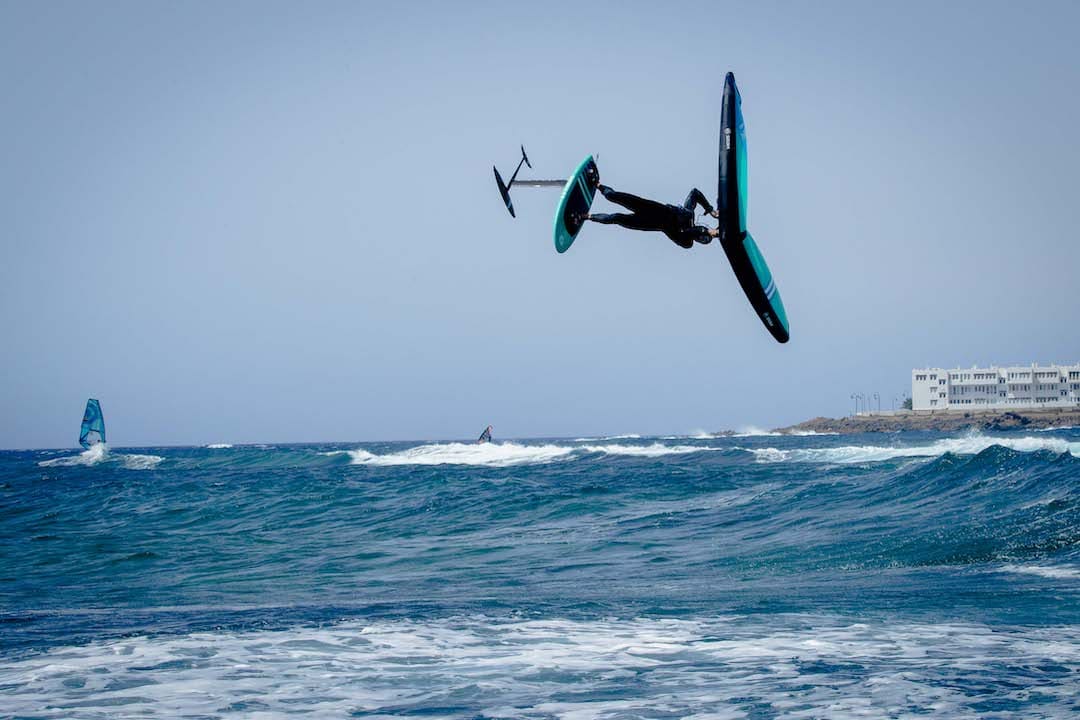
Testing Phase
If everything meets the specifications, the desired on-water performance (thanks to tests in different wind, swell, and rider conditions), and withstands mechanical stresses in the workshop, then the industrialization phase can be launched, where each step is optimized to mass-produce foils.
In conclusion.
Producing a carbon foil requires a lot of research and time to achieve a high-performance and durable product. Some brands want to accelerate these different steps to produce quickly and create marketing buzz.
Our strategy is quite the opposite. We prefer to take the time to ensure each step is perfectly executed to produce a high-performance and durable foil. This requires a lot of patience, time, and energy. But it allows us to create an exceptionally powerful and robust carbon foil.