


How to Surf Foil
Surf-Foiling emerged in the 2000s. Among the pioneers were big names like Laird Hamilton, Dave Kalama, and Paolo Rista. Originally, it was just a way to fly above the water while tow-surfing in large swells. In 2016, Kai Lenny caused the number of practitioners to explode. The discipline immediately conquered Hawaiian, Australian, Californian, and Brazilian surfers. The level soared. Gradually, surf foiling arrived in Europe, and in France. The advantages of foiling are to increase the number of possible sessions, practicable spots, and offer new sensations. In this article, we will explain how a Surf Foil works, its different parts, and we will detail the importance of the front wing's characteristics.
This article explains how a Foil works for the following sports: Surf Foil, SUP Foil, Downwind SUP Foil, and Tow-in Foil (tow-in waves).
Composition of a Surf Foil
The Foil is composed of the following elements: mast, fuselage, front wing, and rear wing (stabilizer).
The mast is attached perpendicularly to the board and the fuselage. Thus, the wings are parallel to the board. In this way, it is possible to act on the foil by simply pressing with the feet.
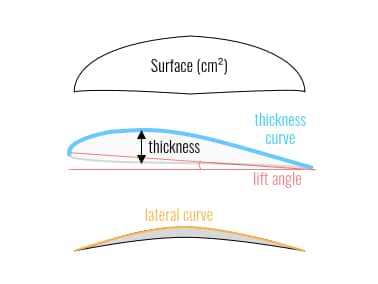
The front wing has a curved upper part (extrados) and a flatter lower part (intrados). The front wing has a rounded leading edge that quickly thickens, then tapers towards a thinner trailing edge. "Chord" refers to the width of the front wing (the distance from the center of the leading edge to the center of the trailing edge) and "span" refers to its length (the right/left extremity).
Finally, the stabilizer has a shape quite similar to that of the front wing, with equivalent properties. However, it has a reduced surface area and a different profile.
Principles of Foil Operation
The operating principle of a surf foil comes from fluid dynamics. The front wing is pulled upwards when it moves forward, because the water molecules passing over the extrados of the front wing accelerate to catch up with the water molecules that passed over the intrados (which is shorter because it is flat). The acceleration of molecules on the upper part of the wing creates a depression, and the deceleration of those on the lower part creates overpressure. The consequence is an upward suction effect. The higher the speed of the foil, the more the foil is "pulled" upwards (with equal profile and angle).
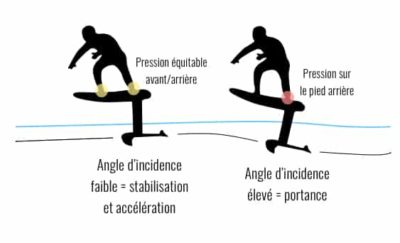
We can easily compare the operation of a foil to that of an airplane, which has roughly the same shape if we omit the mast and the board. The speed of movement creates lift and allows it to take off. The difference in angle given to an airplane's wings allows it to stabilize in the air. A decrease in travel speed reduces lift and thus allows an airplane to land (at a constant angle of incidence). Finally, to change the foil's angles of incidence, the rider can, by alternating pressure on the front or rear foot, make the foil go up or down or stabilize it. It's all about dosing the pressure on the supports.
To take off, the speed must be high enough to create a lift force on the front wing. Combined with a high angle of incidence (thanks to pressure on the rear foot), the board takes off. To stabilize, pressure on the front leg reduces the angle of incidence, thus the lift, and accelerates.
The swell as an energy source
While an airplane uses the suction force of air molecules, a foil relies on the suction of water molecules, which have a much higher density than air. This density will further increase the lift (the upward suction effect) of the foil with speed.
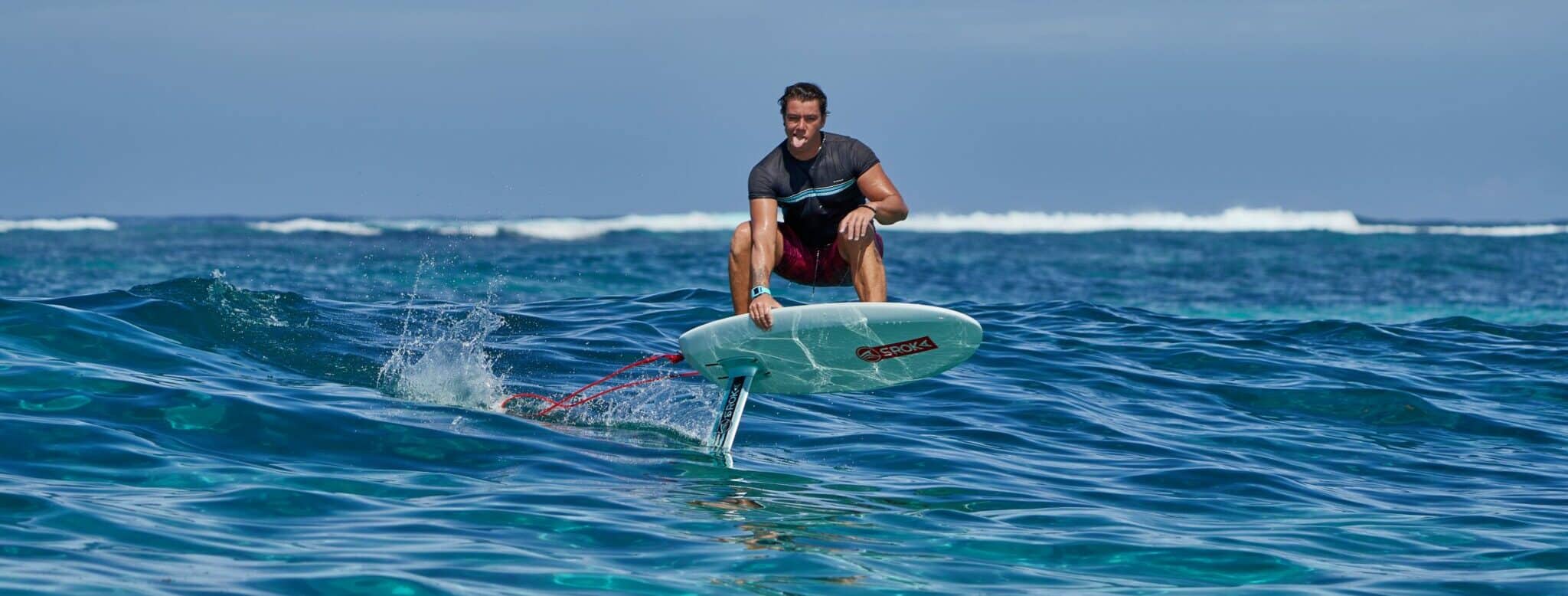
In this article, we are talking about Surf Foiling, which means using water movements (waves, swell, troughs, boat wakes) to fly. In contrast to wind, which allows the use of a constant external force to the water in kite or windfoiling, the water movements of waves are variable forces with precisely localized lift zones on the water surface.
HOW FOIL CHARACTERISTICS VARY
When dealing with fluid dynamics, every detail or change made to the Foil is important and affects its characteristics. We looked at 4 major characteristics of a Surf Foil to explain which parameters influence them (there are many others, but we won't cover them in this article).
Lift
The lift of the Foil, or the upward suction effect, varies mainly according to the size of the front wing, its thickness, its profile shape, and its angle of incidence. The larger the surface of a wing with thickness, the more lift it generates. The more positively high the angle of incidence, the more lift it generates but the more it brakes the foil. Conversely, the lower these parameters, the lower the lift. With equal surfaces, angles, and thicknesses, two different profiles will result in different lifts and speeds. Surface area as the sole reference parameter is not sufficient to determine whether a foil has a lot of lift or not.
Indeed, the specificities of the front wing's profile will affect the overall lift of the Foil. This can include the upper curve of the extrados or the lateral curve, which goes from one side to the other in the direction of the length.
Finally, other external elements influence the overall lift of the Foil, such as the rider's weight, the board's weight and size, and of course, the power of the waves.
Speed
In parallel with the Foil's lift, its speed depends on the surface area and angle of incidence of the front wing. A front wing with a small surface area and/or little thickness will offer more speed, and a front wing with a smaller angle of incidence will also be faster.
Next, the specificities of the wing's shape for the same surface area affect the Foil's speed. A wing with less chord and thus more span will be faster. Moreover, the wing's profile (parameters mentioned above) is very influential on speed and the ability to accelerate.
Finally, as mentioned earlier: the rider's weight, the board's size and weight, and also the power and speed of the swell are external factors that strongly condition the Foil's speed.
Stability
A relatively slow Foil with a lot of lift (i.e., large surface area, wing thickness, and a bit of angle of incidence) will be more stable than a less lifting and faster foil.
The main elements that allow the Foil to gain stability are the length (chord) of the front wing, its thickness, and the surface area and span of the rear wing, also called the stabilizer.
The rear wing (stabilizer) plays its full role in stabilizing the Foil. Its lift is inverse to that of the front wing and thus slightly counteracts the front wing's lift by creating opposing forces to stabilize the entire foil.
External factors influencing the stability of the Foil are necessarily the rider's weight and technical skills, but also the type of body of water on which Surf Foil is practiced. A choppy body of water with current, eddies (backwash), and breaking waves will be more unstable because these elements disturb the depressions and overpressures that generate the upward attraction of the Foil (like an aerial disturbance when in an airplane).
Maneuverability & Glide
While a Foil with little lift (i.e., small surface area, angle of incidence, and thickness) is faster and indirectly more maneuverable, this is not the only parameter that affects its maneuverability.
The major element concerning maneuverability remains the shape of the front wing, particularly the lateral curve, which, when accentuated, allows for easier turning with the Foil. A high lateral curve will result in a more maneuverable but slower foil because for the same lift surface area (projected shadow on the ground), the total surface area will be larger and will create more drag. Conversely, a flatter lateral curve will turn less but will be faster.
Span also influences maneuverability. The larger the span, the longer the foil will glide, but the less tight the turns will be. It's a bit like a longboard versus a shortboard.
IN SUMMARY
The overall shape and dimensions of the Foil vary these four characteristics:
- The larger, thicker, and higher the angle of incidence of a wing = the more lift it generates and the slower it goes
- The smaller a wing, with little thickness, little angle, and little chord relative to its span = the faster it is
- The more span a wing has, the longer it will glide and thus the more efficient it will be for pumping.
- The larger and thicker a wing with a longer chord = the more stable it is
- The smaller a wing, less thick with more curve = the more maneuverable it is
- The more span a wing has, the less maneuverable it will be.
OUR S-FOIL DEVELOPMENT CHOICES
When we developed our S-Foil, we spent several months of R&D and testing to achieve the best compromise of accessibility, versatility, and performance.
Accessibility
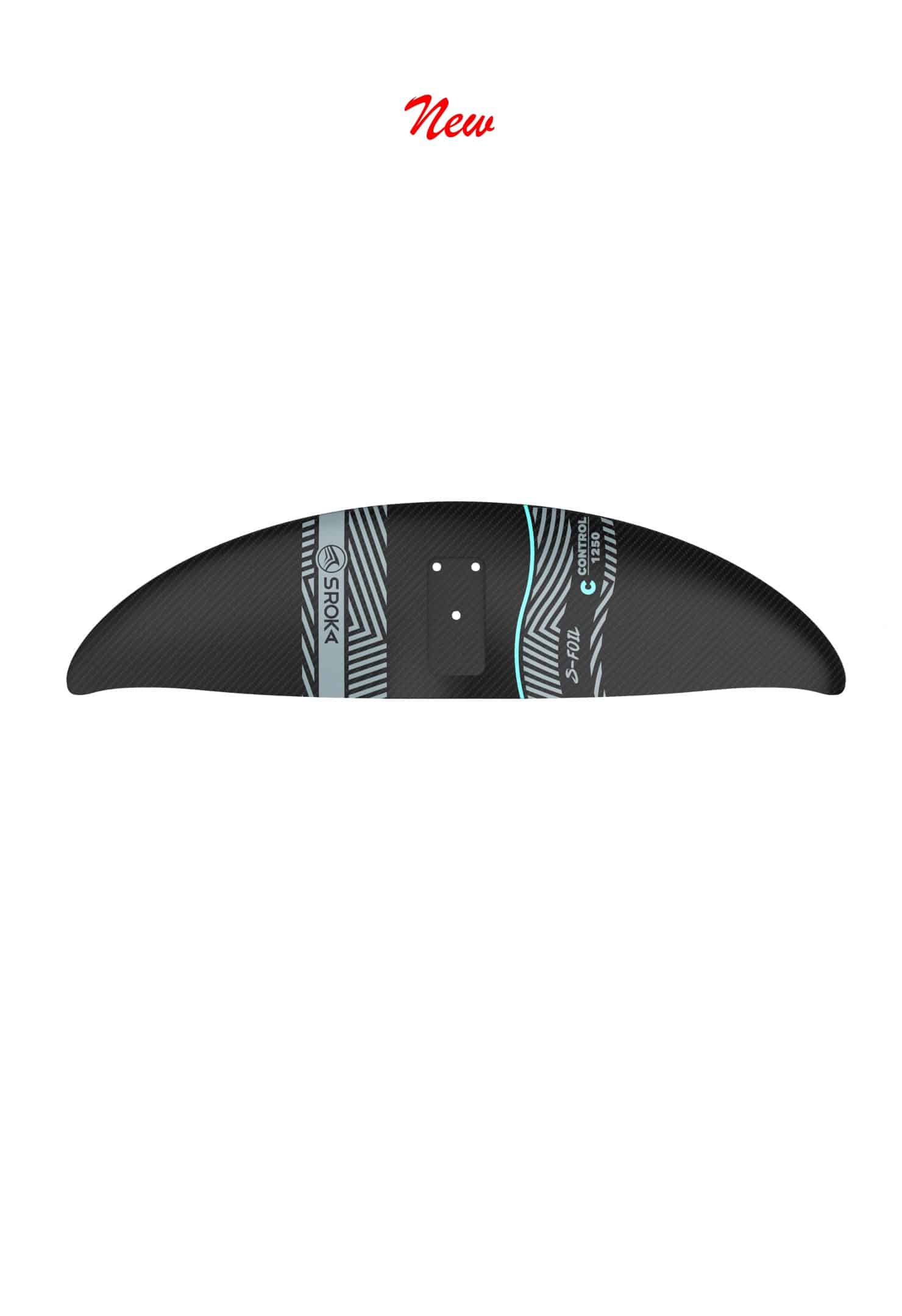
Our vision is the democratization of board sports, both through offering easy-to-learn and progressive products and through their accessible price on the market, all while maintaining excellent overall performance. We have particularly worked on our S-Foil control with an easy wing profile, tolerant of errors, and stable to support every rider as easily as possible.
To achieve this, we increased the surface area, chord, span, and thickness of the front wing compared to our old models to gain lift and stability. We also redesigned the stabilizer by adding surface area, lateral curve, and a better thickness curve on the surface to maximize glide.
Versatility
Given the abundance of equipment available today, the choice of versatility was a natural one. Versatility in terms of type of practice (Wake, Wing, Surf, Kite, etc.) but also in terms of conditions (wide wind ranges and all types of waves).
In this context, we recommend the HA range and particularly the 1190 L or W, which will allow you to wing foil, but also to be comfortable on the surf foil and to have perfect tolerance for both sports.
Performance
While the choice of accessibility and versatility does not always align with performance, we have worked on the profile and shape of our wings to find a compromise that allows for easy pumping, maximum glide, and maneuverability.
By adapting the length of the fuselage and the size of the stabilizer, we can make a foil much more maneuverable and thus achieve a compromise between glide, ease of pumping, and foil maneuverability. This is what we have done in the UHA range; combined with shorter fuselages, we achieve an almost perfect compromise.
THE INFLUENCE OF THE BOARD ON FOIL BEHAVIOR
Length
The length of the board will influence your Surf Foil practice in two ways. A longer board with more volume makes it easier to catch waves for takeoff. However, a long board reduces the foil's lift once in the air compared to a short board due to the extra weight at the front.
While the choice of accessibility and versatility does not always align with performance, we have worked on the profile and shape of our wings to find a compromise that allows for easy pumping, maximum glide, and maneuverability.
By adapting the length of the fuselage and the size of the stabilizer, we can make a foil much more maneuverable and thus achieve a compromise between glide, ease of pumping, and foil maneuverability. This is what we have done in the UHA range; combined with shorter fuselages, we achieve an almost perfect compromise.
Width
The width of the board, like its length, can facilitate paddling into waves for takeoff. However, once in flight, the rails of a board that is too wide risk touching the water surface during turns and slowing the rider down.
Weight and Volume
The weight of the board negatively impacts the board's lift. The heavier the board, the more the foil's lift will be counteracted (opposing force). However, an increase in volume allows for better take-off on waves.
Shape
One might rightly assume that the board's shape matters little once in the air, but several details improve the flying experience: the rocker at the front and the bevel at the back and sides to avoid touching the water while flying. Furthermore, other parameters such as the rounded nose shape and the concave on the deck and under the hull help improve paddling comfort and efficiency in catching waves.

OUR SELECTION OF SURF/SUP FOIL BOARDS
Fast Flyer Surf Foil Board
Our Fast Flyer surf foil board is designed for easy and high-performance surf foiling. We opted for comfortable dimensions of 4’6 (140cm) long by 21” (55cm) wide. With a rounded nose and a compact overall volume, it's the perfect size compromise for learning, progressing, and performing in all conditions.
To facilitate paddling, we have slightly recessed the deck for more comfort with a progressive rocker on the nose. We designed the hull with a double concave to maximize glide at low speed, allowing you to catch waves that haven't yet broken. The entire deck of the board is covered with pads for comfort and durability. Once in flight, the beveled rails and cut tail prevent touching the surface during turns and when the user is pumping. Its reduced length makes it very responsive and stable in turns, in addition to reducing inertia when pumping.
The Elite SW range
The new SROKA Company SW range establishes itself as the benchmark in high-performance surf foil, designed for all levels, from beginner to expert. Its full carbon sandwich construction (deck and hull) guarantees exceptional rigidity and strength, thus offering maximum responsiveness and liveliness, essential for pumping and dynamic turns. Three sizes are available (4'4 - 32L, 5'0 - 40L, 5'6 - 50L), allowing each rider to find the board adapted to their size and ambitions, while ensuring easy handling and rapid progression.
The innovative shape, with increased length and a narrower tail, facilitates paddling, accelerates take-off, and maximizes maneuverability without risk of touching during tight turns. The SW stands out for its versatility: it is 70% surf foil oriented and 30% wing foil, ideal for those who want to explore both disciplines with a single high-performance equipment. Its sleek design, matte finish, and elegant lines attest to the attention to detail and excellence of the brand.
Reinforced US rails ensure optimal rigidity and precise foil adjustment, while the full pad offers superior comfort and grip. Developed and tested by Bruno Sroka and his team, the SW benefits from high-level expertise, guaranteeing quality, durability, and pleasure on the water.
The SW range is the promise of unforgettable sessions, facilitated progression, and unbeatable value for money in the premium surf foil market.

SUP Foil and Downwind Range
We developed the DW range to combine performance and versatility. Our DW 7’2 boards allow for Wing Foil, Sup foil, and Downwind practice. A long and narrow board will have more glide and will catch even the smallest swell very early. The longer and thinner the board, the more it will glide, but it will lose some maneuverability. The DW 8’3 range will be more oriented towards Downwind on swell lines and Sup foil on very gentle waves.