



To improve and fully enjoy your Surf Foil session, pumping in Surf foil will be THE technique! This key step will allow you to enjoy foiling to its full potential, and to evolve in practice by imitating professionals. Remember Kai Lenny's video in Fiji in 2016, connecting 2 waves and surfing an endless (and almost non-existent) lagoon swell all the way to the beach. So we wanted to share with you some tips to learn pumping and develop your technique. Thanks to our tutorial, the pumping technique will no longer be a secret for you!
If you want to learn how to do a dockstart in foil, i.e. to start foiling from a pontoon, we have written a dedicated article on this subject.
You are new to surf foil and want to learn more about the practice. Foiling has rapidly developed and become democratized, and the technique of pumping is increasingly practiced. This is notably due to the evolution of the foil equipment offer on the market, which makes pumping increasingly easy and accessible.

How do foils work?
Foils are hydrodynamic wings that allow boards to glide above the water with less resistance. They are used in various disciplines such as wingfoiling, wakefoiling, paddle foiling, dockstarting, etc. Their operation is based on the principle of lift and balance.
A foil generally consists of a front wing, a mast, and a stabilizer. The front wing, also called the "front paddle" or "winglet," is the main part that generates lift and raises the board above the water. It is attached to the mast, which connects the front wing to the board. The stabilizer, located at the rear of the mast, helps maintain the balance and stability of the foil.
During a wingfoiling session, for example, the rider uses a wing to propel themselves. By pumping the wing and generating speed, the foil creates lift and allows the board to take off from the water. The rider can then glide above the water by controlling balance and direction through inclination and body movements.

Pumping operating principles
First of all, a few reminders: a foil’s operation is similar to that of an airplane, and requires speed to create lift energy that allows for movement. For more information, we invite you to consult our explanatory article on how foils work. The pumping technique will then allow you to mechanically produce this energy, using your own movements. An adapted pumping technique and maintaining good speed will allow you to expend as little energy as possible when you ride by pumping in Surf Foil.
How to pump on a surf foil: Step-by-step technique
1. Timing
The first step is to exit the wave at the right time. When you’re starting out, it’s best to exit when the wave is as flat as possible. As you progress, you’ll be able to exit when the wave breaks or even pass over the foam of the wave you’re on. The closer you exit to a critical zone of the wave, the greater the turbulence and water movement will be. These movements can be complicated to handle on a foil and cause many imbalances.
2. Trajectory and initial speed
This initial phase is one of the most important, if not THE most important, when you are learning to pump. The challenge here is to maintain as much speed as possible and to start pumping at the right moment. Too sharp a turn will make you lose speed and you will have to redouble your efforts to give your foil momentum again. You will therefore lose energy and risk falling because balance is more precarious at low speed. Pumping is also more technical at reduced speed because it requires a larger and more precise movement to restart it.
The ideal is therefore to lengthen your curve. To do this, you can exit the wave by "following" it, heading towards the channel. This will also allow you to take advantage of the wave's energy a little longer. You can then start pumping and gradually turn towards the peak. This lengthening of the curve will allow you to maintain good initial speed and start your pumping in the best possible conditions. Another tip that can help you initiate your relaunch: try to be as high as possible on your mast before engaging the pumping phase. In other words, try to position your foil's wing as close to the surface as possible. It is indeed in this position that your foil will have the least drag.
3. The Technique
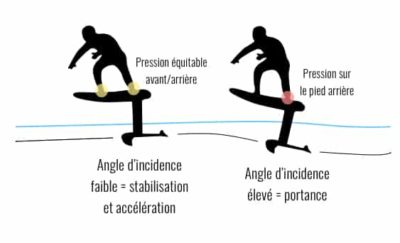
Let's now talk about the pumping technique itself. It's important to know that the faster you go, the easier the movement will be and the less tired you'll get. Pumping isn't just a series of leg muscle flexions and extensions. In fact, you need to generate forward momentum to "create" speed with your foil. Pumping is actually a combination of two movements: a succession of body unweighting and pressure combined with a sequence of delayed flexion and extension of the front and back legs.
The diagram below represents the movement of the foil and its orientation underwater. When they start pumping, many people tend to lack coordination and therefore fail to generate the necessary speed for effective pumping. A simple simultaneous push/unweighting movement of your front and back leg will significantly slow you down without moving you forward.
A slight intentional imbalance forward will allow you to accelerate more easily and give your foil that particular movement. This notion of imbalance is important; it's what will give you speed and forward momentum.
4. Coordination
The key to pumping lies in the coordination between your lower limb movement and weight transfer. Your front and back legs will alternately perform a flexion then extension movement. When the back leg extends (steps 1 and 2 in the image below) your front leg will flex slightly to allow your foil to rise. This is the push phase. You will then push on the front leg while trying to weigh yourself down and use your weight to create more speed and direct your foil downwards (steps 3 and 4).
In these two steps, we see that the foiler uses their entire body to create this downward and forward momentum. The push on your legs must be gradual during the descent phase and must be at its maximum when your foil is at its lowest point to give you rebound for the ascent phase (step 5). It is thanks to this last push that you can lighten yourself and allow your foil to rise again. In step number 5, the legs are almost in full extension and the rider tries to stretch to create the lightening of step number 6 and make the foil rise again. Moreover, steps 1 and 6 correspond to the same phase of pumping.
You can also use your arms to help you during the unweighting phase.
5. Amplitude or Frequency?
What about the rhythm to adopt during pumping? Frequency or amplitude? It's not an exact science yet, but it seems that performing a wide pumping motion is less energy-consuming than a very rhythmic one. Giving amplitude to your movement will allow you to benefit from the rest phases provided by the increased lift of your foil when it is close to the surface.
However, you can give frequency to your foil when exiting a wave to make it accelerate, because remember, speed is one of the key factors for effective pumping!
6. Look ahead
When you start pumping, try to look far ahead or at least at the wave or target you are aiming for. This will force you to give your foil the forward momentum we discussed earlier. In surf foil, looking up becomes even more important because it will allow you to spot water movements and wave formation, and thus choose the right area to join.
7. The Connection
It's important to choose the right area to stop pumping when trying to connect a second wave, otherwise you risk falling or losing it. The wave's energy is located in its upper third. This is the zone you should aim for. In addition to being in a powerful zone, you'll benefit from the acceleration provided by the wave's slope. Your turn will also be important. Just like when you exit a wave, your turn should be extended so as not to lose speed on your foil. The push you apply through your legs during this turn should actually be gradual and increase throughout your turn.
As with a long carve in surfing, the pressure should be increasingly pronounced as you progress through your curve to maintain speed and therefore lift. In other words, too sharp a turn risks making your foil land prematurely because it will have lost its speed.
8. Saturation
With the acquired speed, it is sometimes possible to stop pumping because the foil has enough lift to keep you in flight: it is said to "saturate". This is the ideal time to rest a little. As soon as you feel the foil losing speed and starting to land again, you can resume pumping. When you feel you are entering this phase, place your foil close to the surface to allow it to glide longer and more easily.
Which foil for pumping?
- For dockstart pumping, the S-Foil High Aspect like the 2000 and 1350 Lift offer efficient and effortless gliding, allowing you to plane for a long time and pump effectively. These foils are perfectly suited for wingfoil, surf foil, SUP foil and wakefoil. They offer a real feeling of pleasure on the water.
- Regarding surf foil pumping, the S-Foil 1190 Lift is ideal. This high-lift wing is specially designed for surf foil, SUP foil and wakefoil enthusiasts. With 15 to 20% more lift than the HA 1190 S model, it offers increased power to optimize your pumping and catch waves without interruption. For small waves with little power, the S-Foil 1350 HA Lift is recommended. This foil will allow you to easily reconnect with smaller waves and pump effortlessly. It has been specifically designed for surfing summer waves with little power.
Whether you practice wing foiling, surf foiling, SUP foiling, or wake foiling, choosing the right foil for pumping is essential to optimize your performance and fully enjoy your sessions. Don't hesitate to contact us via our chat to get additional information on which foil to choose based on your level, practice, and desires.
What is SUP foiling?
SUP foiling, also known as paddle foiling, is a discipline that combines stand-up paddleboarding (SUP) and foiling. It involves riding a SUP board equipped with a foil, allowing you to glide above the water with less resistance. SUP foiling offers a unique gliding experience and an incredible feeling of flight. During a SUP foiling session, the rider uses a paddle to propel themselves and gain speed. Once the foil generates enough lift, the SUP board takes off from the water and glides above the surface. The rider can then enjoy a smooth and effortless ride, using their balance and directional control to move on the water. SUP foiling offers many advantages, including a feeling of lightness and freedom, reduced muscle fatigue due to less resistance, and the ability to ride in smaller swell conditions. It is a versatile discipline that can be practiced on different bodies of water, whether in the sea, a lake, or a river.
Some ideas for surf foil training
The effort required for surf foil pumping varies depending on the wing you use. Foils designed for surfing are built for agility and allow for more radical maneuvers. However, they demand a bit more effort in pumping than foils developed for downwind, for example. Pumping with this type of foil will be similar to the effort exerted during a 400m sprint in athletics (predominantly anaerobic lactic effort), which is why connecting a multitude of waves proves to be very physical. So try running 3 x 400m resting only a few seconds between each repetition! The example is a bit extreme but it gives a good idea of the type of effort pumping can sometimes represent depending on the type of wing you are using.
For the most motivated among you, here are some ideas to progress on land, both physically and technically!
Technical training
To improve your technique, skateboarding can be a good way to progress dry. However, you will need access to a nearby skatepark. Ramps such as half pipes and bowls are a good way to work on your leg muscle memory and proprioception. Gaining speed in a ramp is similar to the pumping motion in surf foiling (extension of the leg muscles in the turns when going up, flexion at the top of the ramp, then extension again in the turn when going back down).
The ideal option remains pumptracks, which are concrete or asphalt tracks similar to BMX courses. Coordination between your front leg and back leg is essential to gain speed without pushing with your feet. Pumptracks are quite demanding in terms of muscle and breathing and will also be perfect for a good physical workout. The effort is indeed very similar to that of connecting two waves in surf foil. If you have a cruiser or surf skate type board, it's even better because they will provide more instability and make you work on your positioning in addition to your pumping technique.
Dock starts and beach starts, once mastered, will also be a good way to perfect your technique when there are no waves! Find a pontoon near you and practice. Starts from pontoons and beaches are done at lower speeds than when coming off a wave. The technique therefore becomes a little more complex, but "difficult pumping training, easy connection"! If you want to learn how to start from the beach, check out our article on the beach start technique.
Physical training
Physical training is an extremely vast and complex subject. This section would require an entire book to be truly specific and comprehensive. Although pumping corresponds more to a short and intense effort of the anaerobic lactic type, endurance (aerobic system) should not be neglected for progress. Especially since it will generally help you endure long sessions. Training must therefore be holistic, and even if an activity always has a dominant energy system, the goal here is simply to give you some keys and ideas to progress physically and specifically in your foil practice.
Are you a fan of physical preparation or cross-training? Exercises such as box jumps and burpees will be ideal for working on explosiveness and cardio at home.
If you're restless and want to work more specifically on your breathing capacity, interval training (more commonly known as fractional training) in running is a very good way to progress quickly. The best is to use the stairs near you, as this will also allow you to work on your amplitude.
To summarize
- Choose the right timing
- Remember to extend your curve at the end of the wave to maintain speed
- Engage your body forward with a slight imbalance to create speed
- Coordinate leg movement with body lightening and pressing phases
- Remember to use amplitude.
- Look far ahead
- Aim for the upper third of the wave you want to connect
- That's it! You've just caught a second wave!
If you still have questions on this subject, or for any other request, do not hesitate to contact us!


