


Carbon Foil: Criteria to Consider Before Buying
When choosing a new foil, people are often drawn to 100% carbon foils because all brands suggest they are the best of the best. However, the reality isn't so clear-cut. What are the criteria to consider before purchasing a carbon foil?
In this article, we'll tell you what isn't usually said about carbon foils to help you make the right choice.
"If a carbon foil is sold for twice the price of an aluminum foil without any gain in performance, there's no point." Bruno Sroka.
A carbon foil must offer more performance, more stiffness, more glide, finer flight, less drag, and more responsiveness; otherwise, it's better to stick with an aluminum foil.
What is a carbon foil?
It is common to hear people believe that a 100% carbon foil is always more powerful, stiffer, or faster than a foil with an aluminum base (mast & fuselage), but THIS IS FALSE. To be powerful, a mast must be thin and extremely stiff, which is contradictory; the thinner a mast is, the more susceptible it will be to bending and twisting. It's easy to make a carbon mast as stiff as an aluminum mast if it's thick, but with production costs often twice as high, you pay twice as much for a mast with the same performance, which is useless.
The challenge of developing a high-performance mast is to use the best carbon with the best lay-up plan to have a mast that is both thin and ultra-stiff. Indeed, a stiff mast is the most important thing for a high-performance foil. The stiffness of a mast stiffens the entire foil (the mast is like a connecting arm between the board and the lifting part of the foil); the stiffer it is, the more reactive the foil becomes, and thus the supports and the reaction of the foil will be precise. So stiffness is fundamental. For more information on the differences between 100% carbon foils and aluminum foils, check out our article on the subject. In summary, having a high-performance carbon foil requires a mast that is thin in chord and thickness, and stiff.
The quality of carbon fibers
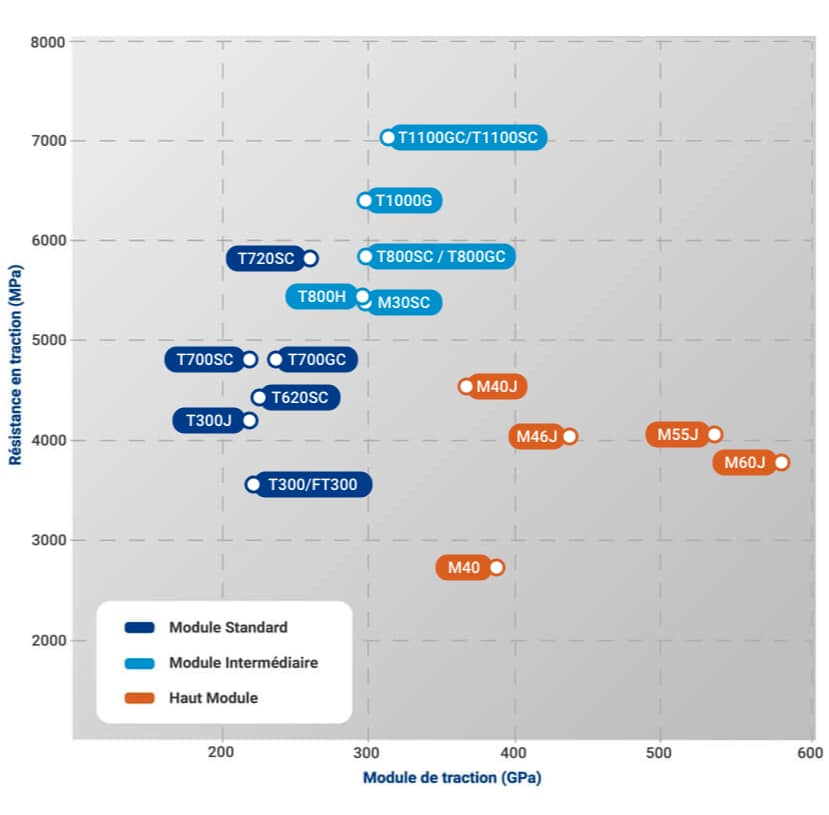
The quality of the carbon fibers used for the mast is essential. There are three main types of carbon: basic, mid-range, and high modulus (high-end or HM). The latter provides increased stiffness, reduced elongation, and superior reactivity, making it a preferred choice for high-performance foils. However, high modulus masts can cost two to three times more than basic carbon ones. For example, in our carbon foil, we use M40J, which is a high modulus carbon used in Formula 1 and aerospace. It provides flexural stiffness with little elongation but is much more expensive.
Mast profile
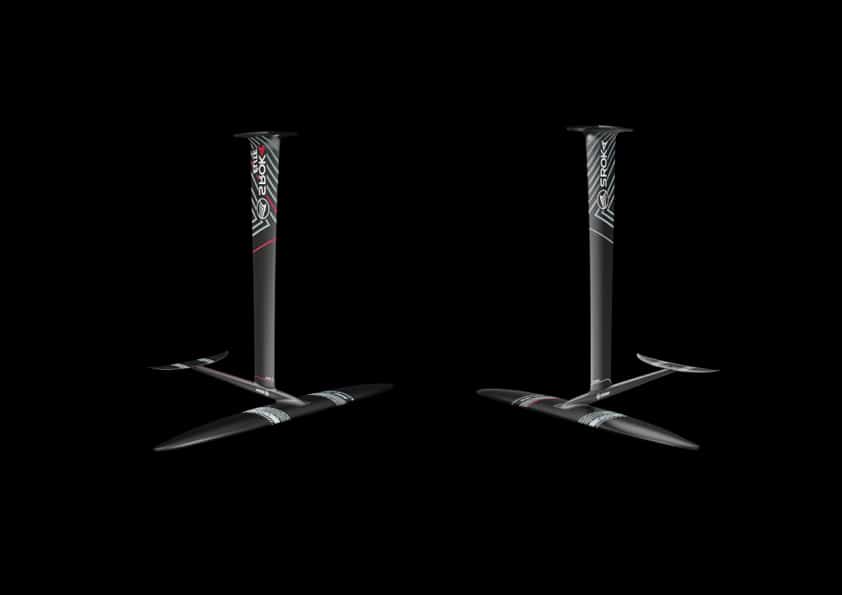
The thickness and chord of the mast are immensely important for the stiffness and drag of a mast. A thin mast (about 14 mm) will have much less drag than a thick mast (> 16 mm). It will glide better and allow for higher speeds with its ultra-thin profile while offering you a better response thanks to its stiffness. The Sroka carbon mast is available in 14mm and 16mm thickness depending on your preferences and needs. The 14mm Elite mast will be very thin and stiff. The 16mm mast will be less gliding but lighter and slightly less stiff, but cheaper.
How to make a stiff carbon mast? Our choice
The construction of a carbon mast is a very technical process. But here's how to get a stiff carbon mast.
To have a stiff mast, there are only two solutions:
- Either you increase its thickness and chord to stiffen the whole thing, and consequently, you can foam the inside and be light.
This is the simplest and least expensive solution, but it greatly increases the mast's drag, making it slower.
- Or you increase the quality of the carbon fibers used in the mast (high-modulus fibers) and increase the amount of material to minimize the mast's thickness and chord. This results in reduced drag, improved glide, increased speed, while having a very reactive and high-performing foil.
At Sroka, we have chosen the second option, offering you one of the best carbon masts on the market, combining thinness, a narrow chord, and exceptional stiffness.
The fuselage
There are two possibilities for making a fuselage:
- either keep an aluminum fuselage which will be heavier and will require disassembling the foil after each session to avoid oxidation between the aluminum and stainless steel (screws).
- Or make the fuselage out of carbon to avoid this oxidation and save weight. But it will be more fragile to impacts. So more care will be needed. The last option is to make a titanium/carbon fuselage.
At Sroka, we have chosen the carbon fiber option for a 100% carbon foil and to reduce the price of the foil, we also offer an aluminum fuselage.
The length of the fuselage determines the maneuverability of the foil; the longer a fuselage, the more stable it is longitudinally, but the less maneuverable the foil. Conversely, a very short fuselage will increase maneuverability and pumping capacity, while sacrificing longitudinal stability.
However, if the mast is thin with a short chord, its maneuverability is increased, making it more agile. Thus, a longer fuselage can be maintained while being just as maneuverable as with a less maneuverable mast that requires a shorter fuselage.
We refer you to the video next to this text, which explains all the differences.
The front wing
The performance of a foil's front wing depends on various characteristics, such as its wingspan, chord, thickness, twist, and the profile used. This is defined by the aspect ratio, which is the ratio between the wing's span and its chord. For example, the higher the ratio, the larger and narrower the wing is in relation to its chord.
- Low aspect ratio: These foils have a large chord and very little span. They are great for beginners, however, they will quickly reach their speed limit due to their significant chord.
- Medium aspect ratio: The perfect compromise between High aspect and Low aspect. These foils are accessible to all levels. They are perfect for beginners while offering significant room for progression. They correspond to the foils in our Classic range in large sizes, or the Control range in the performance category.
- High Aspect Ratio: With a high aspect ratio, these foils are more technical than others. They allow for maximum flight finesse, excellent glide, and can fly for a long time. They correspond to our High Aspect foils range.
The stabilizer
The stabilizer (stab) or rear wing, is designed to stabilize the foil.
The larger the stabilizer, the more stable the foil will be, but this also means there will be more drag and thus you will go slower. Conversely, a smaller stabilizer will stabilize the setup less but will offer much more glide, as there will be less drag, and it can also allow you to go faster.
At Sroka, we offer 3 types of stabilizers,
- the 300cm2, the most stable stabilizer in our range, perfect for beginner riders or with large front wings.
- The 240 cm2, the medium one, a compromise between stability and speed. Adaptable with all our front wings. It will be your best friend in light wind and also for people looking for comfort and speed while riding.
- The 180 cm2, a speed weapon. With its ultra-thin profile, it will allow you to exceed your speed limits.
It is important to remember that the use of adjustment shims will allow you to adapt it even better to your riding style and build. This also allows us to reduce the number of stabs and thus meet all needs. By increasing lift by adding angle under the rear screw or by removing angle (i.e., increasing thickness under the front screw), lift is reduced, and therefore drag. For more information on stabilizer adjustments with angle shims, watch this video.
In conclusion:
- To have the best carbon mast, you need the best carbon and the best lay-up plan with a thin profile, minimal thickness, and a short chord. Compare, shop around, you'll see many differences. If the information isn't clear from a brand, ask yourself why? Or question them!
- A mast with a thinner profile and a short chord, like the Sroka carbon mast, will allow for higher speeds and offer better response from your foil.
- The manufacturing method of the mast is very important. An ultra-light carbon mast is absolutely not a sign of quality. It will be flexible and probably foamed inside. Consequently, it will be less rigid and more "marshmallow-like" underfoot.
- The choice of the front wing is essential to adapt your equipment to your requirements and thus optimize.