


How to towed foil?
Foilboarding is expanding into new horizons. Today, it's possible to get on the water regardless of wind or sea conditions. Towed foiling is perfectly aligned with this dynamic; it's a way to enjoy our passion in light wind conditions.
Towed foiling can also, in a performance context, provide access to tow-in, allowing you to surf waves that would be impossible to catch by paddling. So, learning to towed foil is an entry point to many new activities. Finally, when we talk about towed foiling, we must mention wake foiling. This discipline is booming, and there's no need for a big boat. A simple RIB with 25 hp can be enough.
To give an idea of the accessibility level of the practice, remember that towed foiling is used by most wingfoil schools to learn wing foiling.
So, together we will cover all the tips and tricks for starting and progressing in towed foiling.
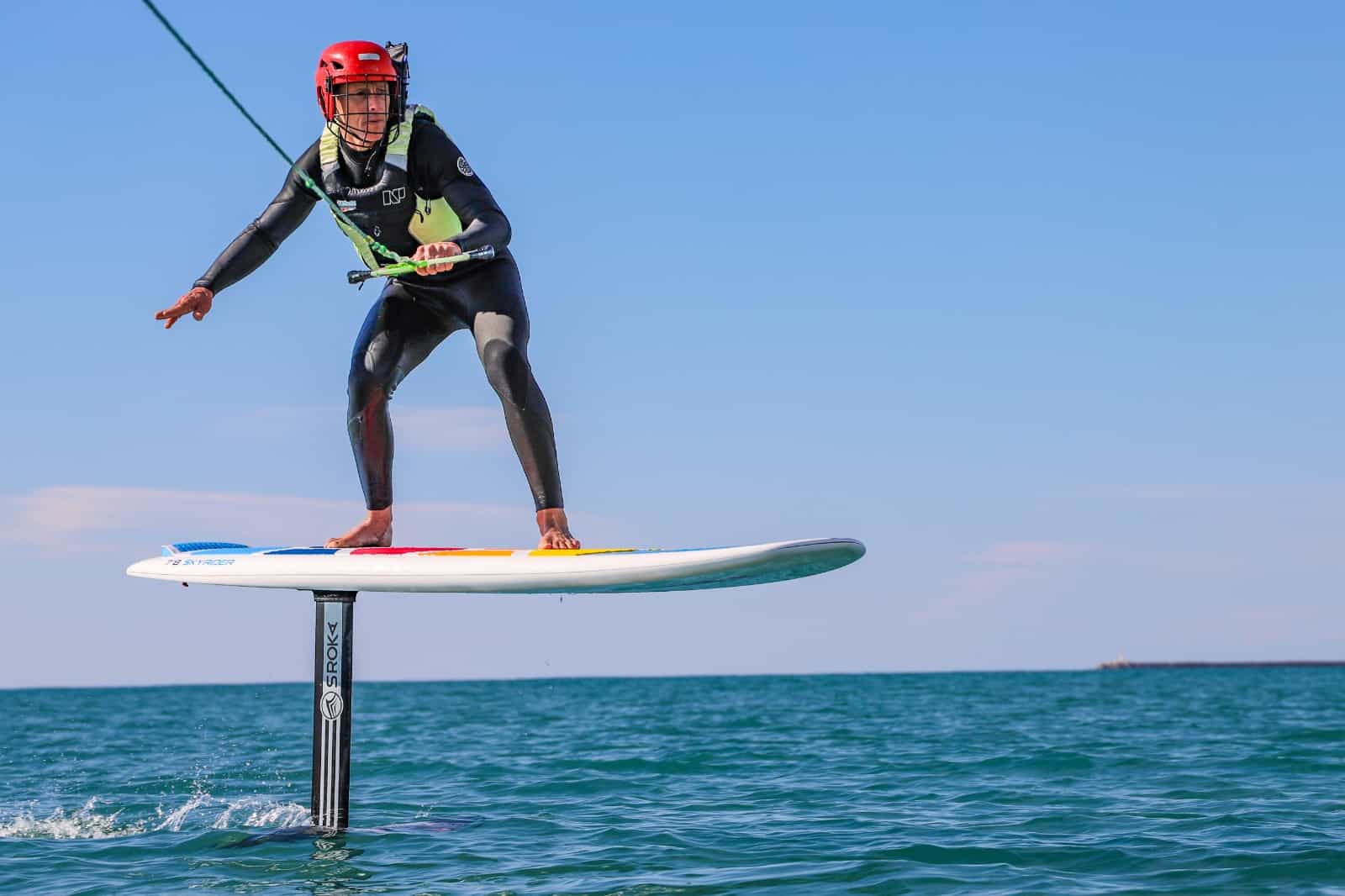
What is towed foiling?
1. The equipment
Towed foiling is an activity where you are towed by a motorized vessel. It is therefore necessary to have a boat equipped with a tow rope.
For your personal equipment, it is important to protect yourself because foiling remains a risky activity. We recommend wearing a life vest or an impact vest, a helmet, and neoprene booties. Don't overestimate yourself and be careful.
As for the board, equip yourself with a board and foil set following these recommendations:
- Don't start with too small a foil; the main idea is to learn to towed foil and fly.
- If you already know how to fly with wingfoiling or kitefoiling, use a foil you are used to.
- Regarding the board, initially use a board with more volume than your weight; this will greatly facilitate the learning phases and preparation for getting on the board.
- Once you have progressed, you can reduce the size of the board to unleash the foil's maneuverability.
2. Safety first!
As mentioned earlier, safety is paramount. It is important not to overestimate yourself and to wear as much safety equipment as possible to avoid injuries during your trials.
The boat driver must be aware of the dangers and attentive to what is happening in front and behind them. From a regulatory perspective, you must always have at least two people in a towing boat: a driver and a person monitoring the rider behind! Don't forget your orange flag to signal that you are towing a rider!
For choosing the spot and conditions, prefer calm waters without obstacles (other users, rocks, mooring buoys...). The flatter the water, the easier it will be to fly. As for the conditions, find a calm slot with no wind and low traffic.
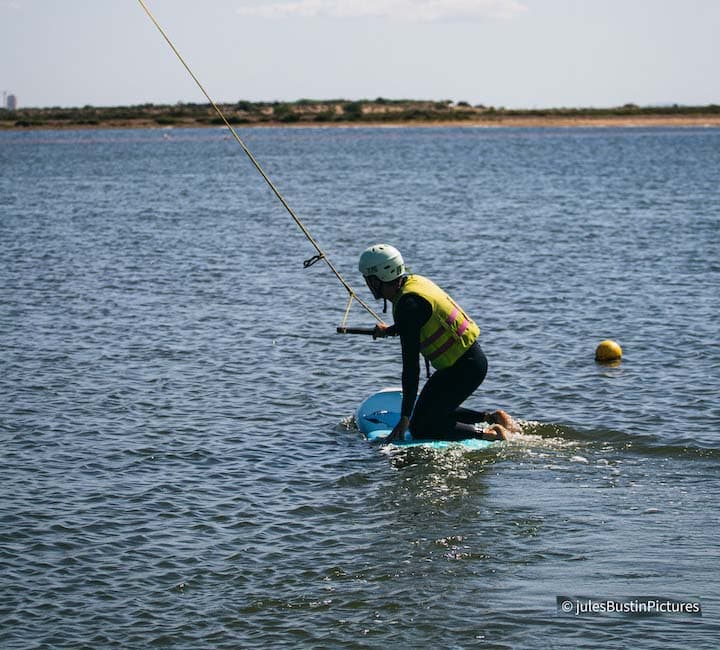
First steps on the water: how to balance and hold the board.
For a board that floats:
- During the learning phase of towed foiling, it is recommended to keep your feet aligned with the board or to offset them by placing the front foot closer to the heel-side rail and the back foot closer to the toe-side rail. Being balanced is fundamental for fast learning. To maintain good posture, it is advisable to look far ahead, about 5 to 10 meters. Do not look at your feet. Finally, a magic trick to lock the pelvis and straighten up over your center of gravity: clench your glutes to engage your abs.
- If you don't feel comfortable starting standing, we recommend starting on your knees. Get a little speed, then stand up on the board.
- To control your foil well, it is important to transfer your weight between the front and back leg rather than pressing on one or the other leg. To do this, hold your tow rope and look ahead. When you are standing on the board, stand straight on your board, with your torso over your support points.
For a sinking board:
- Sink your board and position it under your feet. With your front hand, hold the tow rope and the front of the board, and with the other hand, hold the back of the board. Bend your legs well and keep a crouched position. This position is similar to someone crouching underwater during a wake waterstart. Maintain balance as long as the boat isn't moving. Once the boat starts, the pressure from the foil and board will press the latter against your feet. Point the nose of the board towards the water's surface and gradually rise to the surface. While rising to the surface, bring your second hand to the tow rope and push with your legs.
- When you are on the water's surface, the procedure is the same as with a more voluminous board. You will simply need more speed.
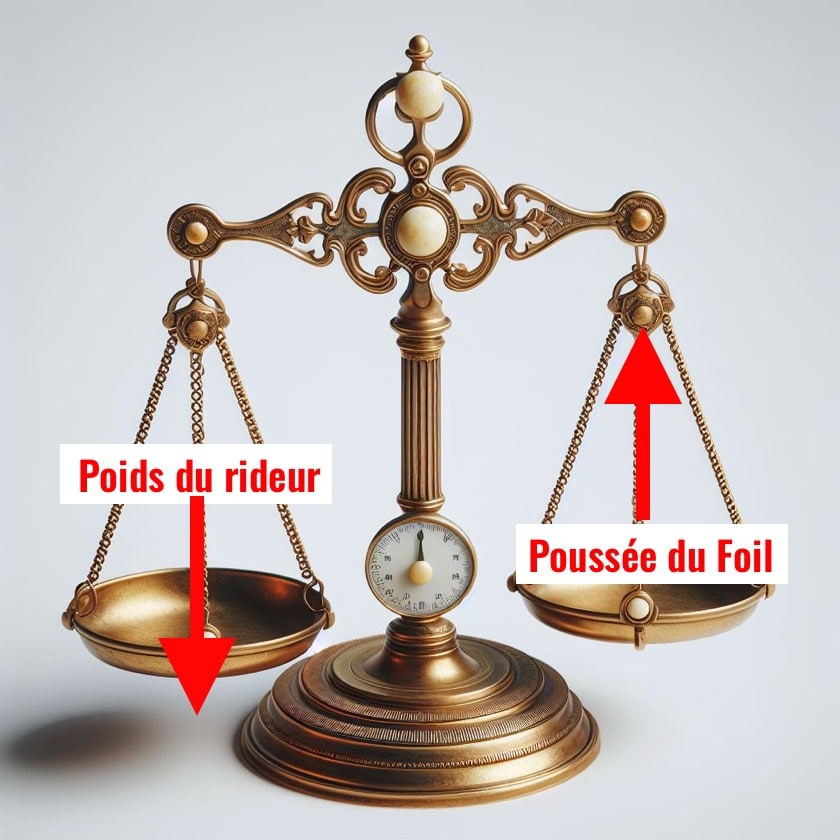
Managing wing power: how to control traction to maintain balance.
Once you are out of the water, your foil will lift you more and more strongly as the boat's speed increases. This force will be even greater with larger foils (front wing). To compensate for this increasing pressure, it is necessary to press a little more on the front leg. To fly horizontally, it is important that your weight equals the foil's lift. For this, three things are essential: The speed of the boat. It should not be high. It should be proportional to the foil's surface area and the rider's weight, the foot placement, and the foil placement.
The further forward your foil is in the box, the greater the pressure under your front foot. This increases the likelihood of being ejected. The further back it is, the more you can control the trim if you go faster. However, comfort at low speeds will be reduced.
So, initially, we recommend placing your box in the center of the US rails. Then, fine-tune according to your size, level, and boat speed.
Foot placement is a key element for maintaining balance on the board. The foil pushes upwards, your weight presses on the board. The rider's weight must be equal to the foil's lift. Otherwise, the foil will either constantly rise or constantly descend. Therefore, the rider's weight should be approximately above the center of lift of the front wing. (1/3 of the front wing's leading edge.) To compensate for excessive pressure under the front foot, move forward. To compensate for excessive pressure on the back foot, move your support points back on the board.
Do you need more details: here are the different steps to get on the board
First, the goal will be to understand how the foil works
To do this, it is essential to eliminate any balance issues that may hinder your progress. Use a short mast and get on your knees, well balanced on the board, this will facilitate your learning. The lower the height and the closer you are to the water, the easier the foil is to control.
Placement on the board: on your knees, this makes it easier to understand the balance of the board and the foil. Position yourself in the center of the board, remain balanced on the board, especially as soon as the boat starts to move. Control your lateral stability by trying to distribute the same pressure on both knees. If your board rears up too much, press a little more on the front of your knees. If your board doesn't lift at all, shift your weight a little more onto your heels while remaining on your knees. You are well balanced when you are flying horizontally on the water. Do a few flights on your knees to better master and control your foil.
Tips: Opt for a longer tow rope. This will help to smooth out any potential loss of tension or slack in the rope.
Transition from kneeling to standing.
When you can fly effortlessly on your knees, it's time to stand up.
With the boat stopped, get on your knees, balanced on the board.
Engage the engine, and as soon as the board moves a little, start by placing your front foot on the board, then stand up and place your back foot on the board. Two solutions are available to you:
1- Place your feet along the longitudinal axis of the board.
2- Place your feet slightly off-center from the longitudinal axis of the board (the front foot off-center towards the rail closest to the heels, and the back foot a little closer to the board's rail on the toe side).
Tips: this second solution provides a lot of stability for beginners.
Fly balanced!
Once flying, controlling your flight involves transferring weight between the front and back legs (and not simply pressing on the front and back leg). Straighten your torso, keep your arms extended. Control the board by transferring weight to the front or back leg.
Tips: If you're struggling to get the board to fly, ask the boat to speed up a little initially; when you're airborne, it can slow down again.
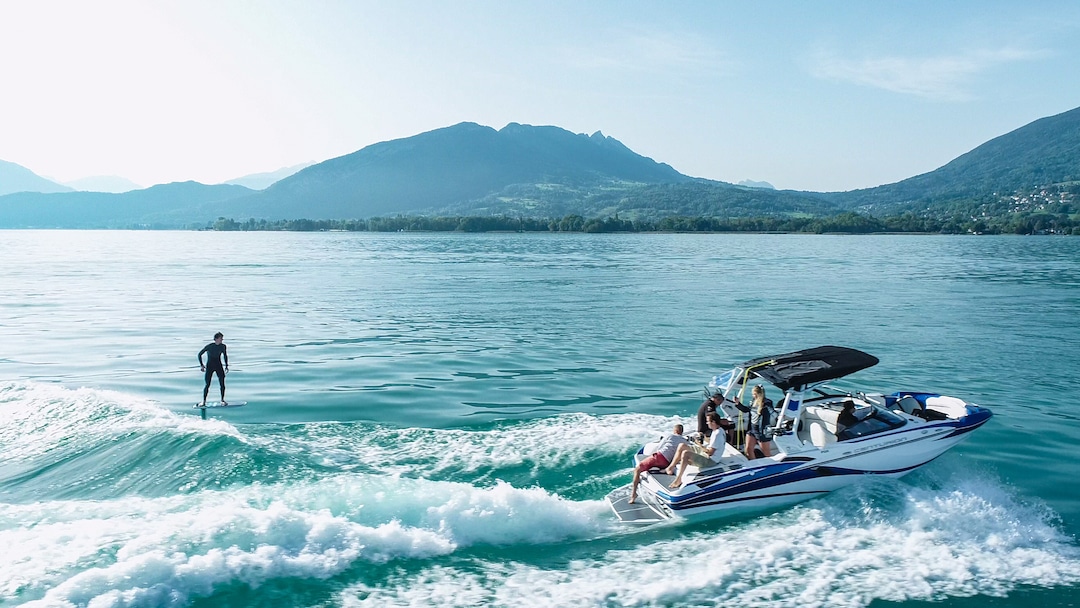
Going further in practice:
1. How to accelerate smoothly:
If you're starting to feel comfortable, begin making turns and moving away from the boat's axis. Press on your toes or heels to change direction. This will allow you to better control trajectories and achieve greater acceleration.
2. Start wake foiling the boat's wave
Release the rope and try to stay in the trough of the boat's wake wave. Use the power of the wave (its hollow) to generate lift and thus stay airborne.
3. Learn pumping
If you are starting to master foiling behind the boat. You can try to loosen the tow rope then let go of it and pump with the foil. This will be very useful for winging.
4. Start jumping
The idea here is not to provide a complete tutorial on towed and foil jumping; that might be the subject of a future article. The goal is simply to give a few examples of what is possible to do with only a few towed sessions under your belt.
The simple jump is a good start. The rider pushes on the back foot to get the foil out of the water, groups up in the air, and lands by bringing the front wing in first, quickly pressing on their back foot to encourage the foil to fly as quickly as possible. It is important to try to take advantage of a spring effect, by sinking the foil into the water before pressing on the back foot to jump. The simple jump is performed in line with the boat to avoid any lateral imbalance due to traction.
Tips: Always maintain a setup that gives you pressure under your front foot. This allows for better control in all situations.
To get started, we recommend the Pocket 4'0, which will be a good compromise for beginners in Wake foiling with an S-Foil 1750 for complete beginners. It will provide ease and comfort to start with.
For those who are a bit more experienced, we recommend the Wake foil pack with the Pocket 4'0 and a 1190 L or 1350 Foil.
Conclusion
In conclusion, learning to towed foil is an activity to add to your skill set. It offers the possibility of enjoying the sea even on windless or waveless days. But above all, it allows you to develop new skills that will be transferable to any foiling activity.
Generally speaking, every moment spent on a foil helps you progress in different disciplines. So, what are you waiting for?
Towed foiling is a water sport that involves being towed by a boat while equipped with a foil. The foil is a wing that lifts the board above the water and reduces drag. This activity is accessible to practitioners of water sports such as kitesurfing, surfing, wakeboarding, windsurfing, wingfoiling, etc. Learning to towed foil allows you to discover foiling without needing a sail. It is possible to start with sessions towed by a motorboat or with a cable park to experience your first flights, and control pitch and direction. It is a great stepping stone to discover various foiling activities.