


How to transport a paddleboard?
You love your paddleboard, but every trip becomes a perilous adventure? Between finding space for your inflatable paddleboard in the trunk, tangled straps, and easily forgotten paddles, it’s time to simplify your transport routine. Whether you use a roof rack, a carry bag, or a trailer, there are tips for every situation. With the right accessories, transporting your SUP, whether rigid or inflatable, becomes quick and convenient. Avoid scratches, secure your equipment, and save time: follow our advice for optimized transport and set off on an adventure worry-free.
Why is transporting a paddleboard correctly important?
To enjoy your paddleboard for a long time, you need to protect it. And that means transporting it correctly to:
- Avoid damage: a poorly secured paddleboard risks getting hit during transport. Scratches, dents, or even cracks or breakage if the board flies off the roof. These mishaps can ruin your next sessions.
- Extend its lifespan: by taking care of your paddleboard during transport, you ensure its longevity. A well-maintained paddleboard is one that will accompany you for many years.
- Ensure your safety: a poorly secured paddleboard on your car is a danger to you and other road users.
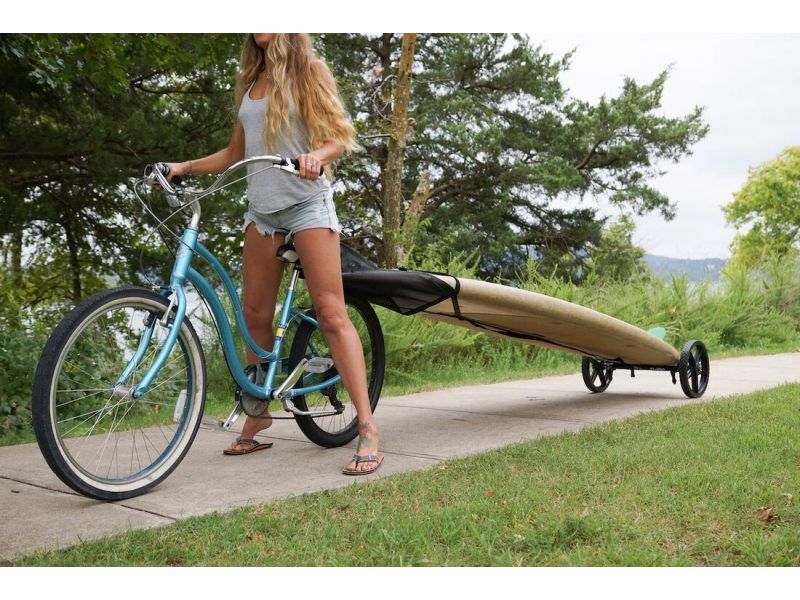
Transporting your paddleboard on foot or by bike
Transporting your paddleboard by bike or on foot requires a bit of organization and, most importantly, the right accessories. In all cases, always prioritize comfort and safety. Here are our tips for optimally transporting your paddleboard.
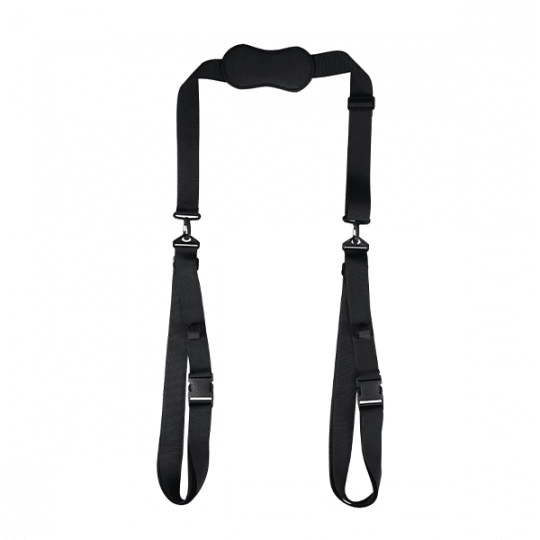
Using paddleboard carrying straps
Carrying straps are very practical accessories to facilitate the transport of your rigid or inflatable paddleboard. They adapt to all board sizes and allow the weight to be distributed more evenly over the shoulders. Thanks to the straps, you can transport your paddleboard effortlessly and safely. There are different strap models, with or without padding, so you can choose the one that best suits your needs and comfort.

Using a cart to transport a paddleboard
If you prefer to avoid carrying your paddleboard, especially if the distance is significant, a transport cart is an ideal solution. Specially designed for paddleboard transport, these carts are equipped with all-terrain wheels that facilitate movement on different types of surfaces, such as sand or rocky paths. A lightweight cart allows you to transport your paddleboard effortlessly, whether on foot or by pulling the paddle cart behind your bike.

Carrying an inflatable paddleboard by hand
If you have an inflatable paddleboard, carrying it by hand is often the simplest solution for short distances. Lightweight and easy to handle, an inflatable paddleboard can be easily folded and stored in your storage bag. This bag, usually provided with the board, allows for quick and convenient transport, ideal for easily getting to the beach or lake. However, be careful about the risks of fatigue and potential back pain. It is important to grasp the board's carrying handle firmly and keep your back straight.
Transporting your paddleboard by car
Transporting your paddleboard by car is often the most practical solution, especially over long distances. But just like on foot or by bike, you need to be well-equipped.

Essential equipment: straps, roof racks and covers
To transport a paddleboard on your car roof, you'll need some essential equipment:
- Roof racks are the base for securely attaching the board. Make sure they are compatible with your vehicle and properly installed.
- Add sturdy tie-down straps to secure the board to the roof racks and prevent it from moving during transit. Opt for elastic and resistant straps for optimal hold.
- A protective cover is ideal for preventing scratches or minor impacts on your board, especially during long journeys or in bad weather.

Steps to secure the paddleboard on the car roof
- Prepare your board: remove all accessories from your paddleboard (pump, paddle, leash) and store them in your car trunk.
- Install the roof racks: follow the manufacturer's instructions to install the roof racks on your vehicle. Make sure they are tightened securely.
- Place your paddleboard on the roof racks: lay your paddleboard flat on the roof racks, lengthwise with your car.
- Secure the straps: pass the straps around your board and the roof racks. Tighten them enough to hold your board in place without deforming it. Make sure the straps are not in direct contact with your board's surface to avoid scratches.
- Put on the protective cover: wrap your board in the protective cover and ensure all closures are secure.

Mistakes to avoid to protect your paddleboard and your vehicle
To protect both your paddleboard and your car:
- Never overload the roof racks and respect the maximum load indicated by the manufacturer.
- Avoid overtightening the transport strap. This could damage your board.
- Remember to check the strap fastenings regularly during the journey.
- Do not leave your paddleboard on your car roof overnight or in bad weather.
- Remember to remove the roof racks and protective cover once you arrive at your destination.
- Ensure the board does not extend too far forward or backward from the car to avoid accidents or fines.
How to transport your SUP without a roof rack?
Don't panic if you don't have a roof rack! There are several alternatives to transport your SUP, even without this equipment. Of course, these solutions are not as convenient as having roof racks, but they can be useful in certain situations.
- Interior carrying straps: if your vehicle is large enough, you can transport your SUP inside. By folding down the rear seats, place the board flat and use a carrying strap or ropes to secure it and prevent it from moving during transit. This is a simple and effective solution, especially for inflatable paddleboards, which take up less space once deflated.
- Sunroof: if your vehicle has a large enough sunroof, you can also try to pass your SUP through there. Be careful not to damage either your board or your vehicle.
- Inflatable supports: these supports inflate and attach to the car roof, creating a soft and stable base for your paddleboard. They are easy to install and remove, perfect for people who don't transport their SUP frequently.
- All-purpose trailer: if you have a trailer, you can transport your SUP safely. Secure your board well with straps to prevent it from moving during transit.
Transporting your paddleboard on public transport
It is also possible to transport your paddleboard by bus, train, or metro. The most practical way is to opt for an inflatable paddleboard. Once deflated, it takes up much less space and can easily fit into a backpack or sports bag. Not only is your travel simplified, but you also avoid disturbing other passengers with a large board.
Some rigid paddleboard models can be folded in half, or even in three. This significantly facilitates their transport on public transport.
Another small tip: traveling outside peak hours is often easier to avoid crowds and have more space for your equipment.
Looking to make transporting your paddleboard easier? Sroka supports you in all your aquatic adventures with paddleboards designed for easy transport. Whether you choose an ultra-compact inflatable model or a foldable rigid one, you are sure to find the board that suits your needs and transport constraints. Our boards are lightweight, robust, and designed to withstand the hazards of transport.
To complete your equipment, Sroka offers an inflatable paddleboard bag, made with resistant materials and featuring an ergonomic design and padded straps. This bag ensures comfortable and effortless transport, whether you are on foot, by bike, or on public transport.
Choose quality, performance, and ease of use with Sroka. Don't wait any longer to equip your paddleboard and set off on an adventure!
If you still have questions on this subject, or for any other request, do not hesitate to contact us!