


How to go faster in wingfoiling?
Wingfoiling, a hybrid and exhilarating board sport, offers a unique sensation of freedom and speed. Whether you are a beginner or experienced rider, the quest for speed is often at the heart of the experience. But how do you optimize your speed in wingfoiling? SROKA Company and Bruno SROKA (Kitesurf Racing World Champion), an expert in board sports equipment, reveal the secrets to boosting your performance.
We will therefore discuss together the different tips to always go faster in Wingfoiling.
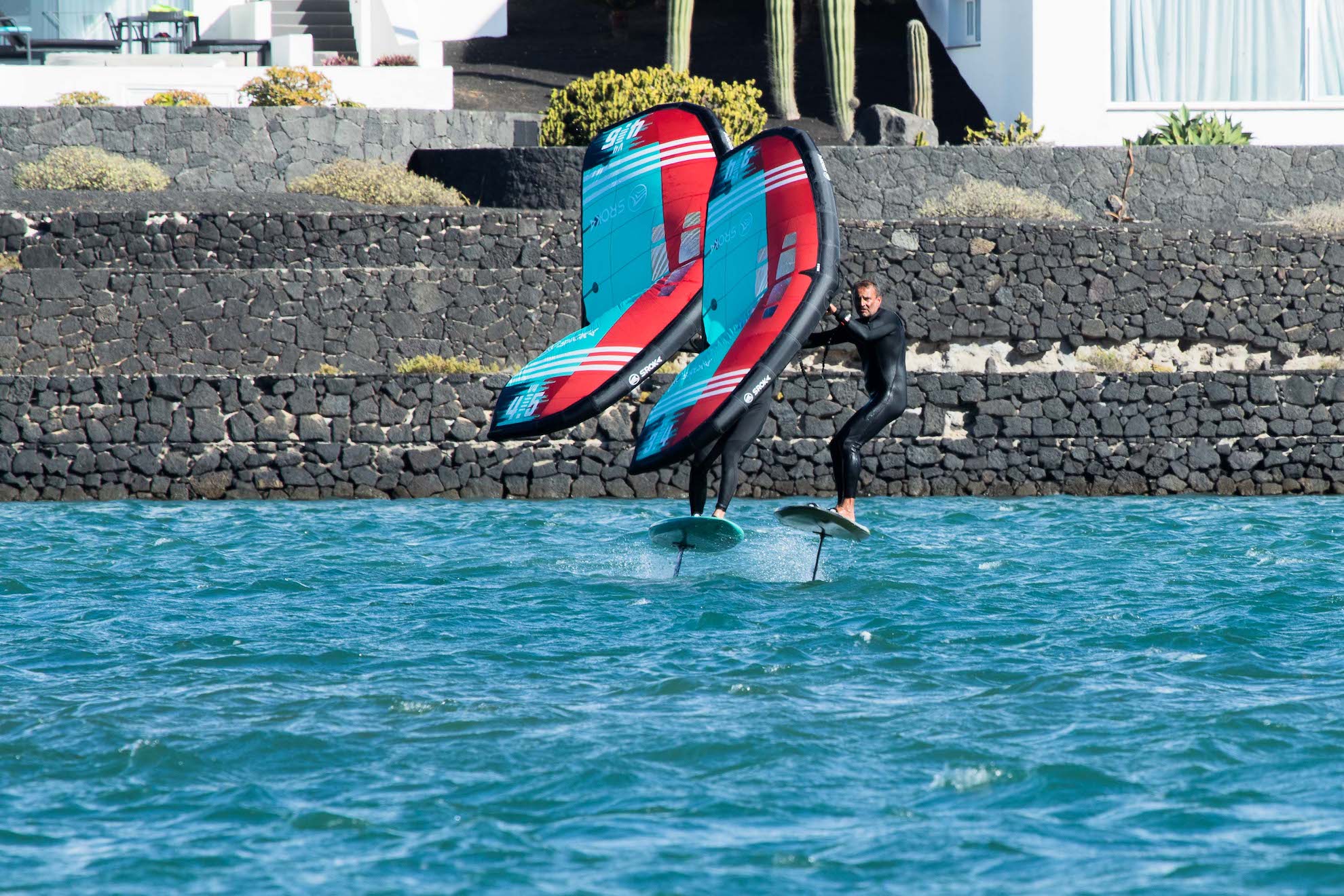
Why is Speed Crucial in Wingfoiling?
The wingfoil speed record is 37.89 knots, or 70.17 km/h over one second. All while being one meter above the water. To reach these speeds, the rider used a Kite foil for the Olympics with a very small front wing surface (around 500 cm2).
1.1. Sensations and Adrenaline:
Speed provides thrills and an incomparable adrenaline rush. It allows you to fully feel the power of the wind and the glide of the foil. It also makes it easier to perform all maneuvers on the water, to jump higher, to jibe more easily. Speed is fundamental for greater stability on the water.
Not all spots are suitable for going fast. It is therefore important to choose your spot carefully depending on what you want to do. Navigating on a flat body of water, if possible without current and with a steady wind, is fundamental for going fast. Spots "like" Leucate with offshore wind or a relatively enclosed body of water are recommended because the water will remain flat even with very strong wind.
1.2. Performance and Progression:
Speed is a key element of performance in wingfoiling. It allows you to perform more radical maneuvers, jump higher, and cover greater distances, and go upwind better. But going fast is not innate; you have to learn, understand how to tune a foil, and progress to push the limits.
Choosing the Optimal Wing Foil Equipment for Speed (SROKA Expertise)
2.1. The Wing: The Propeller
The wingfoil wing is your engine. It is therefore important to choose a wing adapted to the conditions and your size. Not all wingfoil wings allow you to go fast.
- A thin and elongated wing profile reduces drag and promotes acceleration. SROKA wings, like the V4 Elite series, are designed with optimized aerodynamic profiles for speed. Compared to the SROKA V4 of the same size, there are 2 knots more speed for the same size.
- Surface: A wing surface adapted to your size and wind conditions is essential. Opt for a range with a wide choice of sizes to meet all your needs.
- Shape: The shape of the wing (dihedral, sweep) influences its stability and responsiveness, and more particularly the fall tension and the profile that is put into the wing. Some wings generate a lot of power but little speed, and vice versa.
- Materials: The rigidity of the fabric and structure is crucial for good power transmission. SROKA V4 Elite wings are made with high-quality materials for maximum durability and performance. We generally use stiffer materials such as Dynema or Aluula and P85. A wing generates drag, so ideally if you want to go fast, choose a medium to small wing size. Wings with ultra-thin leading edges such as thewing V4 SROKA Elite in P85 will offer unmatched air penetration and unwavering profile rigidity.
Finally, a wing with a rigid handle will be more efficient than a wing with a soft handle. This will provide rigidity and control at high speed.
2.2 The wingfoil board.
A wingfoil board that goes fast should not be too wide. It is recommended to opt for a narrower board with a bit of length to optimize your planing start with a small foil.
- Size: A narrower and thinner board reduces drag and promotes speed. SROKA boards, such as the Superfly range or LW will perfectly suit this program.
- Shape: The shape of the board influences its glide and its planing start. SROKA boards offer a shape optimized for speed and acceleration: reduced width and a bit more length.
- Construction: The materials and construction of the board determine its rigidity and weight. SROKA boards are made with high-quality materials for maximum durability and performance. The stiffer your board, the easier it will be to control your board at high speeds. It is therefore preferable to opt for a full carbon sandwich board to maximize rigidity and responsiveness.
The Foil: The Support
The foil is the key element for going faster. As we mentioned earlier, there is 800 times more drag in water than in air. The foil therefore has a major impact, as it is in contact with the water.
- Front Wing: A front wing with a small surface area and medium aspect ratio (around 8 aspect ratio) is ideal for speed. SROKA foils, from the HA range were designed for this, especially in smaller sizes, offering exceptional glide and minimal drag.
- Stabilizer: The stabilizer influences the stability and maneuverability of the foil. A smaller and thinner stabilizer promotes speed. A larger one will provide stability but slow you down.
- Mast: A rigid and thin mast reduces vibrations and drag and improves steering precision. SROKA Elite 14mm carbon masts are one of the best performance/rigidity compromises, made with high-quality materials for maximum rigidity.
- Fuselage: The length of the fuselage influences the stability and maneuverability of the foil. A shorter fuselage offers more responsiveness, while a longer fuselage provides more stability.
If you want to increase your speed, we advise you to switch to a 550 S HA, 670 S HA or 810 S HA winglet.
It's not enough to have the right equipment. You have to adjust your equipment. To go fast, you have to be stable. If you are unbalanced in the longitudinal axis, you will never be able to go fast. To do this, we recommend using adjustment shims for the stabilizer.
Bruno SROKA's Tips
- Personally, to go fast, I add a little more stabilizer, meaning I increase the angle of the stabilizer using a positive angle shim (elevation on the back of the shim). For my 80 kg, I use a +0.75° shim (0.25° + 0.50°).
- I push the foil all the way back in the US rails.
- And I push the straps all the way forward.
- My quiver for going fast: 550 S HA or 670 S HA, Elite carbon mast, 180 stabilizer. Superfly 5’1.
Positioning on the board
It is crucial to adopt a wide stance to ensure total control of your board at high speed. You also have the option of using footstraps. They will allow you better control of your board and thus increase your speed.
Foot pressure on the board.
Foot pressure plays a major role in gaining speed. Indeed, it is important to have the pressure mainly on the front leg. It allows for better board balance as well as better control by reducing the risk of stalling, which would lead to a loss of speed. Leaning your weight forward also promotes a smoother glide and helps maintain the foil at an ideal flight height for better speed and reduced drag.
Body position
By leaning your body slightly forward, while keeping your shoulders low and your back straight, you promote air penetration and therefore a smoother glide. Keep your arms slightly bent to better react to variations in wind force. This also helps to increase your enjoyment and navigation time by reducing muscle fatigue.
Counter-tacking
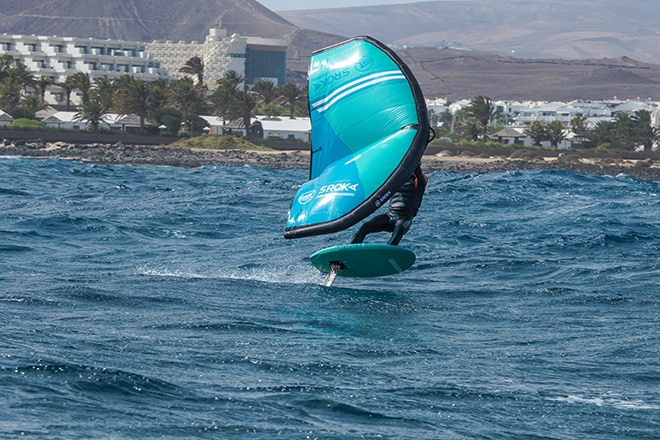
Counter-tacking is a sailing technique that consists of shifting your weight towards the wind during navigation, which has the effect of tilting the board and the foil, thus accelerating the foil. To do this, you need to sail with the sail low and shift your weight towards the wind (i.e., more on your heels) without luffing (sailing upwind) or bearing away (sailing downwind). This will, with the inclination of the foil, increase the pressure on the front leg and thus increase speed.
Weight and balance management
It is important to sail with the wing low without touching the water, while pushing the wing forward to optimize the efficiency of the wing's propulsion. Keep the wing stable; this will help promote constant acceleration and speed on the water.
Wing positioning
It is important to sail with the wing low without touching the water, while pushing the wing forward to optimize the efficiency of the wing's propulsion. Keep the wing stable; this will help promote constant acceleration and speed on the water.
Weight and balance management
To sail fast, it is important to have a stable flight with the wing low, while having your weight rather forward, in order to have better control of the flight during navigation. You must also always analyze the body of water to anticipate increases and decreases in wind, as well as the condition of the water. You must not be caught off guard by the speed. For this, it is important to learn to sail fast by taking it step by step.
The Adventure of Speed with SROKA Company!!
In summary, it is important to remember that going fast in Wingfoiling is not learned overnight.
You need to start by getting used to sailing fast and with small front wings. The choice of equipment is essential to push your speed to the next level. Opt for a narrow board with some length to optimize the planing start, a wing with a thin leading edge and a rigid profile for better wind penetration, and a foil such as the SROKA 14mm Elite carbon with a front wing like the SROKA 550 S HA, 670 S HA, or the SROKA 810 S HA.
Going fast isn't just decided; it must be learned. You have to learn to push your limits. Experience and training will be fundamental to breaking your records. Finally, it's easier to try to push your limits with others than alone. So motivate each other, and try to be better than your colleague.