


3 tips for riding upwind in wing foil
Wing foiling, a discipline that has gained significant popularity since 2019, needs no introduction. This rapid evolution demonstrates the growing enthusiasm for wing foiling and its notable impact on the world of water sports. Knowing how to ride upwind in wing foil is one of the most important criteria for autonomy. It is the essential step to becoming independent in your practice. We will therefore discuss the essential steps and prerequisites to enable you to ride upwind. Follow our tips for riding upwind if you want to progress quickly in wing foil. You will gain in safety and autonomy.
Understanding the basics of wing foiling and upwind riding
In sailing, no boat can go directly against the wind; yet, the wind constantly pushes us in its direction. To overcome this, our predecessors found a way to ride upwind. The principle is quite simple: you "gain ground" as you tack, little by little. You zigzag against the wind. It's like in the mountains, it's hard to climb a mountain in a straight line, you have to "zigzag." Riding upwind allows you to move anywhere on the water and be completely autonomous on the spot.
Close-hauled
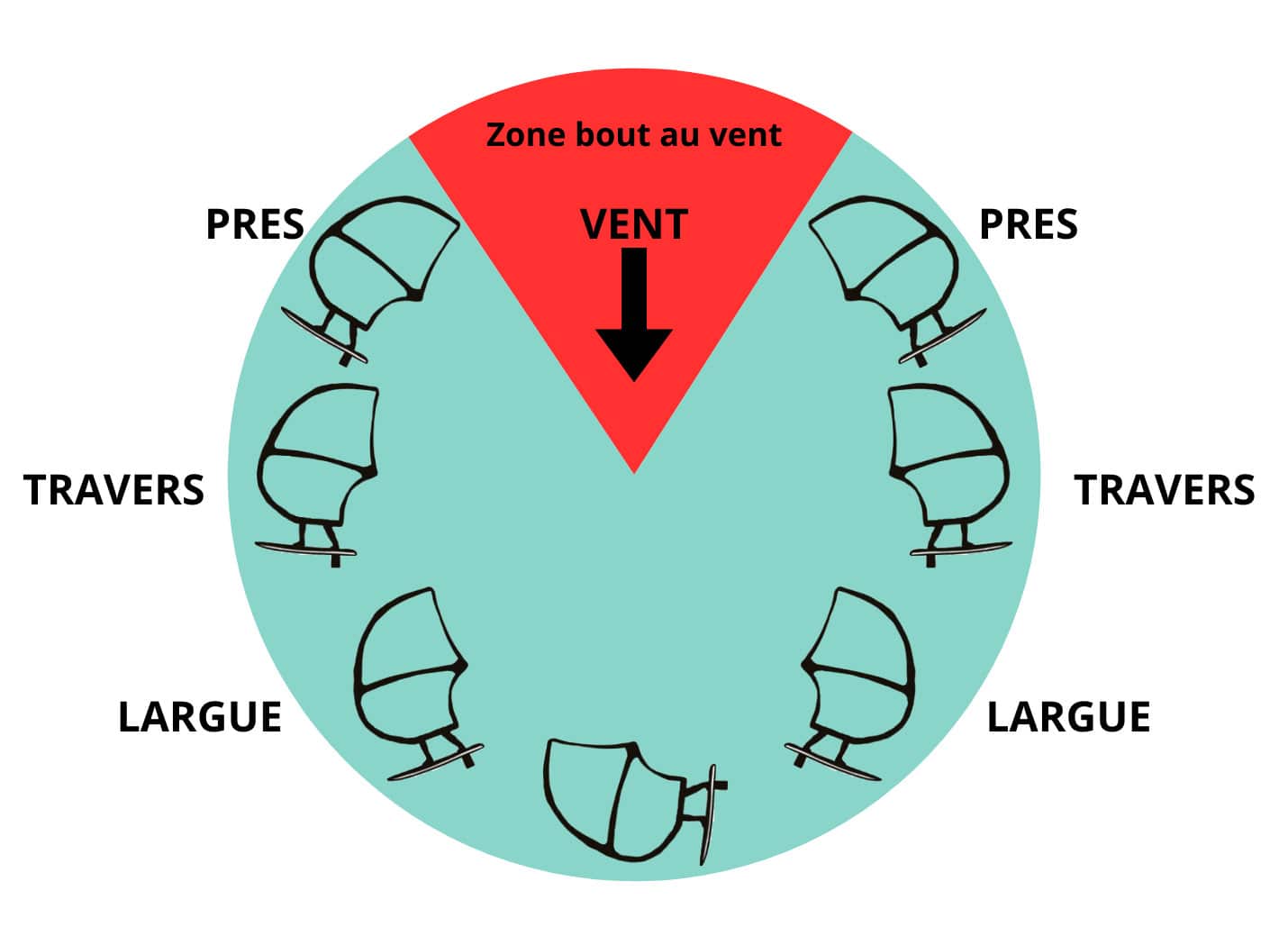
In sailing, we name our directions "points of sail"; close-hauled is one of them. It is the point of sail that will allow us to ride upwind; it is located between a beam reach and directly into the wind. Its limits are thus perpendicular to the wind on one side and the stopping of the boat on the other side (which is shown by the red zone in the table below.)
Position and balance
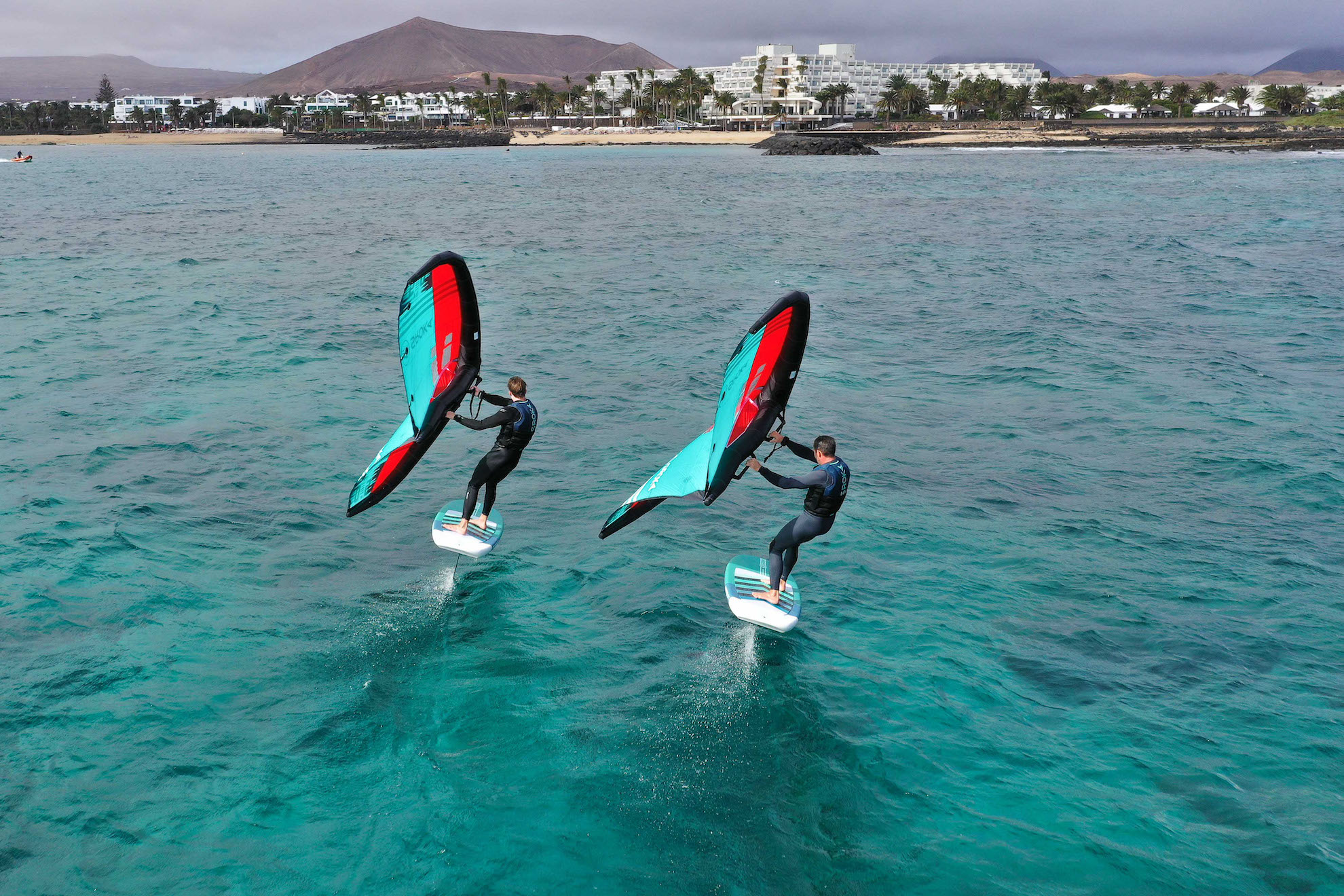
To ride upwind, you will need to put the foil in a particular position (counter-heeling, meaning the board must be tilted towards the wind by mainly pressing on your heels). The goal is to orient your board slightly towards the wind (the nose of the board slightly angled towards the wind). To do this, you press on your heels, which will slightly tilt the board. For a comfortable tack, you must find a kind of balance: the wing pulls you (downwind), the foil pushes you. You are between the two and must be in balance. You need to feel that exact point where the balance is perfect, that point where you are in control of the situation and your trajectory.
The position on the board varies from rider to rider; some prefer to have their back foot out of the strap, while others prefer to keep it in, as you wish. The essential thing is to feel secure, because the more secure you are, the more you can accelerate to make your course efficient. A slight bend in the legs allows for better control of your foil through better management and reactivity of your foot pressure. Get into a position that allows you to lightly press on your heels to tilt the board while being comfortable. A simple reference: when riding upwind, you feel like you are pushing your buttocks back; keep this in mind when you are riding (by off-centering the center of gravity, you will be able to have more counterweight and therefore transmit more power to the foil to make the foil rise). The wing is placed slightly lower than normal (almost in front of you); this allows for a stronger horizontal force. Be careful not to touch the water with the tip of your wing, or you'll be saying hello to the fish. Depending on the wings you use, and depending on their profile, you will need to sheet in your wing more or less, meaning pull on the back hand. Find the point where your wing develops the most power possible! (try by pulling a little less or a little more).
Testimonial” (Jules Bustin, sailing instructor): “The most common mistake I observe is body position. Riders let their shoulders go forward with the wing. You need to straighten up, your shoulders should almost go slightly back to contain the pull of the wing. So straighten up and be proud (shoulders back, chest out).”
The upwind angle:
The concept of VMG (Velocity Made Good):
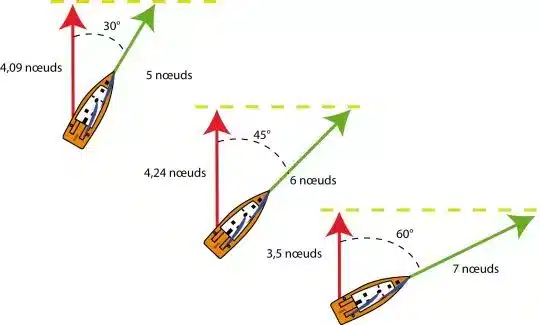
To put it simply, VMG represents the compromise between your course, meaning the angle of your upwind ride, and your speed. It expresses the efficiency of our upwind progress relative to a target.
Still with the aim of simplifying, if we ride tight upwind (as close to directly into the wind as possible), our speed will be very low, but the distance to cover will be less. Conversely, if we sail almost across the wind, our speed will be high, but the distance to cover to reach the same point will also be greater. VMG therefore represents the best compromise between these two extremes.
The concept of a header and a lift:
This refers to the wind variations mentioned above. A lift is when the wind shifts in your favor, allowing you to gain even more ground. A header is the opposite; it's when the wind shifts against you. In regattas, it is said that you should always tack when you are hit by a header and take advantage when you encounter a lift.
These effects can be due to a coastal effect, clouds, or a direct change in wind direction. Therefore, a good understanding of coastal effects is fundamental to optimizing your upwind performance.
Upwind riding techniques
Riding upwind generally resembles zigzagging on the water, at least that's how it's explained to children. The correct term is "tacking". We commonly use the expression "to tack". This consists of making the widest possible back-and-forth movements on the water while heading towards the wind.
Pumping can help you gain a few degrees and maintain your speed (very often used in competition). We observe two distinct types of pumping: wing pumping and foil pumping. Wing pumping should be done with both arms simultaneously; it resembles a downwind pumping action that could be performed in windsurfing. You use the elasticity of your shoulders to generate power. Foil pumping is done by varying the propelled height of flight, meaning you will alternately press on your front and back leg to make the foil oscillate and accelerate the board. In any case, learning all the techniques and maneuvers specific to our sports (wing, kite, etc.) and particularly in foil sports, takes time. So, be patient and get in the water when conditions allow and when you feel ready.
Understanding the basics of wingfoiling and upwind riding
Two scenarios are possible when riding:
- either you ride with a harness,
- or without a harness.
In both cases, body position is crucial.
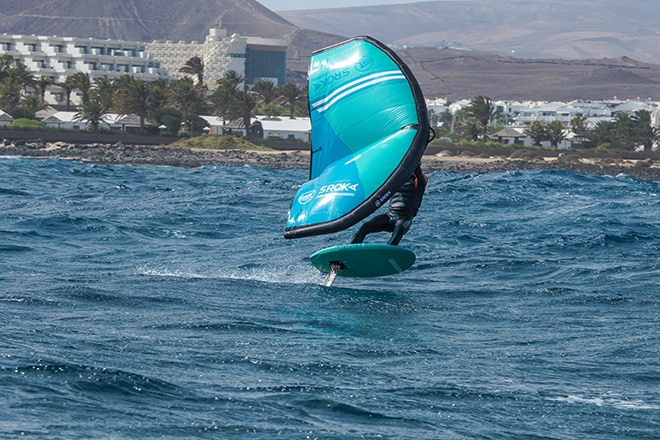
- With a harness, you will bend your legs a bit more to press as hard as possible on the foil, but not only that; observe the position of foilers, they all have their buttocks back, their center of gravity is far from their board and the vertical of their foil, this allows for better grip in the water.
- Without a harness, the pull of the wing will eventually tire you out; bending your legs will generate a lot of pull in your hands. That's why, without a harness, we will try to ride with more finesse by straightening up (aligning feet, pelvis, and shoulders).
Improving your upwind riding
To improve, you need to practice! While this may seem obvious, too many riders are content to stay in the same spot during their sessions. Don't fall into that trap; go explore, ride upwind, ride downwind... Get out of your comfort zone to face a multitude of varied situations that will allow you to progress. For more online tutorials, YouTube is an exemplary database with content in English and French. Among the channels that offer their services, SROKA's "Sroka company" is recommended.
In conclusion, riding upwind in wingfoiling is not about magic or extraordinary abilities; it's more about thought than technique. Whatever your past in board sports, any rider can ride upwind. It's sometimes just a matter of time and determination.
To improve faster, you can analyze your trajectories with a GPS or a phone, but we also advise you to progress with others. There's nothing better than being able to compare yourself with a friend on the water and trying to be better than them. Emulation allows for faster progress on the water.